I did an article back in May about growing Alligator pears, better known as Avocados. Well, recently I have stumbled onto some fascinating things about them and their flowering habits. I just planted a new variety 'Donnie' and while I was researching this kind, I found out about the flowers.
In case you missed the May article and want to catch up, I included most of it here, PLUS the new information.
Pushing the limits of what I can grow is a great passion of mine. Don't tell me I can't grow something. I may not succeed the first or even the second attempt, But I will keep on trying. I had a beautiful tree growing. I babied it for about 5 years and was expecting fruit within a year or two. Then, the Winter of '09-'10 came to visit. The tree was about 12 feet tall and would not fit in my greenhouse. I know now that I could have/should have topped it and put it in the greenhouse. It would have been fine and probably just bushed out more. I will tell you what I tried. I laid it down on the concrete patio and covered it up with a blanket. This actually worked for about a week. The tree was surviving very well. However, being that it was SO cold for SO long, it just didn't make it.
I know what I did wrong, I will fix it. I really want to pick my own Avocados.
The Avocado (Persea americana) probably originated in southern Mexico, but was cultivated from the Rio Grande to central Peru long before the arrival of the Europeans. It was first reported in Jamaica in 1696. It wasn't until 1825 that it was planted in Hawaii and it was common throughout the islands by 1910. Florida got into the act in 1833, when it was introduced by Dr. Henry Perrine. California started in 1871.
Now the avocado is grown commercially not only in the United States and throughout tropical America and the larger islands of the Caribbean but in Polynesia, the Philippines, Australia, New Zealand, Madagascar, Mauritius, Madeira, the Canary Islands, Algeria, tropical Africa, South Africa, southern Spain and southern France, Sicily, Crete, Israel and Egypt. Seems like a popular fruit. Botanically speaking, Avocado is considered a fruit, not a vegetable....just in case you get a spot on Jeopardy.
There are some 60 varieties of commercially grown Avocados, including West Indian, Guatemalan, Mexican and assorted hybrids. The most common type we see in grocery stores is 'Hass'. It was registered in California in 1932. It is a Guatemalan Mexican Hybrid.
The West Indian race requires a tropical or near tropical (think southern Florida) climate and high humidity especially during flowering and fruit setting. The Guatemalan race is somewhat hardier, having arisen in subtropical highlands of tropical America, and it is successful in coastal California. The Mexican race is the hardiest and the source of most of California avocados. It is not suited to southern Florida, Puerto Rico or other areas of similar climate. Temperatures as low as 25 degrees do it little harm. In areas of strong winds, wind-breaks are necessary. Wind reduces humidity, debydrates the flowers and interferes with pollination, and also causes many fruits to fall prematurely. See why I think I can grow these things? Citrus works for me, so Avocados should too.
They grow on a wide range of soils as long as it has good drainage. The PH range they like are rather Alkaline, 6-7.5.
Avocados can be grown from seed. However, there is a good chance it will not come true to type. This can be half the fun. It might be as good as the fruit you ate, might be a little worst or it could even be better!
Normally, avocado seeds lose viability within a month. I would still plant them as soon as possible. Why delay the fruiting process any?
There are two ways to germinate an avocado pit. The first is to pierce the seed with toothpicks and suspend it, pointed end up, over a glass of water. Roots should start to develop within two to six weeks. Then pot up the plant, leaving the tip just poking out of the soil. However, not all avocado seeds will germinate, so if your seed hasn't sprouted after six weeks, try again with a fresh seed.
The second method is basically to just plant the pit in some good potting soil. Place it pointed end up and only cover about three quarters of it. Keep it warm and damp and wait for it to germinate. It will take anywhere from 7-10 years before it bears fruit. Every indoor Avocado grower holds out hope for fruit from his or her plant. This is always a possibility, but realistically it is not likely to happen. Indoors, the plants may never experience good enough conditions to ever flower, let alone ripen fruit. They are sun lovers but will grow in partial shade.
When it actually comes to flowering, this is where it gets confusing and yet very interesting. There are two "Types" of Avocados, please don't get this confused with varieties. There is a type "A" and a type "B". Nature has provided for avocado cross-pollination by creating varieties of these two types. The "A" type is female in the morning of the first day and male in the afternoon of the second day, As long as the temperature is above 70 degrees. The "B" type is just the reverse: its flowers are male in the morning and female in the afternoon. Aren't you glad marriage isn't like this? Honey, I thought you were the female yesterday afternoon and now it's my turn. Some of the "A" varieties include: Hass (the most popular), Gwen and Pinkerton. The "B" parade has Bacon, Fuerte and Zutano. I have Hass already growing and apparently my 'Donnie' is also a Type "A". If anybody reading this happens to come across a Fuerte or something from the "B' list, please let me know. Personally, I am not sure why one tree would not suffice? I would imagine that there would be flowers of either sex open at different times on one tree. Mother Nature, she sure is complicated sometimes!
Now, when it comes to Avocado irrigation it is no different from citrus or other fruit and nut trees,water slowly, deeply and thoroughly.
I am determined to grow one of these to fruition. While researching this article, I found some really interesting ways to enjoy Avocado.
In Brazil, the Avocado is used mostly mashed in sherbet, ice cream, or milk shakes.
In Java, Avocado flesh is thoroughly mixed with strong black coffee, sweetened and eaten as a dessert.
Some Oriental people in Hawaii prefer the Avocado sweetened with sugar and they combine it with fruits such as pineapple, orange, grapefruit, dates, or banana.
As for me, I want to make some really good, spicy Guacamole. I already grow the Limes, Onions, Garlic and Hot Peppers......now I just need some Alligator Pear.
Happy Growing!
Darren
Sunday, July 18, 2010


Wednesday, July 14, 2010
Not MY Friends.....They Stink!!
My mother asked me the other day about some shield shaped bugs that were on some of her plants. Being that I live in Charleston, SC and she lives in Raleigh, NC, I was kind of guessing. I am pretty sure they are Stink Bugs, possibly Leaffooted Bugs. After I talked to her, I got thinking about them.....Yes, I have no life, so I think about these bugs and what kind of damage they can do.
I actually have a bunch of these things myself in the yard this year. So, I figured others will too, I might better write about them.
The Brown Stink Bug, Euschistus servus

The Green Stink Bug, Acrosternum hilare

The Leaffooted bug, Leptoglossuis phyllopus

All adult stink bugs are shield-shaped. Green stink bugs are bright green with a narrow orange-yellow line bordering the major body regions. They are about one half inch long. Brown stink bugs are dull grayish-yellow in color and also about one half inch long. Leaffooted bugs are about three quarters of an inch long, have dark brown bodies, and flattened, leaf-like hind legs.
Brown and green stink bugs have been reported as far north as Quebec, however, in the United States, they are more often to inflict more damage to plants in the South.
Stink bugs feed on over 50+ plants, including native and ornamental trees, shrubs, vines, weeds, and many cultivated crops. The preferred hosts are nearly all wild plants. Stink bugs build up on these hosts and move to cultivated hosts as their preferred food becomes unavailable. Among vegetable crops, stink bugs attack bean and cowpea seeds, okra pods, ripening tomato fruit, and stems of melons and asparagus.
Bean, cowpea, eggplant, potato, tomato, peach, strawberry, okra, and watermelon are on the Leaffooted menu as well.
Babies and adults of these bugs pierce plants with their needle-like mouthparts and suck sap from pods, buds, blossoms, and seeds. They use their saliva to penetrate their food material, dissolve the contents and then suck up the digesting mixture. Sorry, but I wanted you to know HOW they do it. The degree of damage depends, to some extent, on the developmental stage of the plant when it is pierced. Immature fruits and pods punctured by bugs become deformed as they develop. Seeds are often flattened and shriveled, and germination is reduced.
Stink bugs overwinter as adults in ditch banks, along fence rows, on roadsides, and in other similar places. They become active in Spring when temperatures rise above 70 degrees. Each female deposits up to several hundred eggs, usually in mid- to late June. These eggs are laid in clusters, primarily on leaves and stems, but also on pods. Approximately 5 weeks elapse between hatching and adulthood. The Leaffooted bug has a very similar life cycle.
Stink bugs have some natural enemies,including several common species of birds, but most notably, parasitic flies in the family Tachinidae. These parasites place their eggs directly on the adults. There are also beneficial stink bugs. Stay with me on this. They can be told apart by their mouthparts. The proboscis or "eating probe" of the beneficial species fold back under the body leaving a space between the body and the mouthparts, whereas in the pest species, the proboscis appear attached to the head at the anterior tip of the head. I have tried to look at the different stink bugs I have around here, I guess they are shy and won't show me their proboscis. OKAY, just to show you I am actually keeping this blog clean, I found this picture of a Spiny Stink Bug, using his proboscis to eat.

They are difficult to control with insecticides, Sevin can be used if the infestation is severe. Please make sure you read and follow the directions! They can be removed by hand, but remember, if held too long or crushed, they emit a foul odor (hence their name). I read of one person, not wanting to take any chances, using a vacuum cleaner to suck them up! Thorough weed control may reduce overwintering populations near fields, but infestation by stink bugs and leaffooted bugs that emerge from nearby woods or other areas is inevitable.
I have often wondered what certain insects are useful for. Bees, we understand are used for pollination. Butterflies are pretty. Spiders eat other insects. Stink bugs, I include leaffooted bugs here, I truly believe are a form of a practical joke. I have been on the recipient end of a good old fashioned stink bomb, I guess Mother Nature wanted to get into the act as well!
Happy Growing!
Darren
I actually have a bunch of these things myself in the yard this year. So, I figured others will too, I might better write about them.
The Brown Stink Bug, Euschistus servus

The Green Stink Bug, Acrosternum hilare
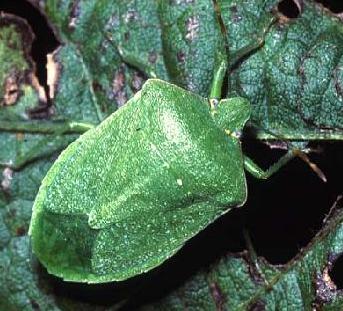
The Leaffooted bug, Leptoglossuis phyllopus

All adult stink bugs are shield-shaped. Green stink bugs are bright green with a narrow orange-yellow line bordering the major body regions. They are about one half inch long. Brown stink bugs are dull grayish-yellow in color and also about one half inch long. Leaffooted bugs are about three quarters of an inch long, have dark brown bodies, and flattened, leaf-like hind legs.
Brown and green stink bugs have been reported as far north as Quebec, however, in the United States, they are more often to inflict more damage to plants in the South.
Stink bugs feed on over 50+ plants, including native and ornamental trees, shrubs, vines, weeds, and many cultivated crops. The preferred hosts are nearly all wild plants. Stink bugs build up on these hosts and move to cultivated hosts as their preferred food becomes unavailable. Among vegetable crops, stink bugs attack bean and cowpea seeds, okra pods, ripening tomato fruit, and stems of melons and asparagus.
Bean, cowpea, eggplant, potato, tomato, peach, strawberry, okra, and watermelon are on the Leaffooted menu as well.
Babies and adults of these bugs pierce plants with their needle-like mouthparts and suck sap from pods, buds, blossoms, and seeds. They use their saliva to penetrate their food material, dissolve the contents and then suck up the digesting mixture. Sorry, but I wanted you to know HOW they do it. The degree of damage depends, to some extent, on the developmental stage of the plant when it is pierced. Immature fruits and pods punctured by bugs become deformed as they develop. Seeds are often flattened and shriveled, and germination is reduced.
Stink bugs overwinter as adults in ditch banks, along fence rows, on roadsides, and in other similar places. They become active in Spring when temperatures rise above 70 degrees. Each female deposits up to several hundred eggs, usually in mid- to late June. These eggs are laid in clusters, primarily on leaves and stems, but also on pods. Approximately 5 weeks elapse between hatching and adulthood. The Leaffooted bug has a very similar life cycle.
Stink bugs have some natural enemies,including several common species of birds, but most notably, parasitic flies in the family Tachinidae. These parasites place their eggs directly on the adults. There are also beneficial stink bugs. Stay with me on this. They can be told apart by their mouthparts. The proboscis or "eating probe" of the beneficial species fold back under the body leaving a space between the body and the mouthparts, whereas in the pest species, the proboscis appear attached to the head at the anterior tip of the head. I have tried to look at the different stink bugs I have around here, I guess they are shy and won't show me their proboscis. OKAY, just to show you I am actually keeping this blog clean, I found this picture of a Spiny Stink Bug, using his proboscis to eat.

They are difficult to control with insecticides, Sevin can be used if the infestation is severe. Please make sure you read and follow the directions! They can be removed by hand, but remember, if held too long or crushed, they emit a foul odor (hence their name). I read of one person, not wanting to take any chances, using a vacuum cleaner to suck them up! Thorough weed control may reduce overwintering populations near fields, but infestation by stink bugs and leaffooted bugs that emerge from nearby woods or other areas is inevitable.
I have often wondered what certain insects are useful for. Bees, we understand are used for pollination. Butterflies are pretty. Spiders eat other insects. Stink bugs, I include leaffooted bugs here, I truly believe are a form of a practical joke. I have been on the recipient end of a good old fashioned stink bomb, I guess Mother Nature wanted to get into the act as well!
Happy Growing!
Darren
Sunday, July 11, 2010
Real Flying Dragons
Growing up I was very fond of "Godzilla" and "Gamara" movies. For the non-geeks in the audience, Gamara was a giant monster turtle.....he was a good guy type monster.
Anyway, the fairy tale, monster type stories, I never really got into was the flying dragon type ones. Godzilla to me was just more believable.
Then I got heavy into horticulture, now I believe in flying dragons!! Of course, I am talking about Poncirus trifoliata 'Flying Dragon'.
The dragon is one of only a few deciduous (loses its leaves in Winter) Citrus relatives. Without its leaves it looks like this:

Can you kind of see how it got its name? The branches look like dragons in flight.

There is also a straight form of the Poncirus trifoliata, all information regarding the two are interchangeable, other than the twisted stems.
Introduced to the U.S. from Japan in 1915. Highly prized in the Orient, where it has been cultivated for centuries. The dragon is used primarily as rootstock for other Citrus trees. A rootstock is a plant onto which another plant is grafted onto. Why would you want to graft one kind of Citrus onto another?
Flying Dragon is used for a number of reasons:
1) It gives some cold hardiness to the Citrus on top. FD is considered cold hardy to about -15 degrees. So folks as far north as Cape Cod, Massachusetts can grow the Flying Dragon. Sorry my northern friends, the scion (Citrus on top) will not survive that cold. It only offers it a couple of extra degrees of protection.
2) It dwarfs the Citrus tree. A dwarf tree is simply one defined by convention as being about 5 to 6 feet tall at maturity. In other words, a common grapefruit or sweet orange tree on "standard" or non-dwarfing rootstock will reach a 15 to 20-foot height at maturity, while a tree on Flying Dragon may grow to only "dwarf" size.
3) It also offers some resistance to certain soil borne illnesses. One example is it has resistance to Phytophthora foot rot. Foot rot, is also known as brown rot gummosis. This disease can affect the root system, the trunk below and above ground, branches, leaves, blossoms and fruit. Infection of the lower areas of the trunk results in dark, water-soaked areas in the active areas of infection. Often gum exudes profusely from active lesions. The dead bark frequently breaks away from the wood in vertical strips. In other words, a really nasty disease for Citrus.
The Flying Dragon is considered a slow growing tree. Requires full sun and a well draining soil. It does very well in containers and can be used as a Bonsai. It is also used for hybridization or breeding of other types of Citrus trees. I mentioned the cold hardiness of FD's. Breeders have been crossing the Poncirus with many other kinds of Citrus, trying to introduce that cold hardiness into some of the better tasting fruits. There has been very little success. There are a few good crosses out there however, Dragon Lime being one. This is a cross between the Flying Dragon and probably a Sweet Orange, though the exact parentage is not known. It has a Limeade like taste and is the size of a Sweet Orange. If nothing else,they have come up with some really weird names due to the crossings: Citradia (Poncirus and Seville Orange)....Citraldin (Poncirus and Calamondin) and my favorite... Tai-Tri (Poncirus trifoliata and Citrus taiwanica).
What about the fruit that it produces on its own? Have you ever tasted kerosene? That pretty much describes the flavor. They are edible in the sense that you won't die from eating them, but you may wish you would. Michael Dirr, in his "Manual of Woody Landscape Plants", comments that "Ripe fruits set aside for several weeks become juicy and develop a sprightly, slightly acid flavor. Serves as a substitute for lemon, pulp can be made into marmalade, and peel can be candied". I have never waited several weeks to try this, I can't get past the initial smell and gag reflex. They are ugly, seedy little fruits too, about the size of golfballs:

When growing FD beware of the thorns. I read somewhere that it maybe illegal to put barbed wire around your home, but the dragon is a very good, legal, substitute.(See very first picture again) Imagine having a solid hedge of this around your yard?
The name Poncirus trifoliata reveals a little about its description. The word trifoliata is a form of the word trifoliate or having three leaves or leaflike parts. As you can see in this picture:
 Courtesy, University of Georgia
The dragon also produces pretty white flower that are fragrant and attract bees. With all this being said, Lets recap what that the Poncirus trifoliata is good for, Grafting, Hybridization, Ornamental, Stalag 13 encampment and one last thing that I haven't mentioned......They are good for Target Practice!!
Happy Growing!
Darren
Anyway, the fairy tale, monster type stories, I never really got into was the flying dragon type ones. Godzilla to me was just more believable.
Then I got heavy into horticulture, now I believe in flying dragons!! Of course, I am talking about Poncirus trifoliata 'Flying Dragon'.
The dragon is one of only a few deciduous (loses its leaves in Winter) Citrus relatives. Without its leaves it looks like this:
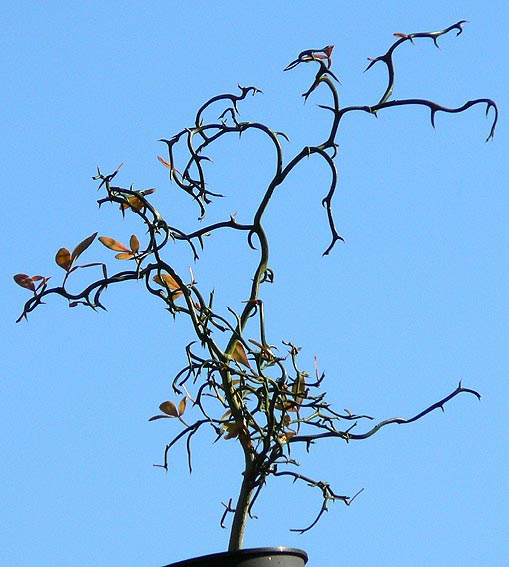
Can you kind of see how it got its name? The branches look like dragons in flight.
There is also a straight form of the Poncirus trifoliata, all information regarding the two are interchangeable, other than the twisted stems.
Introduced to the U.S. from Japan in 1915. Highly prized in the Orient, where it has been cultivated for centuries. The dragon is used primarily as rootstock for other Citrus trees. A rootstock is a plant onto which another plant is grafted onto. Why would you want to graft one kind of Citrus onto another?
Flying Dragon is used for a number of reasons:
1) It gives some cold hardiness to the Citrus on top. FD is considered cold hardy to about -15 degrees. So folks as far north as Cape Cod, Massachusetts can grow the Flying Dragon. Sorry my northern friends, the scion (Citrus on top) will not survive that cold. It only offers it a couple of extra degrees of protection.
2) It dwarfs the Citrus tree. A dwarf tree is simply one defined by convention as being about 5 to 6 feet tall at maturity. In other words, a common grapefruit or sweet orange tree on "standard" or non-dwarfing rootstock will reach a 15 to 20-foot height at maturity, while a tree on Flying Dragon may grow to only "dwarf" size.
3) It also offers some resistance to certain soil borne illnesses. One example is it has resistance to Phytophthora foot rot. Foot rot, is also known as brown rot gummosis. This disease can affect the root system, the trunk below and above ground, branches, leaves, blossoms and fruit. Infection of the lower areas of the trunk results in dark, water-soaked areas in the active areas of infection. Often gum exudes profusely from active lesions. The dead bark frequently breaks away from the wood in vertical strips. In other words, a really nasty disease for Citrus.
The Flying Dragon is considered a slow growing tree. Requires full sun and a well draining soil. It does very well in containers and can be used as a Bonsai. It is also used for hybridization or breeding of other types of Citrus trees. I mentioned the cold hardiness of FD's. Breeders have been crossing the Poncirus with many other kinds of Citrus, trying to introduce that cold hardiness into some of the better tasting fruits. There has been very little success. There are a few good crosses out there however, Dragon Lime being one. This is a cross between the Flying Dragon and probably a Sweet Orange, though the exact parentage is not known. It has a Limeade like taste and is the size of a Sweet Orange. If nothing else,they have come up with some really weird names due to the crossings: Citradia (Poncirus and Seville Orange)....Citraldin (Poncirus and Calamondin) and my favorite... Tai-Tri (Poncirus trifoliata and Citrus taiwanica).
What about the fruit that it produces on its own? Have you ever tasted kerosene? That pretty much describes the flavor. They are edible in the sense that you won't die from eating them, but you may wish you would. Michael Dirr, in his "Manual of Woody Landscape Plants", comments that "Ripe fruits set aside for several weeks become juicy and develop a sprightly, slightly acid flavor. Serves as a substitute for lemon, pulp can be made into marmalade, and peel can be candied". I have never waited several weeks to try this, I can't get past the initial smell and gag reflex. They are ugly, seedy little fruits too, about the size of golfballs:

When growing FD beware of the thorns. I read somewhere that it maybe illegal to put barbed wire around your home, but the dragon is a very good, legal, substitute.(See very first picture again) Imagine having a solid hedge of this around your yard?
The name Poncirus trifoliata reveals a little about its description. The word trifoliata is a form of the word trifoliate or having three leaves or leaflike parts. As you can see in this picture:
 Courtesy, University of Georgia
The dragon also produces pretty white flower that are fragrant and attract bees. With all this being said, Lets recap what that the Poncirus trifoliata is good for, Grafting, Hybridization, Ornamental, Stalag 13 encampment and one last thing that I haven't mentioned......They are good for Target Practice!!
Happy Growing!
Darren
Wednesday, July 7, 2010
Attack of the Killer Hornworm
This year I have been struggling a little bit with growing Tomatoes. In case you didn't know, I grow mine in large containers. The heat that came upon us so quickly really didn't help matters much. I continue on though. I have made some Spaghetti sauce and have had a decent amount of Tomato and Jalapeno sandwiches. Hey, don't knock them, they are great with Miracle Whip and black pepper!!
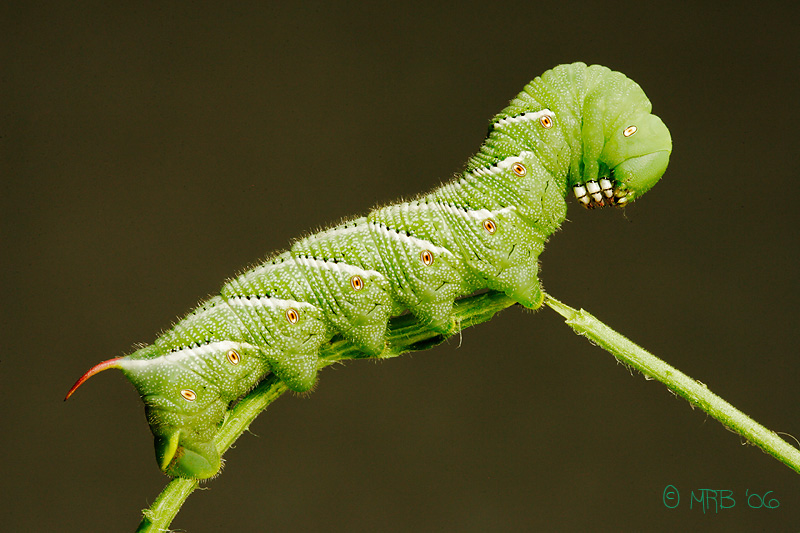
I water my plants almost everyday, talk to them every time I go by, just hoping that they will produce more tasty treats. Then.....THEY CAME!! The Manduca sexta, better known as the Tobacco Hornworm. Here is the latest Post Office photo:
I know what some of you are saying, that looks like a Tomato Hornworm. Those guys are known as Manduca quinquemaculata. They look like this:

The Tobacco Hornworm larva (Manduca sexta) is generally green with seven diagonal white lines on the sides and a curved red horn. The Tomato Hornworms (Manduca quinquemaculata) have eight V-shaped marks on each side and their horn is straighter and blue-black in color. Either way, they are both known as nasty little, Tomato plant eating varmints! They both also eat, Peppers, Eggplants, Potatoes as well as Tobacco.
These "Hornworms" are the larvae of the hawk or sphinx moths, also known as Hummingbird moths.

The Hawk moths (Tomato Hornworm moths)are large, heavy-bodied with narrow front wings. The moth is a mottled gray-brown color with yellow spots on the sides of the abdomen and a wing spread of 4 to 5 inches. The hindwings have alternating light and dark bands. They are usually seen after dusk. The moth doesn't cause any damage.
The Sphinx moth (Tobacco Hornworm moth) are usually much more colorful.

There is conflicting information about the origin of these two "horned" pests. One report has it that ships bringing tobacco plants (and the Tobacco Hornworm) from Nicaragua to Virginia in 1641 introduced the insect. Then there are reports that the Tomato and the Tobacco Hornworm are native to the United States.
Either way, the larvae (hornworm) is the damaging stage and feeds initially on the upper portions of leaves, giving you stripped stems and leaving behind dark green or black droppings. If you see something that looks like this on your Tomato plants, look around, you have a visitor.

The larvae blend in with the plant canopy, and therefore go unnoticed until most of the damage is done. They can bend and curl to look just like a leaf. The poop is usually the best way to locate them, it drops down, so look up from it.
The best advice is to examine plants frequently from early July through the rest of the growing season for hornworm eggs and small caterpillars, and to begin control measures as soon as young larvae are observed.
To control these little beasts, handpicking is recommended. I like to take them off the plant, put them on the concrete or out in the road and watch the birds come get them. You can also cut them in half with your garden shears. If you are a little squeamish or just can't get yourself to pick them off, BT (Bacillus thuringensis) can be used. It is very effective, especially on smaller larvae.
Of course, there is one time that I don't mind seeing a hornworm. I know, "What are you crazy?!" Probably, but that is besides the point. No, I enjoy seeing them when they look like this:

All those white, rice looking things are cocoons. They are from a small braconid wasp, Cotesia congregatus. Larvae that hatch from the wasp eggs that are laid on the hornworm feed on the inside of the hornworm until the wasp is ready to pupate. The cocoons appear as white projections protruding from the hornworms body. If you see a hornworm like this, leave it alone. The wasps will kill the hornworm when they emerge from the cocoons and then will seek out other hornworms to inflict the same fate. Mother Nature can sure be cruel sometimes.
Hopefully, this pest will not be a nuisance to you, in the meantime......I must go feed some birds!
Happy Growing!
Darren
I water my plants almost everyday, talk to them every time I go by, just hoping that they will produce more tasty treats. Then.....THEY CAME!! The Manduca sexta, better known as the Tobacco Hornworm. Here is the latest Post Office photo:
I know what some of you are saying, that looks like a Tomato Hornworm. Those guys are known as Manduca quinquemaculata. They look like this:

The Tobacco Hornworm larva (Manduca sexta) is generally green with seven diagonal white lines on the sides and a curved red horn. The Tomato Hornworms (Manduca quinquemaculata) have eight V-shaped marks on each side and their horn is straighter and blue-black in color. Either way, they are both known as nasty little, Tomato plant eating varmints! They both also eat, Peppers, Eggplants, Potatoes as well as Tobacco.
These "Hornworms" are the larvae of the hawk or sphinx moths, also known as Hummingbird moths.
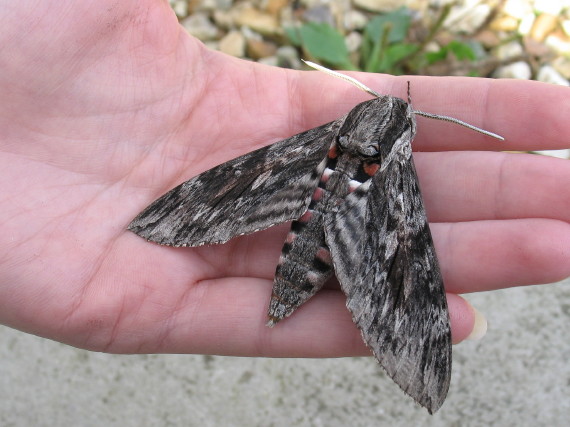
The Hawk moths (Tomato Hornworm moths)are large, heavy-bodied with narrow front wings. The moth is a mottled gray-brown color with yellow spots on the sides of the abdomen and a wing spread of 4 to 5 inches. The hindwings have alternating light and dark bands. They are usually seen after dusk. The moth doesn't cause any damage.
The Sphinx moth (Tobacco Hornworm moth) are usually much more colorful.

Either way, the larvae (hornworm) is the damaging stage and feeds initially on the upper portions of leaves, giving you stripped stems and leaving behind dark green or black droppings. If you see something that looks like this on your Tomato plants, look around, you have a visitor.

The larvae blend in with the plant canopy, and therefore go unnoticed until most of the damage is done. They can bend and curl to look just like a leaf. The poop is usually the best way to locate them, it drops down, so look up from it.
The best advice is to examine plants frequently from early July through the rest of the growing season for hornworm eggs and small caterpillars, and to begin control measures as soon as young larvae are observed.
To control these little beasts, handpicking is recommended. I like to take them off the plant, put them on the concrete or out in the road and watch the birds come get them. You can also cut them in half with your garden shears. If you are a little squeamish or just can't get yourself to pick them off, BT (Bacillus thuringensis) can be used. It is very effective, especially on smaller larvae.
Of course, there is one time that I don't mind seeing a hornworm. I know, "What are you crazy?!" Probably, but that is besides the point. No, I enjoy seeing them when they look like this:

All those white, rice looking things are cocoons. They are from a small braconid wasp, Cotesia congregatus. Larvae that hatch from the wasp eggs that are laid on the hornworm feed on the inside of the hornworm until the wasp is ready to pupate. The cocoons appear as white projections protruding from the hornworms body. If you see a hornworm like this, leave it alone. The wasps will kill the hornworm when they emerge from the cocoons and then will seek out other hornworms to inflict the same fate. Mother Nature can sure be cruel sometimes.
Hopefully, this pest will not be a nuisance to you, in the meantime......I must go feed some birds!
Happy Growing!
Darren
Sunday, July 4, 2010
Greening Update: Good News, Bad News
I have written about Citrus Greening a number of times on this blog. With it being the most serious of Citrus diseases out there, the Citrus Guy would be totally remiss in not bringing it to your attention. Well, there have been some updates, both good and bad.
Let me bring you up to date very quickly on this disease in case you haven't heard about it.
Citrus Greening, also called Huanglongbing or yellow dragon disease, is a very serious disease of citrus. This bacterial disease is thought to have originated in China in the early 1900s. There are three strains of the bacteria, an Asian, an African version, and a Brazilian.
The Asian strain, Candidatus Liberibacter asiaticus was found in Florida in early September, 2005.
The most characteristic foliage symptoms of Citrus Greening are the blotchy mottling of leaves and leaf yellowing that may appear on a single shoot or branch. The disease may also cause small, narrow leaves and short stems that give plant growth a bunched appearance. Other symptoms include twig dieback, poor flowering, and stunted growth. Fruit from diseased trees is small and often misshapen. Typically, some green color remains even on ripe fruit. Affected fruit tastes bitter, medicinal, and sour. Seeds usually abort, and fruit set is poor. The tree may survive for several years, but death is inevitable.
The disease has been found in two parishes in Louisiana, and in two counties in South Carolina. The entire states of Georgia and Florida are under quarantine. There are also a number of Mexican states listed. The list of quarantines for the Asian Citrus Psyllid, the transmitter of the disease, seems to be getting longer every day. It includes: Alabama, Arizona, California, American Samoa, the Northern Mariana Islands, Florida, Georgia, Guam, Hawaii, Louisiana, Mississippi, Puerto Rico, South Carolina, Texas....Got the point? This thing is spreading.
THEN:
On April 21, 2010, the Animal and Plant Health Inspection Service (APHIS) confirmed the first detection of citrus greening, in plant tissue samples collected from Key Lime trees located at a local agricultural experiment station near St. Croix, U.S. Virgin Islands. In addition, plant tissue samples of Key Lime from nearby residential properties also tested positive for the disease. Based on recent surveys, the insect vector responsible for transmitting this disease, Asian Citrus Psyllid, is also present.
Okay, had enough bad news? Here is some good news.
A team of scientists from the Agricultural Research Service and the University of Florida’s Indian River Research and Education Center have turned an ornamental plant into a tool for combating this bacterial disease.
Periwinkle, (Catharanthus roseus), has proved to be an effective screening tool or treatments to control Huanglongbing, according to Yong-Ping Duan of the ARS, U.S. Horticultural Research Laboratory in Fort Pierce, Fla.
Duan and his colleagues have found that periwinkle performs well as a stand-in for citrus, becoming quickly infected with HLB bacterium, and responding well to antibiotic compounds tested to reduce infection. The researchers used HLB-infected lemon trees to infect periwinkle plants and then ran greenhouse experiments to find the optimal nutrient and soil treatments for regenerating periwinkle with high infection rates.
Duan emphasized that the results are limited to greenhouse settings and that the chemical compounds, must still be evaluated in field trials and approved for use by regulatory agencies before commercial use is possible.
Untold millions of dollars are being spent on finding ways to combat this disease. There are more than 130 projects and studies going on, according to Peter McClure of Evans Properties and the 2009 Citrus Achievement Award winner.
One of these studies that is going on, basically, will develop a vaccine that we can give to a sick Citrus tree so that it will produce antibacterial compounds to protect itself.
As a hobby Citrus grower and lecturer, I find this very exciting. We can put people on the moon, make huge pieces of metal fly and float, but we can't make a sick Lemon tree well?! Hopefully soon this disease will be just a footnote in the history of citriculture!
Happy Growing!
Darren
Let me bring you up to date very quickly on this disease in case you haven't heard about it.
Citrus Greening, also called Huanglongbing or yellow dragon disease, is a very serious disease of citrus. This bacterial disease is thought to have originated in China in the early 1900s. There are three strains of the bacteria, an Asian, an African version, and a Brazilian.
The Asian strain, Candidatus Liberibacter asiaticus was found in Florida in early September, 2005.
The most characteristic foliage symptoms of Citrus Greening are the blotchy mottling of leaves and leaf yellowing that may appear on a single shoot or branch. The disease may also cause small, narrow leaves and short stems that give plant growth a bunched appearance. Other symptoms include twig dieback, poor flowering, and stunted growth. Fruit from diseased trees is small and often misshapen. Typically, some green color remains even on ripe fruit. Affected fruit tastes bitter, medicinal, and sour. Seeds usually abort, and fruit set is poor. The tree may survive for several years, but death is inevitable.
The disease has been found in two parishes in Louisiana, and in two counties in South Carolina. The entire states of Georgia and Florida are under quarantine. There are also a number of Mexican states listed. The list of quarantines for the Asian Citrus Psyllid, the transmitter of the disease, seems to be getting longer every day. It includes: Alabama, Arizona, California, American Samoa, the Northern Mariana Islands, Florida, Georgia, Guam, Hawaii, Louisiana, Mississippi, Puerto Rico, South Carolina, Texas....Got the point? This thing is spreading.
THEN:
On April 21, 2010, the Animal and Plant Health Inspection Service (APHIS) confirmed the first detection of citrus greening, in plant tissue samples collected from Key Lime trees located at a local agricultural experiment station near St. Croix, U.S. Virgin Islands. In addition, plant tissue samples of Key Lime from nearby residential properties also tested positive for the disease. Based on recent surveys, the insect vector responsible for transmitting this disease, Asian Citrus Psyllid, is also present.
Okay, had enough bad news? Here is some good news.
A team of scientists from the Agricultural Research Service and the University of Florida’s Indian River Research and Education Center have turned an ornamental plant into a tool for combating this bacterial disease.
Periwinkle, (Catharanthus roseus), has proved to be an effective screening tool or treatments to control Huanglongbing, according to Yong-Ping Duan of the ARS, U.S. Horticultural Research Laboratory in Fort Pierce, Fla.
Duan and his colleagues have found that periwinkle performs well as a stand-in for citrus, becoming quickly infected with HLB bacterium, and responding well to antibiotic compounds tested to reduce infection. The researchers used HLB-infected lemon trees to infect periwinkle plants and then ran greenhouse experiments to find the optimal nutrient and soil treatments for regenerating periwinkle with high infection rates.
Duan emphasized that the results are limited to greenhouse settings and that the chemical compounds, must still be evaluated in field trials and approved for use by regulatory agencies before commercial use is possible.
Untold millions of dollars are being spent on finding ways to combat this disease. There are more than 130 projects and studies going on, according to Peter McClure of Evans Properties and the 2009 Citrus Achievement Award winner.
One of these studies that is going on, basically, will develop a vaccine that we can give to a sick Citrus tree so that it will produce antibacterial compounds to protect itself.
As a hobby Citrus grower and lecturer, I find this very exciting. We can put people on the moon, make huge pieces of metal fly and float, but we can't make a sick Lemon tree well?! Hopefully soon this disease will be just a footnote in the history of citriculture!
Happy Growing!
Darren
Tuesday, June 29, 2010
You Little Stinker
A couple of years ago, I gave my mother a cute little succulent. It kind of looked like a cactus, but didn't have any spines. Then one day when I was talking to her, she was all excited because it had this huge pod looking thing growing out from it. I told her it was getting ready to flower. Well, it kept getting bigger and bigger. There was numerous references made to that old horror flick, Invasion of the Body Snatchers. It finally opened up. I think my mother wanted to disown me after that! Only kidding.
She could not believe the smell coming from this thing! I had a good laugh.
In case you are wondering, I am talking about the Stapelia gigantea. This type of succulent has numerous common names, including carrion flower, giant toad flower, Zulu giant, starfish flower and (in Australia) dead horse plant. Some of these names really fit it well. It's big, it resembles a starfish and it attracts flies like a dead horse, because that is what it pretty much smells like. The flies are the principle means of pollination. It has been reported that the flies are sometimes so deceived by the odor that they lay their eggs on the flower itself, convinced that it will be a food source for their hatching larvae.
The name Stapelia was introduced by Linnaeus who described it in 1737. The name honours Johannes van Stapel, a 17th century physician and botanist.
Here is what mine looks like in flower:

Stapelias are native to the deserts of South Africa. The flowers are large, fleshy, 5-pointed stars, like a starfish. They can be 10-16 inches across.
They need a well drained, cactus type soil. Give them full sun, but be careful, if they have been shaded for any long length of time, they can sunburn. Moderate amounts of water during the growing season will be beneficial. They need a cool, dry rest period in Winter. Fertilize once during the growing season with any good fertilizer. They are best managed in pots and can withstand extreme heat. They don't like frost, if you live anywhere outside a Zone 9-11, bring them in during the Winter. Being they like a cool, dry rest period during the Winter, you can pretty much put them in a window and forget about them until Spring. I put mine in a forgotten corner of my greenhouse and they love it!
Stapelia gigantea and any of the other Stapelias are propagated by stem cuttings. Take cutting in spring when the new growth begins. Let cuttings callus up for 2-3 weeks before planting. Use any cactus potting mix to root.
There are a number of other Stapelias. To give you a very small sample of what they can look like:
 Stapelia kwebensis
 Stapelia grandiflora
 Stapelia flavopurpurea
(Photos courtesy of S.P. Bester, National Herbarium)
The only pest that I have heard of that will bother Stapelias are Mealybugs. Luckily, I have not had a problem with them.
For a parting piece of information, they are considered an invasive plant in Hawaii and a weed in Australia.
If you can find any of these beauties, I encourage to give them a chance. Then you can always say, Oh....Look at my little stinker!
Happy Growing!
Darren
She could not believe the smell coming from this thing! I had a good laugh.
In case you are wondering, I am talking about the Stapelia gigantea. This type of succulent has numerous common names, including carrion flower, giant toad flower, Zulu giant, starfish flower and (in Australia) dead horse plant. Some of these names really fit it well. It's big, it resembles a starfish and it attracts flies like a dead horse, because that is what it pretty much smells like. The flies are the principle means of pollination. It has been reported that the flies are sometimes so deceived by the odor that they lay their eggs on the flower itself, convinced that it will be a food source for their hatching larvae.
The name Stapelia was introduced by Linnaeus who described it in 1737. The name honours Johannes van Stapel, a 17th century physician and botanist.
Here is what mine looks like in flower:

Stapelias are native to the deserts of South Africa. The flowers are large, fleshy, 5-pointed stars, like a starfish. They can be 10-16 inches across.
They need a well drained, cactus type soil. Give them full sun, but be careful, if they have been shaded for any long length of time, they can sunburn. Moderate amounts of water during the growing season will be beneficial. They need a cool, dry rest period in Winter. Fertilize once during the growing season with any good fertilizer. They are best managed in pots and can withstand extreme heat. They don't like frost, if you live anywhere outside a Zone 9-11, bring them in during the Winter. Being they like a cool, dry rest period during the Winter, you can pretty much put them in a window and forget about them until Spring. I put mine in a forgotten corner of my greenhouse and they love it!
Stapelia gigantea and any of the other Stapelias are propagated by stem cuttings. Take cutting in spring when the new growth begins. Let cuttings callus up for 2-3 weeks before planting. Use any cactus potting mix to root.
There are a number of other Stapelias. To give you a very small sample of what they can look like:
 Stapelia kwebensis
 Stapelia grandiflora
 Stapelia flavopurpurea
(Photos courtesy of S.P. Bester, National Herbarium)
The only pest that I have heard of that will bother Stapelias are Mealybugs. Luckily, I have not had a problem with them.
For a parting piece of information, they are considered an invasive plant in Hawaii and a weed in Australia.
If you can find any of these beauties, I encourage to give them a chance. Then you can always say, Oh....Look at my little stinker!
Happy Growing!
Darren
Saturday, June 26, 2010
Tomato Woes
All the Master Gardeners in the Tri-County area got an e-mail recently that should have some folks worried. I know it does me. Apparently, because of the weird weather we have been having there have been cases of Anthracnose fruit rot found.
This major tomato disease was first noted in 1879. It is now found in North America, Europe, and Asia. The disease results in a fruit rot which reduces the
quality and yield of tomatoes. Colletotrichum coccodes is the plant pathogen that causes it. Many common weeds and crop plants are hosts and they become inoculum reservoirs. The pathogen can overwinter on seed, in the soil, and in infected plant debris. This is a good place to stress sanitation in your garden. ALWAYS, keep leaf and dropped fruit litter cleaned up.
Symptoms of Anthracnose appear first as small, circular, slightly sunken lesions on the surface of ripening fruits. Most infection takes place on ripe or over-ripe fruit. The spots quickly enlarge, become deeply depressed, and develop a water-soaked appearance directly beneath the skin (epidermis) of the fruit.
The fungus forms small, dark survival structures called sclerotia (a compact mass of hardened fungal mycelium containing food reserves) in the centers of the fruit spots. These sclerotia can survive in soil for up to three years and cause infections either directly or by producing secondary spores. Green fruit are infected but do not show symptoms until ripening. The fungus then spreads from infected to healthy fruit as spores are splashed by rain, overhead irrigation, or by picking fruit from wet plants.
To control it, you need to harvest fruit as soon as possible after ripening. Make sure you remove infected or rotting fruits from the plant as soon as possible. Avoid excessive overhead irrigation or use drip irrigation to reduce moisture levels on fruit and humidity in the plant canopy. Fungicide sprays used to control leaf diseases help reduce losses from Anthracnose when applied on a regular schedule and in a manner to achieve thorough fruit coverage. Mancozeb or Chlorothaonil are two examples, I am sure there are others. Always follow label directions! There are no organic controls that are effective. A three-year rotation may reduce chances for infection. For example, do not plant your tomatoes where peppers, eggplants, potatoes or a previous tomato crop has been grown in at least two years. Using disease-free seed is also recommended. Resistant varieties are available and should be used whenever possible. Allow the proper spacing between your tomato plants and stake them to allow for the proper air circulation.
Here are some pictures of what it looks like:


Just so you know, there are times that you can follow all the recommendations and still get this disease. I removed one of my plants today because I discovered it. I am hoping that the rest of the varieties I am growing are the resistant ones. In the mean time, I will keep an ever vigilant watch for the signs and will try to get some fungicide this week.
Happy Growing!
Darren
This major tomato disease was first noted in 1879. It is now found in North America, Europe, and Asia. The disease results in a fruit rot which reduces the
quality and yield of tomatoes. Colletotrichum coccodes is the plant pathogen that causes it. Many common weeds and crop plants are hosts and they become inoculum reservoirs. The pathogen can overwinter on seed, in the soil, and in infected plant debris. This is a good place to stress sanitation in your garden. ALWAYS, keep leaf and dropped fruit litter cleaned up.
Symptoms of Anthracnose appear first as small, circular, slightly sunken lesions on the surface of ripening fruits. Most infection takes place on ripe or over-ripe fruit. The spots quickly enlarge, become deeply depressed, and develop a water-soaked appearance directly beneath the skin (epidermis) of the fruit.
The fungus forms small, dark survival structures called sclerotia (a compact mass of hardened fungal mycelium containing food reserves) in the centers of the fruit spots. These sclerotia can survive in soil for up to three years and cause infections either directly or by producing secondary spores. Green fruit are infected but do not show symptoms until ripening. The fungus then spreads from infected to healthy fruit as spores are splashed by rain, overhead irrigation, or by picking fruit from wet plants.
To control it, you need to harvest fruit as soon as possible after ripening. Make sure you remove infected or rotting fruits from the plant as soon as possible. Avoid excessive overhead irrigation or use drip irrigation to reduce moisture levels on fruit and humidity in the plant canopy. Fungicide sprays used to control leaf diseases help reduce losses from Anthracnose when applied on a regular schedule and in a manner to achieve thorough fruit coverage. Mancozeb or Chlorothaonil are two examples, I am sure there are others. Always follow label directions! There are no organic controls that are effective. A three-year rotation may reduce chances for infection. For example, do not plant your tomatoes where peppers, eggplants, potatoes or a previous tomato crop has been grown in at least two years. Using disease-free seed is also recommended. Resistant varieties are available and should be used whenever possible. Allow the proper spacing between your tomato plants and stake them to allow for the proper air circulation.
Here are some pictures of what it looks like:


Just so you know, there are times that you can follow all the recommendations and still get this disease. I removed one of my plants today because I discovered it. I am hoping that the rest of the varieties I am growing are the resistant ones. In the mean time, I will keep an ever vigilant watch for the signs and will try to get some fungicide this week.
Happy Growing!
Darren
Subscribe to:
Posts (Atom)