Sunday, August 15, 2010

I Like Lichens

I received an e-mail the other day from a woman that needed some scale identified on her Citrus and she also wanted to know what was growing on her Cherry tree. In case you are wondering, the scale was Cottony Cushion Scale, easy enough to eradicate. The stuff growing on her Cherry tree was also easy to identify, it was Lichens. The way to pronounce this is "Like-Ins".
They are among the most interesting organisms on the planet. Just so that there is not a mad dash to rid your tree, rocks, gravestones or whatever you have them growing on, they will cause you, nor the thing they are growing on, any harm. Although the Lichens are attached to the bark or penetrate into it a short distance, they do not enter the inner bark where food is transported, and hence do not rob the tree of nourishment.
A Lichen is a plant. It has no leaves, stems or roots, but like other plants it makes its own food using energy from sunlight. When a lichen is wet from rain or dew it grows actively, but when it dries out in Summer, it stops growing. However, the lichen does not die, but instead lies dormant until the next rain starts it growing again. They can come in many forms: paint-like rusts; scalloped, wrinkled sheets; lace-like pads; bushy tufts; unkempt strands of black, gray or green "hair". You have probably seen some and never even realized, that is what you are looking at.


What is amazing about these things is every Lichen species is actually composed of two, possibly even three,  distinct species of  organisms. One species is a kind of fungus. Usually the other species is an algae, but sometimes it can be a photosynthesizing bacterium known as a cyanobacterium. Sometimes all three organisms are found in one Lichen.
Lichens first appeared about 400 million years ago so they have been around for a long time. Some individual species have been around for at least 25 million years and maybe for as long as 70 million years. Obviously, they have figured out the essentials of good living!.
If you have Lichens on your trees it is a good sign.  Minerals in the air such as tiny, dust-like particles of soil are carried by the wind to the surface of Lichens. There, dissolved in rainwater, they are taken up by the lichen and used for growth. Small amounts of airborne minerals, the amounts found in clean air, are beneficial to the Lichens. However, it is possible to get too much of a "good" thing. Large amounts of minerals, such as the amounts found in polluted air, will poison the Lichens and kill them. Whether we live in a city or way out in the country, each of us would like to have the assurance that the air in our own neighborhoods is clean, right?
Wouldn't it be nice if there was a measuring device that was cheap, that can be used anywhere, and that responds to many kinds of airborne pollutants? Lichens, especially those which grow on trees, can provide just such a device. If you are planning on moving into a new area, drive around and look on the trees, especially older trees, you see Lichens, you probably have pretty clean air.
I highly don't recommend trying it, but Lichens are eaten by many different cultures across the world.
In Japan, one species, Umbilicaria esculenta, is considered a delicacy where it is eaten as a soup or in salads. In the Northern Tundra, Reindeer and Caribou eat loads of Lichens. Lichens can make up half the food these animals will consume during the Winter. They are dug up from below the snow by the hungry animals. Eskimos harvest and store these Lichens as part of the Winter feed for their animals. Very few lichens are actually poisonous, but those high in vulpinic acid or usnic acid are toxic. Most poisonous Lichens are yellow. I would consider these like mushrooms, unless you know exactly what you are doing, don't eat them!
There are also other uses, both current and in years past, that are rather interesting.
Extracts from many species were used to treat wounds in Russia in the mid-twentieth century.
In Mediterranean countries red and purple dyes were long made from species of Roccella. A brown dye has also been manufactured from Parmelia omphalodes. Lichen dyes are still sometimes used for Harris Tweed, but the production of more modern dyes and ecological concerns over the amount of Lichens harvested have pretty much rendered Lichen dyes obsolete. Lichens are still used in the perfume industry though. It is estimated that around 9,000 tons of lichens are used this way each year. Lichens are also used as packaging materials by some florists and one study revealed that about 18,000 tons of Cladonia stellaris was exported from Finland to Germany and other European countries for this purpose.
Lichen is used in model railroading and other modeling hobbies as a material for making trees and shrubs.
So next time you are walking through the woods, take a look around you, the Lichens you see might be in your next bottle of perfume or that little tree in your child's train set.
Happy Growing!
Darren

Added 12-29-2010
This is my entry into an Epiphyte contest. I hope you enjoy it!
To see the contest, please go to: http://www.therainforestgarden.com/2010/12/epiphyte-blog-carnival-and-giveaway.html
Make sure you enter.

Thursday, August 12, 2010

I wouldn't sleep there!

Some of the things they came up with in the Medieval Times for torture were amazing. The rack, The Iron Maiden of Nuremburg and the Judas Cradle were some of the more devious devices. I contend that I can grow a plant just as wicked and have a cool name for it. I am talking about "The Bed of Nails" plant (Solanum quitoense).

This is a young one, pretty cool huh?
They are a member of the nightshade family, which include the Tomato, Potato, Peppers and Eggplants.
The usually spineless Naranjilla (Spanish for "little orange") is believed to be indigenous and most abundant in Peru, Ecuador and southern Colombia. The forms found in the rest of Colombia and in the central and northern Andes of Venezuela and interior mountain ranges of Costa Rica may vary from partly to very spiny. Apparently mine came from the later.
They are a spreading, herbaceous shrub that can grow to 8 feet in the wild. I have never gotten mine over 3 feet. On the ones with spines, there are many of them on the petioles, midrib and lateral veins, on the top and on the underside of the leaf.
The flowers are very similar to what you see on its relatives, the peppers, tomatoes, etc.
The plant does best in a rich, organic soil. It also grows well on poor, stony ground. However, it must have good drainage. They prefer morning to early afternoon sun. Keep moist, not wet, especially when fruiting. If they suffer too much from drought, the fruit will be smaller and less juicy.
They are usually propagated by seed. I wouldn't say the seeds are small but, there are about 140,000 seeds to the pound.
The seeds come from a little fruit, slightly smaller than a golf ball. This fruit is covered by a brown furry coat until it is ripe. When you are ready to eat it, you can rub the fuzz off.  In Florida, where they are produced commercially, the field workers remove the hairs by stooping down and rubbing the fruit in dry grass. You need to be careful with these hairs, they can be very irritating to some people. I use a paper towel to get the tiny little hairs off.
In this picture they look like tiny tomatoes, but in actuality they are orange.
The taste, to me anyway, is kind of sweet and very crunchy.... like sesame seeds. Fully ripe Naranjillas soften and ferment very quickly. Fruit picked when half colored will remain in good condition at ordinary temperatures for 8 days. They can be stored for 1 or 2 months at 45-50 degrees.
A healthy plant can bear 100 to 150 fruits a year. A good annual yield is 135 fruits per plant. This results in 25,000 lbs per acre! I guess with that kind of production, I should tell you some of its uses.
Ripe Naranjillas, freed of the hairs, may be casually consumed out-of-hand by cutting in half and squeezing the contents of each half into your mouth. It can be used in Ice Cream, Sauces and made into Pies. Sherbet and jelly are also possibilities.  But the most popular use of the Naranjilla is in the form of juice. For home preparation, the fruits are washed, the hairs are rubbed off, the fruits cut in half, the pulp squeezed into an electric blender and processed briefly; then the green juice is strained, sweetened, and served with ice cubes as a cool, foamy drink. I don't seem to get enough fruit or have enough self control to try the drink, I am usually eating them as I walk around the yard.
The only major pest problem is Rootknot Nematodes. If you grow them in a container, which is advised anywhere north of Florida, these are not a problem. If you want to try them in the yard, treat them as annuals and again, you should not have to worry about the nematodes if you practice a good rotation of your crops.
While I was doing some research on my Bed of Nails plant, I came across something that kind of wrecked my whole torture idea. Apparently,the bed of nails has been used in India for relaxation exercises, meditation and yoga for thousands of years. They literally lay down on a mat of nails for 20-40 minutes, a few times a week as needed. The pain relief is due to the pressure from the bed of nails activating the body’s own production of endorphins, ‘natural painkillers’, which are also released during exercise, sex, kissing, caressing and when you eat dark chocolate. Endorphins give pain relief and a sense of physical well-being.
Oh well, I guess I will keep trying to come up with some kind of "Torture Plant", maybe something that eats things.....hmmm,....Though,...I think that has been done already too!
Happy Growing!
Darren

Sunday, August 8, 2010

To Seed or Not to Seed

Wow, the debate between whether you can or can not grow Citrus from seed is amazing. I often wonder if the whole debate is so the average person will not try growing their own tree from the grocery store fruit and will be dependent on "Big Citrus" to get their trees and fruit. This is probably a little cynical on my part, but this is what I do know.
The current Florida citrus industry developed from 16th-century Spanish introductions of sour orange, sweet orange, lemon, lime, and citron from either seeds or seedlings. Citrus was spread further by Indians and by pioneers who settled the rivers and lakes of north Florida and the eastern Florida seaboard. Does this mean that all those citrus trees produced bad fruit? I don't think so.
Granted, the amount of time that a citrus tree will produce fruit is much longer than if you grafted one. The average wait time can be anywhere from 2-3 years upwards to 12+ years. The seedling trees will also tend to be very thorny. The biggest debate is whether they will come true to type. In other words, if you plant a good tasting sweet orange will it be the same? According to Dr. Carl Campbell at the University of Florida Extension research center, almost any sweet orange will come true from seed, as well as key limes, grapefruit, tangerine and tangelo. Two varieties that will not come true from seed are the temple orange and pomelo (Grapefruit grandfather). Meyer lemon also falls under this category.
There are some advantages to growing your trees from seed. One obvious advantage is that it is much less labor intensive to simply sow citrus seeds and eliminate the grafting step. Another advantage is that the seedling will most likely be free from viruses that sometimes get into the budwood that is used for grafting large numbers of trees.  There has never been an instance where a citrus disease has been proven to have been introduced by seed. My favorite advantage is price! You can buy a great tasting piece of fruit for what, fifty cents to a dollar, depending on time of year? If you get three seeds in it, that equals sixteen to thirty three cents a tree. Now if you compare that to twenty five to forty five dollars per tree, what kind of savings are we talking? It's a no brainer. Of course, this brings us back to the time issue again. Key Limes are your earliest producer from seed, averaging 2-3 years. Your oranges, lemons, Persian limes, tangerines will be in the 5-7 year ballpark. The grapefruit and pomelo will be the longest, taking anywhere from 8-12 years. So patience is most definitely a virtue.
Okay, so you found a fantastic orange that you just have to have more of in the future. It has five seeds in it and you want to try growing it. After extracting seeds, rinse them thoroughly in water and plant them as soon as possible. Citrus seeds do not do well drying out like most seeds, they rapidly lose their viability. You will want to use a good potting mix, keep it damp, not wet. I tell people that you want the consistency of a damp sponge. When planting, place seeds 1/4 to 1/2 inch deep in the pot.  Be sure the seeds get enough sunlight, warm soil temperatures, and stay moist. Under ideal conditions, seeds will take about two weeks to germinate.
Like I mentioned, seedling trees will be thorny. If these pose a problem, clip them off with nail clippers. This will not cause any harm to the tree.  As the tree gets older, the thorns will stop being a problem. 
Now, to be completely truthful, there is always the possibility that the fruit you will get may or may not be the exact same as the fruit you ate. Bees travel great distances to collect pollen. Most citrus that you get in the store have come from very large groves of the same variety. If the fruit you happen to be eating came from the fringe of the grove and a very busy bee was coming from a different grove, there is a slight chance of cross pollination.  Even thought there is a book out there, circa 1971, that suggests that if you plant a lemon seed you might get a grapefruit, the chances that you get what you want is pretty good. Besides, there are only three possibilities of what the fruit will taste like.....not as good, as good as, or better than.....two out of three ain't bad!
Happy Growing!
Darren

Sunday, August 1, 2010

The Swap! .....and some Thank You's!!

I started this blog back in January of this year. I wanted a way to extend the Master Gardener Mission of education. I also wanted this to be fun and inspiring, so that more people would get out and try things they never would have before.  I hope that I have done that for all my followers. I would like to take this time to THANK all of them, as of this writing, I am now at 30. I am also amazed at how many people have viewed my little piece of the internet. I looked at the stats before I started this post, a whopping 5441 people have viewed my blog, just since May. There are views from such places as Shri Lanka, Luxembourg, Australia and Sweden....just to name a few. I am honored that people from around the world have taken time to read my ramblings.
Today, I wanted to start getting the word out about the upcoming Fall Plant Swap. I have been doing the one in the Spring for 7 or 8 years now, last year was the first Fall one I had done. They have been so popular that I am doing it again.
What is a plant swap?
It is pretty much what it sounds like, you bring plants and you swap them. I have a little bit of a twist though.
Yes, everybody brings plants and we do swap them, BUT, how we swap them is the fun part.
All of the plants get laid out in the designated area, no rhyme or reason as to where or in any particular groupings. At the predetermined time, I yell GO and everybody chooses one plant. They then take that plant back to their vehicle or in some little spot, out of the way of all the action. When everybody returns, we do it all over again, this continues on until all the plants are gone. It sounds like there would be total chaos, but it actually goes very smoothly. Of course, the very first round, people tend to "guard' their first acquisition just before I say go....all the better to get there early to scout.
I also encourage everybody that attends to bring some kind of pot luck dish. After all the plants have been swapped, we sit around to eat, socialize and discuss the cool new plants we just got.
Hosting a plant swap of your own is really VERY easy.
Here are the key things you need to get started:
1) A place to hold it. This could be a park, school playground, or even a plant person with a very large yard and plenty of parking. Bathrooms are also a VERY big plus! Always check to see what kind of regulations or permission you might need to use whatever you may choose. If you want to do the pot luck after, it is even better if there are picnic tables.
2) Publicity. This can be the tricky part. There are many websites that can help you, Gardenweb, Plantswap.net,  Blossomswap.com are just a few that I know about. Starting your own Blog is useful. Then there is the local newspaper, library bulletin board, your local Master Gardener or Extension Agent. I tend to avoid garden centers, they may think you are competing with them. The sky is the limit as to who you can get to advertise your swap. If you know one plant person, tell them. They are sure to know somebody else and so on and so forth. Just as a side note, don't be discouraged if your first or second swap isn't what you expect. My very first swap only had 7 people show up, the last Spring Swap I had, there was 75 people and some 800 plants swapped!.
There is a fine line as to too early and too late to start publicizing. Too early and people may forget. Too late and people do not have enough time to start cuttings, seeds or such. I always start about 8 weeks out. Then an occasional e-mail or blog posting just as a little reminder.
3) Have Fun.
If there are people there that can ID plants, that is a super bonus. I have tried to get people to tag their plants, but there are many that do not even know what they are growing. I get the, "My grandmother gave it to me and she didn't know" or the "it's green and has a pink flower". This is where all my Master Gardener friends come in handy.
If you think you will want to do this again, ask for e-mail address'. If the people that show up have fun, they will gladly give it to you for a chance to do it again.
And that really is all there is to it.
The flyers that you use can be as plain or as fancy as you want. Here is a sample of what I use:

Do you have extra Tomato plants?
Plant WAY too many Marigolds?
Looking to trade for something you don’t have?
WELL THAN, COME TO A PLANT SWAP!!
In NORTH CHARLESTON, SOUTH CAROLINA
September 25th, 10am set-up and browse....11am swap...immediately afterwards...LUNCH!
 This year we are having it at Park Circle in North Charleston, by the Gazebo. There are picnic tables, bathrooms and LOTS of room for kids to play and even more room for plants, parking and food.
Pretty much everybody in Charleston is familiar with Park Circle....there are numerous ways to get to it, depending on which way you are coming. If you want or need directions you can E-mail me at Cactusmusic@netzero.com, I will get it and respond ASAP.
The way we swap will be the same... the basic Free For All. I will say go, everybody will grab ONE (1) plant and take it to their hiding area. After everybody has a plant, we repeat the process. Nice and Simple!
I always get asked, what should I bring? Basically, if it grows, it goes!! Shrubs, saplings, houseplants. I also encourage folks to bring garden art, chicken wire, no longer needed tools, garden hoses, pots...if it is garden related, it will go also.
We will have plates, napkins, silverware and such, Please bring your own drinks and food for as many as you can. We like to do a Pot Luck style picnic and encourage everybody to stick around and participate. The socializing afterwards is as much fun as the swap itself, please try to give yourself enough time to stay and enjoy yourself!

I would like to invite you to my swap on September 25th, 2010 at 10am. I hope to see LOTS of you holding plant swaps of your own in the near future. Please e-mail me if you have one, I would love to see how it goes. Any questions? I would love to help answer anything you might have, to make it a little easier for you.
Here are some pictures from my last swap:


Happy Growing! (and swapping)
Darren

Wednesday, July 28, 2010

Honestly Officer, It IS a Hibiscus!

I have a friend of mine that likes to pop over every so often, just to see the yard. She is a plant fanatic, like me. I mention this, because it will add some insight into the rest of the story. She is a Sergeant on the Charleston County Police Force. When she comes by, she is usually in full uniform, unmarked police car and has been known to leave with some plants or containers. My neighbors tend to keep an eye on me and I am sure this unsettles them a little. This whole thing will make a little more sense when I show you what is in flower right now.
HEY, What does THAT look like!?

Here is the flower I was telling you about. Actually, the above two pictures are from the same plant. Can you see why the neighbors might think something is going on, with this growing in the yard and a police officer popping by every so often?

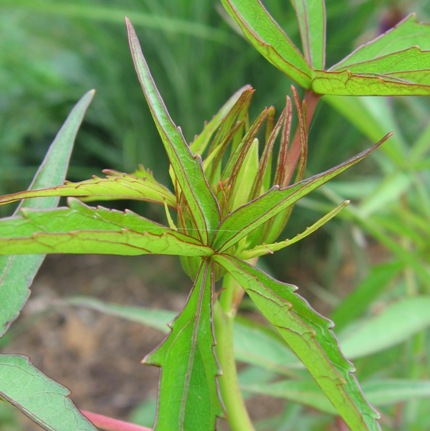
What you are looking at is Hibiscus coccineus, also known Scarlet Swamp Hibiscus, Native Swamp Hibiscus, Scarlet Rose Mallow or Texas Star.  
It is a hardy Hibiscus species that looks much like Cannabis sativa (marijuana).
It is native to the marsh like habitat of the Southeastern part of the United States. Growing in Zones 7-11
The swamp hibiscus is a perennial (a plant that lives more than two years) that can reach a height of 4 to 8 feet with a spread of 3 to 4 feet. It is a very fast grower and will easily attain the 8 feet in a single year. In the Winter it will die back, but comes back with a vengeance.
The leaves are lobed into 3, 5,or 7 parts. The finger-like lobes are slender and have jagged
teeth along their margins.
The deep red flowers, that only last for one day, are 5 to 6 inches wide and appear in mid to late Summer. There is no smell that I can tell. However, they do attract Butterflies and Hummingbirds.
To grow a swamp hibiscus, you do not need a swamp, it is a good candidate for a swampy, boggy area in your yard. Even though it will wilt in the heat of the afternoon, it is actually quite drought tolerant. It prefers part shade to full sun. Flowering is usually diminished in too much shade.  It can grow in practically any soil, from sand to clay.
Hibiscus coccineus can be propagated by seed or by dividing the plant in the Spring. It is not considered an invasive species.
Grasshoppers enjoy chewing the foliage and flower buds.  I usually squish them as a means of control or feed them to the birds. There are no real disease problems associated with the swamp hibiscus.
So, if you really want to mess with your neighbors, plant a whole bunch of Hibiscus coccineus. Then, when they are really growing well, invite a few friendly, plant loving, police officers over.....your nosey neighbors will be just waiting for the handcuffs to go on!
Happy Growing!
Darren

Sunday, July 25, 2010

Okie Dokie Okra

Growing up, I was always told that I would eat poop if it was covered in Chocolate. Well, that was, and still is, probably true. As I have gotten older, you can add deep fried to that. There is one food that I can definitely think of that the ONLY way I can eat it is deep fried, and that is Okra. Though, I haven't tried it covered in Chocolate yet.....hmmm. All my southern friends just went....EEEWWW!
And yet, I still grow Okra. I flour it and freeze it for use later on. I actually grow two kinds of Okra, the typical Clemson Spineless and a Red variety that I do not know the name of. What, never heard of or seen Red Okra? Take a look at this:


Pretty Huh? The leaves are even red hued.
I really don't taste or can tell the difference between the two colors. Though, having the two colors works really well for me and my love of everything Christmas, but that is a story for another time.
Okra (Abelmoschus esculentus) is a flowering plant in the mallow family which includes Cotton, Cocoa, and Hibiscus. It is valued for its green (or red) fruits, harvested when they are immature, and eaten as a vegetable.
Okra is native to West Africa and has become established in the wild in some tropical areas. It is believed that okra first reached the New World during the days of slave trafficking.
It may have been introduced to southeastern North America in the early 18th century. It was being grown as far north as Philadelphia by 1748. Thomas Jefferson noted that it was well established in Virginia by 1781. It was commonplace throughout the southern United States by 1800 and the first mention of different cultivars was in 1806.
Growing Okra is rather simple. It is among the most heat and drought tolerant vegetable species in the world.
Many gardeners soak the seed before planting to improve germination, I have actually soaked it and planted it direct....neither seemed to be superior over the other. It WILL NOT germinate in cool or cold soil, so plant the seeds after the soil has warmed in the Spring. Okra grows best at temperatures between 75 and 90 degrees. 
The crop can be grown on all soil types, although a well draining soil, high in organic matter is the most desirable. Poorly drained soils or ones with heavy amounts of clay, may result in drowning of the plants. They prefer a uniform amount of moisture. Water the garden sufficiently to moisten the soil to a depth of 6 inches. Lighter sprinklings will encourage shallow rooting of the plants. Plant in full sun for best productivity.
When fertilizing your Okra, it tends to respond to a high Phosphate fertilizer (the second number on the bag, i.e. 6-12-12).  The plant has a sensitive balance between vegetation (leaf production) and reproduction (pod production). Extra amounts of Nitrogen should be avoided until the pods begin to affect the plant growth.
Okra should be ready to harvest anywhere from 50 to 65 days after planting and when pods are 2 to 3 inches long. At this stage the pods are still tender. Larger okra pods will tend to be tough and woody. You will want to harvest the pods every 2-3 days. It is a very fast growing plant. If you delay and let the pods mature too long, first off they will become woody as mentioned earlier and second, the plant will not produce as many as it could. I slice, flour and freeze mine after every harvest, they will stay fresh in the refrigerator for about 7 days though.
Aphids, Cabbage Worms, Japanese Beetles and Rootknot Nematodes are the most serious of pest problems you will have. Stink bugs can also cause a problem of stunted, twisted pods. If a plant is stunted, pull the plant out of the ground and check for galls on the roots. These galls are caused by the nematodes, which are microscopic worms. Crop rotation is the best way to avoid this problem. As for the rest of the bad guys, if there is a major infestation , there are products on the market labeled for Okra. Please read and follow all packaging directions.
There are many people that like Okra, of course here in the South one of the main ways it is eaten is in Gumbo. Another way is Okra and Corn with Tomatoes served over rice. No matter how you eat it, there appear to be some pretty good health benefits to eating Okra. 
According to Sylvia W. Zook, Ph.D. (nutritionist), Okra has several benefits. 
Okra is a supreme vegetable for those feeling weak, exhausted, and suffering from depression. 
In India, Okra has been used successfully in experimental blood plasma replacements. (Gives a whole new meaning to having Okra in my veins.....Blog authors commentary)
Okra is used for healing ulcers and to keep joints limber. 
It helps to neutralize acids, being very alkaline, it provides a temporary protective coating for the digestive tract.
On top of all of this, it even has a pretty flower:
You can see the resemblance to the Hibiscus flower that it is related to. 
Why not give Okra a chance in your garden, if nothing else, I am sure you have a neighbor or family member that would love the huge amounts of pods you are going to end up with.  According to North Carolina State University, average yields are about 250 bushels (4 tons) per acre.
So now, if you don't mind, I have some Okra to go harvest.......where did I leave that dipping Chocolate!?
Happy Growing!
Darren


Tuesday, July 20, 2010

It's In The Bag!!

This past Christmas, My wife and I finally got to go up to Raleigh and see my mother and her yard. She has been working on it since she bought the house 6 or 7 years ago. It had been about 3 years since we were last there to see it. She comes down to Charleston 3 or 4 times a year and I hook her up with lots of landscape plants. It is nice to work at a nursery. We throw away an untold number of plants for numerous reasons. My mother collects them, gives them some TLC and brings them back to life. This is probably how three quarters of her yard has been landscaped. Anyway, she was excited for us to come up so she could show me the yard and the unusual pine cones on her Leyland Cypress. When we got there, I hated to give her the bad news, they were not pine cones, they were Bagworms! Sometimes the bags ARE mistaken for pine cones or other plant structures. I only bring this up now because I had somebody call me and ask about one on their Citrus tree.....apparently, it was confused.
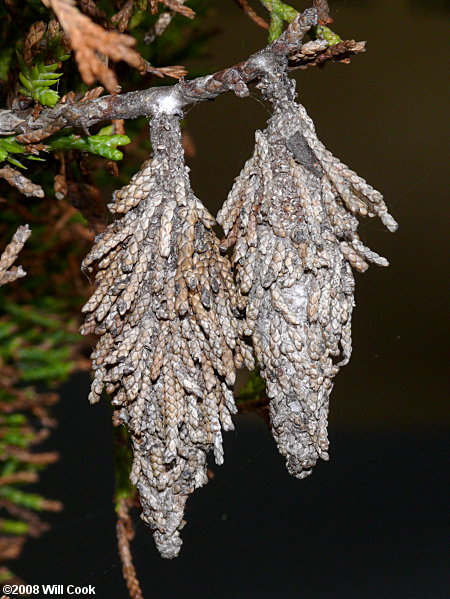
The cocoons that they spin look something like this:

Photo courtesy of Will Cook

The Bagworm (Thyridopteryx ephemeraeformis) is the larval stage of a moth that is reported to feed on over 100 different plants, I have yet to read about Citrus being one of them though. They prefer juniper, arborvitae, spruce, pine, and cedar but also attack some deciduous trees and shrubs. The first stage larvae feed on the leaf surfaces leaving small areas where the epidermis has been removed. Older larvae consume entire leaves. Late in the Summer, when caterpillars are large and consuming a lot of plant material, branches can begin to appear defoliated. Their distinctive 1.5 to 2 inch long spindle-shaped bags are carefully interwoven using silk and bits of leaves and twigs from the host plant resulting in a well-disguised covering.
Very small caterpillars can spin strands of silk to be carried by the wind, an activity called “ballooning”. Larger larvae may crawl to adjacent plants. They are really rather ugly little critters:


The adult male Bagworm develops into a moth that can fly, but the female remains grub-like and stays inside the bag. Female Bagworms lay between 500-1000 eggs in their bag before they die in the Fall. The eggs overwinter and hatch in May and June. Feeding, growth, and molting continue until August, at which time the mature larvae attach themselves to twigs. They close the bag and reverse themselves so that they are head down in the bag. They remain there for about 4 weeks as pupae.
During September and early October, the female releases a sex attractant pheromone and the males leave their cases and fly to the female bags to mate.


Infestations, which may not be noticed at first, can defoliate trees and shrubs. Heavy infestations over several consecutive years, especially when coupled with other stresses, can lead to plant death. Sadly, this is what was happening to my mothers Leyland.
There are some controls for the Bagworm. If only a few small trees or shrubs are infested, and there are only a few bags hanging, handpicking and destroying attached bags may provide satisfactory control. This must be done during the Fall, Winter or early Spring before the eggs hatch. Make sure you destroy or discard the bags. Eggs in bags thrown on the ground will hatch in the Spring and develop into larvae that could re-infest the plants.
The Bagworm has some natural enemies, such as certain species of birds that are able to tear open the bags and feed on the larvae, in addition to insect predators and parasitoids. Unfortunately, this will not usually control the Bagworm population.
When many small Bagworms are present and feeding, an insecticide may be needed to prevent serious damage. The best time to apply an insecticide is while the larvae are still small (less than 1/2-inch long), usually in early June. Small larvae are more vulnerable to insecticides, and feeding damage is relatively minor. Carefully inspect susceptible landscape plants. Young Bagworms are hard to see at first; look closely for the small, upright bags which have the appearance of tiny ice cream cones made of bits of plant material. There are insecticides labeled for Bagworms. Please read and follow the directions carefully. There are also some systemic controls, (where the plant takes the insecticide up through its vascular system), which makes them well suited to control the Bagworms on tall trees heavily infested in the upper canopy.
There is not much more to say about these things other than.....if they ever become crossed with a feline.....somebody is going to have the let the cat out of the....sorry, that was so bad, I am not even going to finish it!
Happy Growing!
Darren