Well, Summer has gone. Fall is fast approaching. Winter will soon rear it's ugly head. I do have a little something that will make some of you smile, I know my mother will.....Only 64 more days until the days start getting longer again!
Like most of you, I use the Winter to start planning my next years garden. The catalogs come in and I start drooling over everything. I want at least one of each and sometimes two.
One thing that I love to grow is Hot Peppers, and boy, I had a great crop this year. So, to give you some ideas of what to start dreaming about, I thought I would give you some pictures of and information about, Hot Peppers.
Chili peppers or hot peppers have been a part of the human diet since at least 7500 BC. There is archaeological evidence at sites located in southwestern Ecuador that chili peppers were domesticated more than 6000 years ago,and is one of the first cultivated crops in the Americas that is self-pollinating.
Christopher Columbus called them "Peppers", because they had a bite similar to white and black pepper, incidentally there is no botanical relationship between the two. Hot Peppers are in the genus Capsicum spp. and the black and white pepper are Piper nigrum.
There are only a few common species of peppers, those being:
Capsicum annuum, which includes many common varieties such as bell peppers, wax, cayenne, jalapeños, and the chiltepin
Capsicum frutescens, which includes the chiles de árbol, malagueta, tabasco and Thai peppers
Capsicum chinense, which includes the hottest peppers such as the naga, habanero, Datil and Scotch bonnet
Capsicum pubescens, which includes the South American rocoto peppers
Capsicum baccatum, which includes the South American aji peppers.
Even though there are only a few species, there are many cultivars and hybrids. However, peppers are commonly broken down into only three groupings: bell peppers, sweet peppers, and hot peppers. I like the hot peppers and I usually end up with the C. chinese, C. annum and C. frutescens. The hotter the better.
I did a blog sometime ago on Scoville units, so I won't go into great detail here on them. Just a quick overview, Bell peppers rate a zero. Jalapenos rate between 2,500-8000. Tabasco peppers rate 30,000-50,000. Bhut Jolokia (Ghost peppers) rate 800,000-1,000,000. Yes, you read that right, One Million. That's a hotta peppa!!
I use some of those as dehydrated flakes on my scrambled eggs. These ranges will vary according to growing conditions, heat, soil, water and a host of other things, so take them with a grain of salt.
Want to see some pictures so you know what to look for in the catalogs?
CHILE HABANERO
JALAPENO
ATOMIC STARFISH
DOLMALIK (From Turkey)
BHUT JOLOKIA
Peppers take roughly 70 – 90 days to mature and during this time they like to be kept as warm as possible. 80 degrees is where they like it, they can and will handle lower temperatures, they just won't do as well. I think I had such a great season because of how freekin hot it was this year!
They want full sun and in their early part of life, a good amount of water. A well drained soil helps to avoid root rot.
Peppers are ready to be picked as soon as they are big enough or you can leave them to change color and flavor gradually. I like to see what color they are going to change to. The Atomic Starfish turn a really pretty shade of Orange. Many will turn Red, Yellow, Orange, Black and all shades in between. Habanero Peppers can even come in Brown or White.
One thing that you should remember when handling these little packets of fire, the oils will get on your hand no matter how careful you are. I know a person that was working with peppers last weekend. She was telling me that if she happened to be biting her cuticles even 6 days later, it burned her lips and tongue. I found a little secret that worked for me if my hands are burning. My wife uses these wipes to remove makeup at night, I rub them all over my hands and it seems to help. Give it a try sometime.
Harvesting your peppers will cause you to have many more. The plant will continue to try and reproduce until frost kills it. Not a bad problem to have I think.
So when the Winter blahs really start to get to you and the catalogs are starting to pile up, look up some hot peppers. If you have saved any or canned any from the Summer, they will warm you up on a cold Winter's night. Just writing about them makes me want some of my Jalapeno poppers, time to eat!
Happy Growing!
Darren
Showing posts with label Bhut Jolokia. Show all posts
Sunday, October 17, 2010
Wednesday, March 24, 2010
Proud Chili Head
Yes, I will admit it, I am a major Chili Head!! I love it hot! I have grown some of the hottest peppers in the world, Bhut Jolokia's.....also known as The Ghost Pepper, and loved them!
The Ghost Pepper in all its Glory:

There is an interesting article that I got alerted to from a friend of mine on BlossomSwap.net. It involves the Indian (India) Military using Bhut Jolokia Peppers as weapons. They are wanting to use this pepper in their hand grenades. It could be used to flush insurgents out of caves and hiding places and to temporarily choke and incapacitate them. It has no environmental side effects. It may be the perfect weapon. Though, this would still not be as strong as the US Grade pepper Spray.
The Bhut Jolokia comes in at a record 1,000,000 Scoville units. That's One Million in case you were having trouble reading zero's. What's a Scoville Unit?
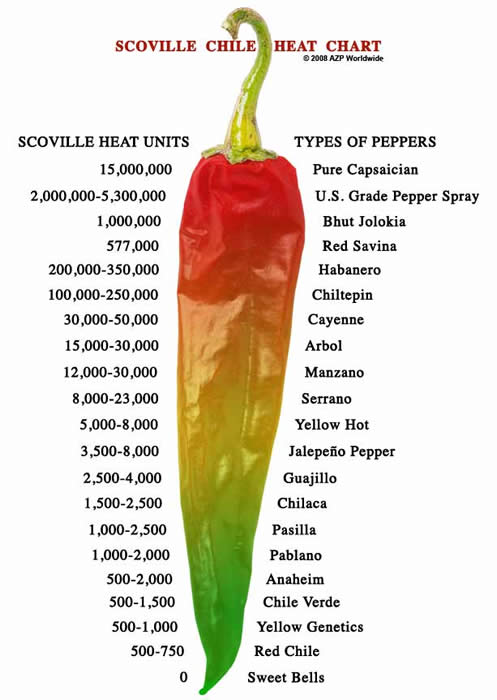
Devised by Wilbur Scoville in 1912, a Scoville unit is the measure of capsaicin in a particular type of pepper. Capsaicin is what makes a pepper hot. To give you an idea of how hot a million Scoville Units are, let me break it down for you.
A Bell pepper is between 0-100 Scoville Units....Basically not hot.
A Jalapeno Pepper is between 3,500-8000 Scoville Units....I love these on my Hot Dogs.
A Cayenne or Tabasco is between 30,000-50,000 Scoville Units....Great on Pizza.
A Habanero or Scotch Bonnet is between 200,000-350,000 Scoville Units...Dehydrated flakes are also good on Pizza.
Then you have the Bhut Jolokia at 1,000,000 Scoville Units....A piece the size of a pea can heat up an entire pot of Jambalaya. I admit it, these go on my Pizza too. I have even sprinkled some flakes on my scrambled eggs.
Here is the Full Chart:

The reason there is such a wide space of units in each pepper variety is because the heat can differ from pod to pod and plant to plant. This is just a basic scale.
How Scoville first started doing the tests on the heat of peppers is actually kind of funny. He used human guinea pigs and their tongues. One problem with Scoville’s test is that no two tongues ever agreed, so the panelists’ estimates had to be averaged. Another problem was that the number of tests a panelist could do in a day was limited. Because the tongue would temporarily get used to a given level of pungency, it had to be given rest to cool down before resuming the task. In an eight hour period, no more than 6 samples could be run through the panel. Today it is tested with a machine known as a High Pressure Liquid Chromatograph, it is supposedly as sensitive as the human tongue.
So, the next time somebody tells you that their food is hot. Ask them how many Scoville Units they think it is. Then give them a Bhut Jolokia. A serious note however, the Jolokia peppers are nothing to play with, these things are EXTREMELY HOT and can cause blistering on persons that are very sensitive, so please be careful. I luckily am not and am in the mood for some hot spicy food! I think it's time to go make some scrambled eggs with pepper flakes, Ghost Pepper anyone?
Happy growing!
Darren
The Ghost Pepper in all its Glory:
There is an interesting article that I got alerted to from a friend of mine on BlossomSwap.net. It involves the Indian (India) Military using Bhut Jolokia Peppers as weapons. They are wanting to use this pepper in their hand grenades. It could be used to flush insurgents out of caves and hiding places and to temporarily choke and incapacitate them. It has no environmental side effects. It may be the perfect weapon. Though, this would still not be as strong as the US Grade pepper Spray.
The Bhut Jolokia comes in at a record 1,000,000 Scoville units. That's One Million in case you were having trouble reading zero's. What's a Scoville Unit?
Devised by Wilbur Scoville in 1912, a Scoville unit is the measure of capsaicin in a particular type of pepper. Capsaicin is what makes a pepper hot. To give you an idea of how hot a million Scoville Units are, let me break it down for you.
A Bell pepper is between 0-100 Scoville Units....Basically not hot.
A Jalapeno Pepper is between 3,500-8000 Scoville Units....I love these on my Hot Dogs.
A Cayenne or Tabasco is between 30,000-50,000 Scoville Units....Great on Pizza.
A Habanero or Scotch Bonnet is between 200,000-350,000 Scoville Units...Dehydrated flakes are also good on Pizza.
Then you have the Bhut Jolokia at 1,000,000 Scoville Units....A piece the size of a pea can heat up an entire pot of Jambalaya. I admit it, these go on my Pizza too. I have even sprinkled some flakes on my scrambled eggs.
Here is the Full Chart:
The reason there is such a wide space of units in each pepper variety is because the heat can differ from pod to pod and plant to plant. This is just a basic scale.
How Scoville first started doing the tests on the heat of peppers is actually kind of funny. He used human guinea pigs and their tongues. One problem with Scoville’s test is that no two tongues ever agreed, so the panelists’ estimates had to be averaged. Another problem was that the number of tests a panelist could do in a day was limited. Because the tongue would temporarily get used to a given level of pungency, it had to be given rest to cool down before resuming the task. In an eight hour period, no more than 6 samples could be run through the panel. Today it is tested with a machine known as a High Pressure Liquid Chromatograph, it is supposedly as sensitive as the human tongue.
So, the next time somebody tells you that their food is hot. Ask them how many Scoville Units they think it is. Then give them a Bhut Jolokia. A serious note however, the Jolokia peppers are nothing to play with, these things are EXTREMELY HOT and can cause blistering on persons that are very sensitive, so please be careful. I luckily am not and am in the mood for some hot spicy food! I think it's time to go make some scrambled eggs with pepper flakes, Ghost Pepper anyone?
Happy growing!
Darren
Subscribe to:
Posts (Atom)