Showing posts with label Hosta. Show all posts

Sunday, March 13, 2011

Hosta La Vista

There are many undeniable truths about gardening, they need water (even Cactus), they need some kind of medium to grow in or on, and they get bigger, just to name a few. The problem with the last one is, when they get bigger, they produce more shade, which can be a good thing in 95 degree weather, but not when you want to have a garden. So, what do you do when there is more shade? Grow shade loving plants!
Hostas,(a.k.a Plantain Lily) are native to China, Japan and Korea, they were introduced into the United States in the early 1800's. The name Hosta is in honor of the Austrian botanist Nicholas Thomas Host (1771-1834).
These shade loving plants are one of the most popular perennials. They are very easy, adaptable, and relatively fool-proof. They have a very wide growing range, Zone 3 to Zone 9. Hostas do need a brief period of cold weather to go dormant. Insufficient Winter chill and dry air, such as in western deserts, are chief limiting factors for folks out there.
A Hosta plant can reach maturity in 4-8 years, and its size depends on the cultivar. Cultivars are "cultivated varieties" or "played with by man", that have been developed for some desirable or improved feature such as plant form, size, flower, leaf color, variegation, pest resistance, etc. The largest measures 4 feet in height with 20-inch-long leaves. The smallest miniatures may be only a few inches across. Most Hostas range between 1 and 2.5 feet tall.
Like I said earlier, Hostas are considered shade-tolerant plants, but most do not thrive if grown in deep shade. Hostas grow best in an exposure with morning sun and afternoon shade and will change color or fade if they are in too much sun. They grow by underground stems called rhizomes. They prefer well-drained,slightly acidic soils,and will not tolerate soggy conditions, especially during the Winter months. They do like to be kept moist however, their native habitat is as an understory plant. A good layer of mulch will keep them happy and some supplemental irrigation in dry weather, especially if growing under trees which take up so much of the soil moisture.
Hostas respond to light fertilization. It is best to get a soil test from your local extension office to find out what is lacking in your soil. Slow release fertilizers, 10-10-10 or 5-10-5 can be applied early in the Spring followed by another application six weeks later. Be careful not to apply slow release or granular fertilizer on top of or touching the new growth, eyes, or leaves of the plant, it can burn or kill the plant. For those of you that prefer, Liquid fertilizer is used for both soil and foliar application. It is applied every 10 to 14 days or according to the fertilizer label instructions.
Planting, transplanting and dividing should be done in early Spring when the leaves begin to emerge. Dividing Hosta plants is very easy. Basically, you dig up the clump and cut it into as many pieces as you want, as long as there are roots and an "eye" or leaf shoot, it will produce a new plant. This is why it is easier to do it in the Spring, just as the shoots are beginning to emerge. Unlike many perennials, Hostas do not need regular dividing to keep them growing strong. Established Hosta plantings have been in place for 30 years and longer with no need for dividing. Matter of fact, Hostas may outlive their gardeners if given a good spot to grow.
These little beauties are mainly grown for their beautiful foliage. Hosta leaves come in many shapes, colors, sizes and textures. The leaves grow as clump-like mounds in colors ranging from yellow-green to dark green to blue-green. Variegated varieties are also very common. The variegation can come in white, cream, or yellow and can occur on the edges of the leaves, in the centers, or streaked throughout the leaf. Even with all this great color,there is another side to growing Hostas, their flowers.
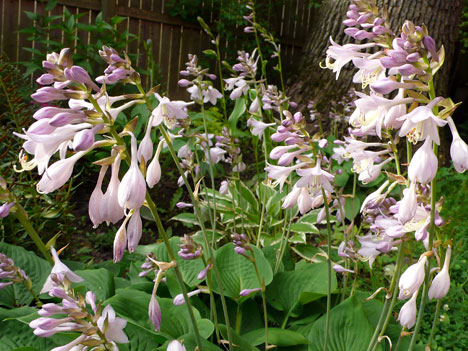
Hosta flowers, are produced from early Summer to Fall depending on the species and cultivar. They are lily-like flowers which may be white, lavender or purple. Some Hostas are even fragrant. There are some newer hybrids that can produce 50-75 blooms per spike. You will want to remove flower stalks after bloom to encourage vigorous growth, rather than seed production.
There are a few pests of Hostas, but for the most part, they can be controlled.
Slugs and snails are night time foragers and are the most common pest of Hostas. They eat small round holes in the leaves. Look for silvery slime trails in garden beds to determine if these pests are present. Thin-leafed hostas and those with leaves growing close to the ground are most susceptible to injury. Chemical slug and snail pellets and baits that contain metaldehyde are widely available commercially, however label directions must be followed carefully. I've heard of several cases where these poisoned and almost killed family pets. Beer traps are widely used, albeit with only moderate success. Place a small shallow container, such as a deep jar lid, level with the soil and fill with beer. Slugs are attracted to it, crawl in, and drown. I don't know if they have a preference of beer, I would start with a cheap one and work your way up until you find one they really like.
Other controls include handpicking, Copper plates and deterrents like a layer of diatomaceous earth or crushed eggshells spread underneath the plants. Though these last few are also only moderately successful.
Deer can also eat all your Hosta plants in one evening, leaving just the stalks standing.
Ten-foot tall fencing, electric fences and trained guard dogs are about the only reliable method to keep them out of the garden. Deer repellants may give temporary control, but these need to be re-applied after a couple of waterings or rain showers.
As far as diseases are concerned, Hosta anthracnose can cause large whitish spots with brown edges to form on leaves and stalks. Remove the damaged leaves and discard in the trash, not your compost bin.
When it comes to what to choose from, there is not near enough room on this blog to list them all. There are some estimates that list 7,400 cultivars and more being introduced every year.
They all have names too. Some are very formal sounding like: ‘Regal Splendor’, 'Royal Standard' and 'Elegans'.
Some give you an idea of their color: 'Gold Standard','Blue Cadet', 'Sun Power' and 'Guacamole'.
Then there are the ones that, well, I will let you decide what they were named for: 'Love Pat', 'All That Jazz', 'Blazing Saddles' 'Captain Kirk' and 'Striptease'.
Interestingly enough, and I DON'T recommend this, unless you know what you are doing, Hostas are edible by humans. They are called "urui" in Japan where they are commonly consumed. The parts eaten and the manner of preparation differ depending on the species; in some cases it is the shoots, others the leaf petiole, others the whole leaf. Younger parts are generally preferred as being more tender than older parts. The flowers are also edible.
Just like almost all other plants, Hostas have their own society. The American Hosta Society can be found at this link: The American Hosta Society
I will leave you with this bit of wisdom from a man that calls himself "The Hosta Guy" (catchy name). One final word of caution: Many "casual" Hosta users thought they could stop whenever they wanted. What begins as an innocent interest can quickly develop into a full-blown addiction. If you routinely tell your spouse you paid less than you really did for a new Hosta introduction, or brag about how many Hosta cultivars you have growing in your garden, you may need help.
Happy Growing!
Darren

Friday, February 26, 2010

Not a "Hi" Society

I have mentioned before, I am an active member of the Coastal Carolina Camellia Society. I really dig this group (half a pun intended). I have learned SO much about Camellias just chatting with and listening to some of these folks. I really feel if you can get involved with any plant society it will be worth your time. There is an Orchid Society here in Charleston also, I plan on joining them sometime in the future. They only meet on even months and the past two meetings I have had something else come up.
Unfortunately, that is about all she wrote.
There is the Charleston Horticultural Society, that is a little different in my book. They are more of a broader range society. They tend to cover all kinds of plants. Don't get me wrong, you can learn a lot from these folks too. When I say join a plant society, I mean an individual plant, i.e. The Camellia Society.
I decided to do some searching around to see what else was out there. Boy, did I come across some neat groups. The American Conifer Society, The Hosta Society, The American Hibiscus Society, just to name a few. I am wanting to learn as much as I possibly can about as many plants as I can without losing my mind. So, my thinking was, I will pick a couple of other societies, join them and LEARN!
Apparently, South Carolina has cooties or something like that when it comes to plant societies. There does not seem to be any chapters here in South Carolina.
Let me give you some examples.
The American Hosta Society. I have just recently learned there are hundreds of Hostas out there. Hostas are a pretty common plant here in SC and you would think there would be a society. Nope! There are none listed. There are two in North Carolina, one in Georgia, one in Virginia and four in Tennessee. All around us, none here.
How about The American Daffodil Society. Georgia, Tennessee, Florida, Virginia, North Carolina...South Carolina, you are outta luck.
The Gesneriad Society. (This is the group that has African Violets, Gloxinias and about 2000 other species and hybrids that make up some unusual houseplants). They are all over the place, Florida, Georgia, California, Colorado, even have one of these in Canada and Sweden! I guess I shouldn't feel too left out, North Carolina got the boot on this one too.
It is a shame that all this great information is not available in my home state of South Carolina. If I had the time and the money I would SO love to start a few of these. Holly, Ivy, Hydrangea and so many more plants all have their own societies. Did we forget to bathe? Is there no interest in SC for societies? Please, if somebody is reading this that would like to start a certain society...Contact me! I will help if at all possible.
Like I stated before, there is so much to learn by joining a society. My biggest fear is that so much knowledge will go to waste because it is not passed on to the next generation. Yes, I know there are books, the internet so forth and so on. It is just not the same. I can look at pictures all day of certain Camellia flowers, I still can't identify them in the real world.....Unless someone has taken the time to show me an actual flower and tell me this is what so and so looks like. Pictures do not do a flower justice.
I want to go see a yard that somebody is growing a "Lost" Hosta or Iris. I want to see the flower of a Daffodil that can't be bought in the store anymore because a "Better, Brighter, Shinier one" has been bred. Breeders are always trying to improve different flowers. That is fine and dandy, just don't throw the old ones out and forget about them.
One little story relating to this. At one of my plant swaps, my mother received some brown Iris bulbs. I did not even know there was such a thing. Apparently these are some old heirloom Iris'. Anyway, had that person not brought them, I would not have probably ever gotten to see them. This is the type of information and knowledge that is being lost. Please, join a society, create one if you have a passion for a specific species of plant. Pass the information on to the next generation!
I wonder if a Citrus Society in South Carolina would work? Hmmm.
Happy Growing!
Darren