Showing posts with label Invasive. Show all posts

Sunday, September 25, 2011

Popcorn Anybody?

Well, yesterday was the Fall version of the annual North Charleston Plant Swap. It was a smashing success with 90 participants and over 2000 plants swapped. During the setup phase, all was well....until.
The Clemson Extension Agent, who was there to participate, came up to me and said, "We have a problem".
She went on to say that somebody had brought a VERY invasive plant, and as Master Gardeners we really can not let them be propagated. I was not aware that somebody had brought it, at first I was not even aware of how invasive it was. I had heard of it, but was not totally familiar with it.
I am now.
The plant was Sapium sebiferum, also know as the Chinese Tallow Tree, and the Popcorn Tree. You will also find it still listed as Triadica sebifera, but the Sapium sebiferum is the proper name.
The Popcorn tree is native to China and Japan where it has been cultivated for its useful seeds and as an ornamental for more than a thousand years. It is said that Benjamin Franklin introduced it into the United States in 1776 for use of its waxy tallow in soaps and candles.
It is a deciduous tree (loses its leaves) that may reach 60 feet in height. The bark is a light gray. It has heart-shaped leaves with a pointed tip.


Slender, drooping spikes up to 8 inches long appear from April to June. In Fall the leaves turn brilliant shades of scarlet, orange, yellow and maroon.


Popcorn Trees can invade a variety of habitats ranging from swampy to saline waters, and from full sun to shade situations. It is often found growing along roadsides, coastal areas, and streams. Larger specimens can produce up to 100,000 seeds that may be eaten and dispersed by birds, facilitating the spread. Native species are crowded out once the Chinese Tallow becomes established. The leaves and fruit are toxic to cattle and cause nausea and vomiting in humans.
It tolerates almost any soil and can grow 5 feet tall in its first year. They are considered moderately drought tolerant. However, It was planted as a street tree in California where it apparently has not yet become invasive, perhaps because of insufficient rainfall.
They have become so invasive, first off, being that they are a native of Eastern Asia, which is the same latitudes as the Southeastern U.S. they love the growing conditions here, but primarily because of the seeds that are readily eaten and dispersed by birds. The seeds also float and can be carried easily by rivers, streams, and stormwater runoff to new destinations and virtually all of them germinate somewhere. The seeds are in a fruit that are 3 lobed, brown capsules, 1/2 inch in diameter, when mature the outer part splits revealing 3 white waxy seeds that resemble popcorn, hence its common name. They mature in late Summer to early Fall.


Photo Courtesy of University of Georgia

If all of this is not bad enough, The leaves produce allelopathic chemicals that change soil content and therefore makes the area uninhabitable to native species.
It has gotten so bad that, the State of Florida lists the Popcorn Tree or Chinese Tallow as a noxious weed and prohibits its introduction, movement or release.
To kill these things, cut the tree down and immediately paint the stump with a triclopyr herbicide such as Brush-B-Gon, Garlon, Pathfinder, Chopper or something like Round-up brush killer. Make sure you follow the label directions or get a certified professional to apply these. Results also can be obtained by spraying the bark in a 6 inch wide band all around the base of the trunk with one of the triclopyr herbicides. I don't usually suggest such harsh treatment because of the danger it can pose to the homeowner and the landscape, BUT, tests of simply cutting down the trees resulted in extensive root and stump sprouting. Before applying any herbicide, read the label!! I can not emphasize this enough.
This is nasty tree. Yes, it has pretty Fall foliage and can be used for some good shade. Tree species recommended that are similar in size to Chinese Tallow include Maples (Acer spp.) and Crape Myrtles (Lagerstroemia spp.). Might I also suggest to use an Eastern Redbud (Cercis canadensis), or a Red Mulberry (Morus rubra) instead. At least the Red Mulberry will give you something good to eat!
Happy Growing!
Darren

Sunday, October 10, 2010

Not Exactly a Domestic Brand

Well, it is nice to be able to write a blog again. The past two weeks have been incredibly hectic. I guess everybody decided to read my last blog on Fall being the best time to plant. We got extremely busy at work, which is a good thing. Then each of the past two weekends, the Master Gardeners have had something going on. Which brings me to today's post.....but first....forgive me for this one folks....I believe today must be a good day to fertilize your plants....it is everybody's most popular fertilizer...10-10-10. Okay, sorry.....I had to get that one out.
I mentioned the Master Gardeners have had a busy couple of weekends. Last week we were out at beautiful Magnolia Gardens for their Autumn on the Ashley event. The MG's were selling plants from the nursery I work at. I had picked them out and passed the word around to all pertinent people. I got a reply back rather quickly that I should investigate and check on one of the plants I was planning on bringing. It is considered an invasive species and we DO NOT want to be known for spreading a bad plant around.
Well, they were half right. The plant that is invasive is Nandina domestica. I was bringing Nandina domestica 'Firepower'. A dwarf version. I will go through some of the differences here.
Also known as heavenly bamboo, and despite the common name, it is not a bamboo at all. Nandina is an evergreen or semi-evergreen woody shrub often used in landscaping. It is a native of China and Japan.
Reaching heights of 6-8 feet tall, it is a very elegant and lacy plant. The dwarf plant only reaches 2-5 feet tall.
Preferring reasonably rich soil, it does not thrive in sand. Nandina can be grown in USDA hardiness zones 4-10. It can take heat and cold, from 110 degrees to 10 degrees. It grows well in full sun to partial shade and requires moderate to low water. It knows practically no pests unless it is extremely stressed. Leaf spot diseases can cause the lower leaves to drop from the plant in the humid regions of the nation. The disease appears to be most severe on plants grown in partial shade where the foliage can remain wet. It is one of the toughest and most adaptable plants in a variety of conditions.
'Firepower' Nandina is a noninvasive selection of the invasive ornamental, Nandina domestica, as determined by the University of Florida/IFAS Infraspecific Taxon Protocol, which is a a tool to evaluate invasiveness of cultivars and varieties. The regular Nandina is listed as a Class I invasive species by the Florida Exotic Pest Plant Council which means that it is "actively disrupting plant communities" It produces seeds which are spread by birds ingesting them. It also spreads slowly by underground rhizomes. 'Firepower' is propagated asexually via division, cuttings or tissue culture. While not considered rhizomatous, the "crown" of 'Firepower' Nandina can increase in diameter with time. Regular Nandina domestica has naturalized and invaded habitats all over the Southeast.
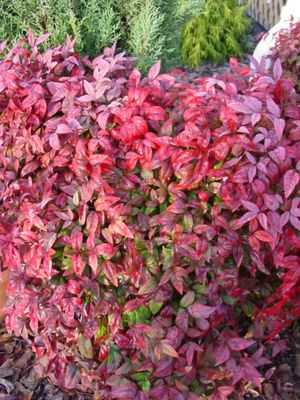
I think the Firepower is much prettier anyway, especially in the Fall. The leaves turn a fire red, hence its name.

Regular Nandina is a little more plain:
Plus, you see it has the berries.
We went ahead and sold the dwarf 'Firepower', it actually sold very well, once we explained to people it would not be taking over their yards. With all this being said, many cultivars have been developed for size, berry color, and Fall and Winter leaf color, and are available at nurseries.
I am still in the thinking that invasiveness is a state of mind, to some degree. I can make the argument for just about any plant. Crape Myrtles here in the South are practically a staple in any yard, I call them crap myrtles. I see seedlings popping up all over the place in my yard, yet they are revered as the most beautiful thing this side of the Mason Dixon line. My Nandina is just sitting in the corner, minding its own business, and it has the same moniker as a serial killer.....where is the justice?!
Happy Growing!
Darren

Sunday, September 19, 2010

Beware the Invasion

There is an invasion that, if you haven't seen it yet, is coming from our southern border. It looks friendly, can be a hard worker, but it is questionable as to whether it should be in our country. I don't know what you were thinking, but I am talking about Ruellia brittoniana (a.k.a. Mexican Petunia).
Mexican Petunia is native to Mexico, but it has escaped cultivation and has established itself in a great deal of the Southeastern U.S.
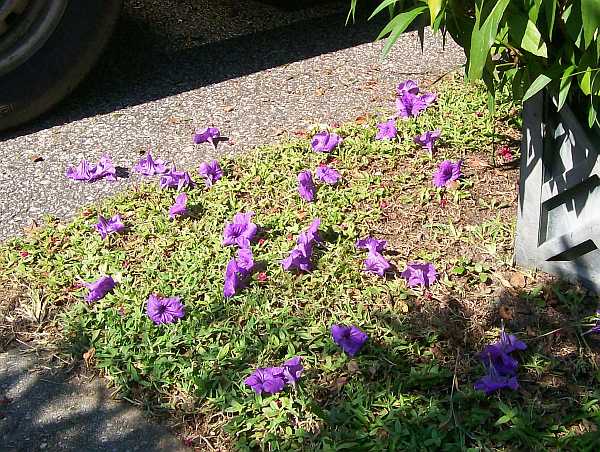
This is what mine looks like at the end of my sidewalk:

When I mentioned it has escaped cultivation, that is probably an understatement! According to the Florida Exotic Pest Council, Mexican Petunia is a Category 1 Invasive Plant. This means that it is "altering native plant communities by displacing native species, changing community structures or ecological functions, or hybridizing with natives". Where hardy, the Mexican petunia excels at invading wetlands, yards, fields, forests and anywhere else it can find soil.
Mexican petunia is a stalk forming perennial that stands up to 3 feet in height. Leaves are dark green, but the foliage will appear metallic blue/purple under full sun. They are 6-12 inches long and 1/2 to 3/4 of an inch wide. The blossoms are trumpet shaped and about 1.5-2 inches in diameter and are borne at the tips of the stems.
There is something neat about this plant, if you like this sort of thing. Every morning there is a beautiful plant full of flowers. Every afternoon, the ground looks like a ticker tape parade went through. The flowers fall off, only to be replaced by brand new ones the next morning.


It likes fertile soil that is moist. Mexican Petunia is a water plant that becomes very aggressive with access to abundant moisture. It will survive dry spells once established however. I mentioned that it likes full sun, but will do well in partial shade. The quantity of blossoms is related to the amount of light the plant receives. The more direct sunlight the more flowers. You will actually get fewer flowers appearing on overcast days or when grown in shadier conditions. There are numerous varieties with a plethora of colors to choose from Purple, White, Pink, and many shades of Blue.
Here is a picture of a Pink one I found:

The reason this thing is considered an invasive plant is because of how easy it is to propagate. The running joke is, if you break off a piece, lay it on the sidewalk, it will root! If you have a friend growing it, ask to break off a piece or two, you only need a piece about 2 inches long to root. Other characteristics that make Mexican Petunia a successful invasive plant is its rapid growth rate, Mexican Petunia will resprout from crowns or rootstocks when cut back or killed back by frost. Mine die back every year and you see how big it is.
It is typically not bothered by any pest or disease.
Use Mexican Petunia towards the back of a flowering border, or as the centerpiece in a container. Butterflies and Bees love the flowers. It blooms enthusiastically throughout the hottest time of the year. It is usually inexpensive and sold in many big box stores.
There is a dwarf variety available, it is suppose to only get about a foot tall. All of the attributes of the full size one, only in miniature. I have not seen it myself, but it is out there.
Dwarf:

I have had no real problem with my Ruellia, but I also keep mine in containers. I see shoots coming out from around the pot occasionally, but my lawnmower or weedwhacker seems to make quick work of them.
I have had many conversations with people about invasive plants. Yes, I can see where, if this thing really was allowed to grow, it could take over the world. Marigolds can do the same thing! I have never seen my Mexican Petunia produce seeds, the shoots are removed easily, and it doesn't borrow the car keys to go over to the next county. If you keep it in control, there should be no problem in growing this very pretty, fast growing plant.
Happy Growing!
Darren