Being a Yankee by birth (New Jersey) and living in the South, I tend to get teased a lot. It is nothing serious, I know it is in fun (I hope), and I usually throw it right back. I currently live in Charleston, SC the birthplace, for all intents and purposes, of the Civil War. That war began with the firing on Fort Sumter, April 12, 1861.
South Carolina was one of the Confederate States of America which consisted of the governments of 11 Southern states that seceded from the Union in 1860-61. So it is fitting that I use this background to introduce today's topic. The Confederates.
There are some plants that use Confederate in their common name, which can actually get confusing, and I will discuss this in a moment.
The first Confederate I want to discuss is Confederate Jasmine (Trachelospermum jasminoides).
Contrary to its name, Confederate Jasmine is not native to the
Southeast, nor is it a true jasmine. It is actually native to China. When supported, this twisting, twining vine can reach up to 20 feet or more. Without support
and with some tip-pinching and pruning, it can be a spreading shrub or groundcover.
It is a fast-growing vine that can be grown on lamp posts,
trellises, or arbors. It will easily twine through chain link fences and
makes a great, evergreen screen.
In early Spring and Summer, Confederate Jasmine produces clusters of small, white, VERY fragrant flowers that look like tiny pinwheels. This plant prefers full sun to partial shade. It likes a moist but well-drained soil, however it is drought resistant. It is relatively problem-free, though rabbits have been known to graze on it. It is primarily grown in USDA Zones 8 - 10. There are a few cultivars that are hardy to Zone 7. Propagation is done by cuttings as they root easily when taken in the Spring. This is probably the South's favorite flowering vine. I highly recommended Confederate Jasmine to new gardeners. It is easy to grow and
satisfies with quick growth and a fabulous floral display. Who wouldn't want to come home to this?
The next Confederate I would like to discuss is the start of the confusing ones. Confederate Rose.
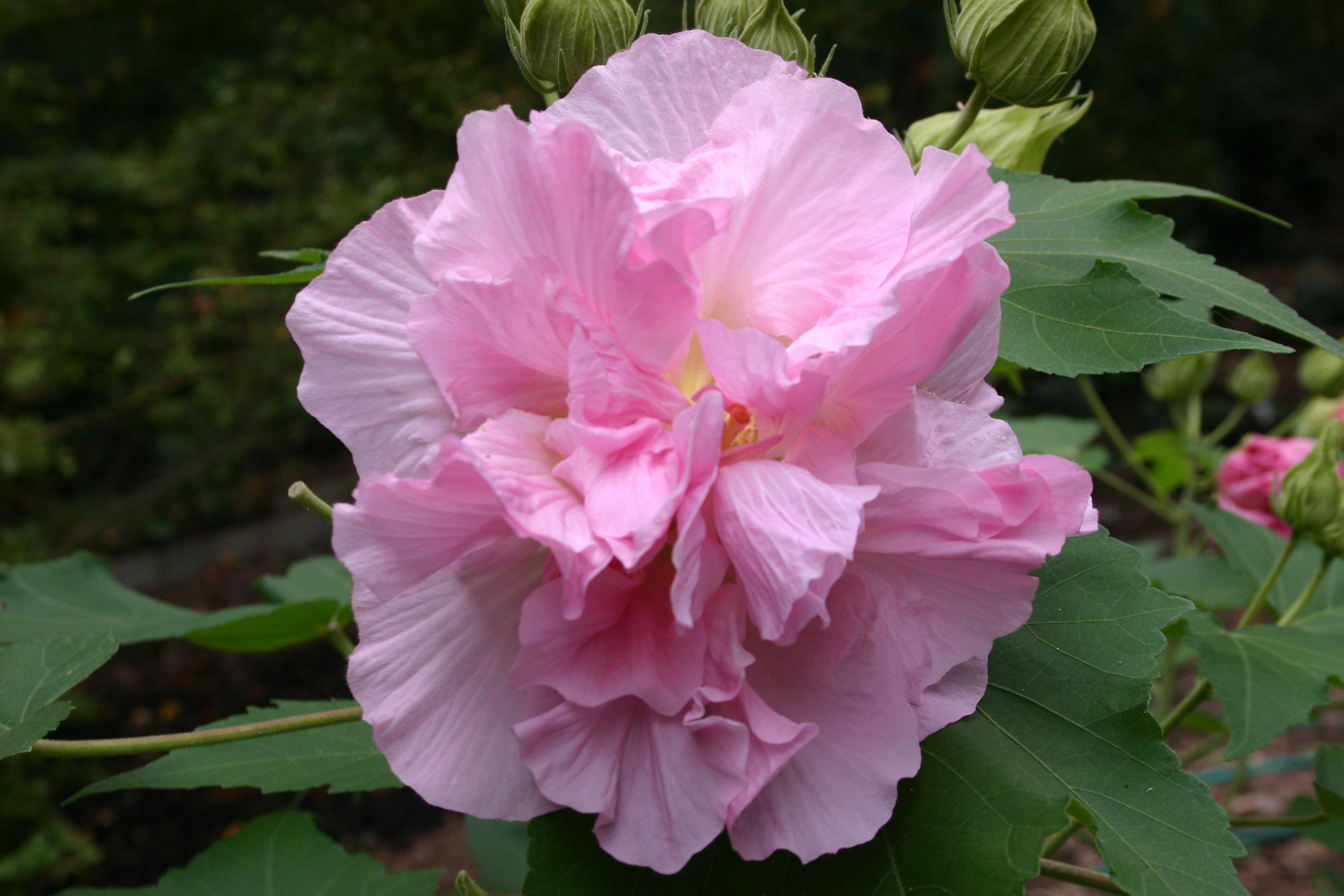
Botanically this is Hibiscus mutabilis. As with the Confederate Jasmine this is neither a confederate, it too is originally from China, nor is it a rose, it is in the Hibiscus family.
One of the most interesting things about this flowering shrub are the flowers themselves. Three distinct colors appear on the bush simultaneously as the blooms
color cycle independent of one another. They open white or pink, and change to deep red by evening.
This can be a large shrub or small multi-stemmed tree that grows to 15 ft high with about a 10 ft spread. USDA Zones 7-9
This plant likes full sun to partial shade. It thrives on regular watering but is very drought tolerant. It is propagated very easily by cuttings.
This is a great plant to add to your landscape as little to no care is required. This shrub truly takes care of itself and is adaptable to most locations and soil conditions. One last tidbit about the Confederate Rose. You can learn a lot by the plants botanical name, (mutabilis), it is mutable, it's flowers changing color with age.
The last plant I would like to discuss is the Confederate Rose.
I know, I did that one already. This is the Confederate Rose Agave. See how common names can screw you up?
There is some confusion as to the exact botanical name, it is believed to be a hybrid, possibly a cross of Agave parrasana and Agave Parryii.
Either way, it is a very nice plant. It is considered a medium sized Agave which grows in clustering
rosettes up to 1 foot across and 1-2 feet high. It has deep blue/gray short, stubby
leaves, with sharp reddish teeth on each leaf. USDA Zones 8-11
As with all succulents this thing is VERY drought tolerant. However, many people do not realize that this plant is so tough that it is highly frost tolerant, it can handle down to below 20 degrees and withstand the blazing hot summer sun. Propagation is usually done by the pups that it sends out.
So there you have it, The Confederates.
Not a story of division between the states nor a story of war. Just some very good, relatively problem free, plants for a Southern Landscape.
I hope you enjoyed this article, for now, this Yankee is off to feed some Southern mosquitoes, rumor has it that they think Yankees are delicious.
Happy Growing!
Darren
Showing posts with label Vine. Show all posts
Sunday, May 26, 2013
Sunday, June 12, 2011
A Glorious Morning
I have this fence line along the front of the house that, for the past few years, has been used for growing Grapes. The Concord Grapes that I grew were wonderful! Sadly, Pierce Disease finally reared its ugly head and the plants died. This wasn't a shock, I knew it was coming, that is the problem with growing that type of Grape in South Carolina. But I digress.
I had grandiose plans of growing Passion Fruit (Passiflora edulis) up there this year.
At the rate the seedlings are growing, the new millennium will be here before they are even up to the first rail. So, what to do?
I had a friend of mine give me some Morning Glory seeds at one of the last plant swaps, they are of some beautiful colors, so why not!?
The Morning Glory, which is in the family Convolvulaceae contains at least 50 genera and more than 1000 species. Wild morning glories have been traced back to ancient China where they were used for medicinal and ceremonial purposes. It was introduced to the Japanese in the 9th century, and they were the first to cultivate it as an ornamental flower. Aztec civilizations used the juice of some morning glory species native to Central America to create rubber-like substances, according to the Massachusetts Institute of Technology.
Most Morning Glory flowers curl up and close during the warm parts of the day, and are fully open in the morning, thus their name. On a cloudy day, the flower may last until night.
In cultivation, most are treated as perennial plants in frost-free areas and as annual plants in colder climates, but some species tolerate winter cold. They are very easy to grow no matter where you live.
Morning Glories should be planted in full sun. They are a vine, and can reach 10 feet in length, so unless you want them sprawling across your yard, you will want to grow them against a fence or trellis. Because of their fast growth, twining habit, attractive flowers, and tolerance for poor, dry soils, some Morning Glories are excellent vines for creating Summer shade on building walls when trellised, thus keeping the building cooler and reducing cooling costs.
You should sow the seeds 1/2 inch deep, and 8 to 12 inches apart. Once planted, you can almost forget that they are there, practically thriving on neglect. Do not over water either.
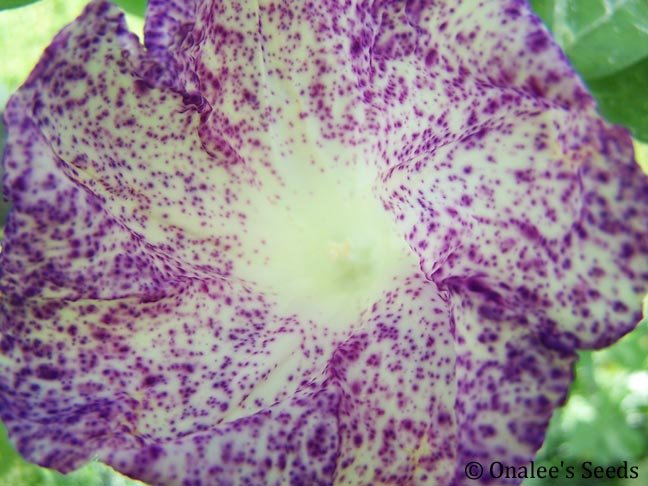
Morning Glories have leaves that are heart-shaped, 4 - 5 inches long. The flowers which can be as much as 8 inches across, though most are around 4 inches, come in an array of colors. Blue, White, Pink, Red, Purple, Speckled and all combinations of these. The seeds that I planted are of a really unusual coloring.
This is what my cultivar 'Fujishibori' will look like:
According to the seed packets that I planted on the fence, I should have about 10 different color flowers, including the 'Fujishibori' listed above. Of course, this will greet my wife and I every morning when we leave for work. By the time we come home in the evening they will be gone. I have a solution for this. In the same area that I planted the Morning Glories, I also planted something else. Moonflower (Ipomea alba) which is a popular fragrant variety of Morning Glory. It opens in the evening with a sweet fragrance and lasts throughout the night until the morning sun comes along.
Then of course, the whole thing starts all over again.
Morning Glories produce round seed pods in clusters hanging from their vines.
The pods turn papery brown and become hard. The seeds themselves are dark-brown to matte-black, wedge shaped, and are sized between 1/8" and 1/4" long. I mention the seeds because, once you plant Morning Glories in your yard, you will find them reproducing themselves for YEARS!! This is actually the first time in eight years that I have actually "planted" them myself. I am still pulling volunteer plants from my garden. They NEVER seem to come back up where I want them. So I am offering this advice, be very careful when deciding whether to plant these beauties in your yard. Morning Glories can reproduce so much that, in the states of Arizona and Arkansas it is considered a Federal Noxious Weed, and technically it's illegal to grow, import, possess, or sell seeds.
I am not sure what the penalty is or if it is heavily enforced, but I wanted you to know that was out there. If you want to plant them, but are worried about the reseeding issues, there is a fairly easy solution. Immediately after the flowers fade and fall, or just as the seed pod is forming, pull it off before the pod turns brown and hard.
There are some significances associated with Morning Glory flowers. They represent the month of September as one of the official birth flowers (Asters being the other). Some couples like to give traditional flowers on their wedding anniversary or use the traditional flower in the decorations of an anniversary celebration. Morning Glories are used for the 11th wedding anniversary.
I hope you have enjoyed this adventure through a "Glorious Day"?
I will conclude this blog today with a picture of how the Morning Glory ends its day.
Happy Growing!
Darren
I had grandiose plans of growing Passion Fruit (Passiflora edulis) up there this year.
At the rate the seedlings are growing, the new millennium will be here before they are even up to the first rail. So, what to do?
I had a friend of mine give me some Morning Glory seeds at one of the last plant swaps, they are of some beautiful colors, so why not!?
The Morning Glory, which is in the family Convolvulaceae contains at least 50 genera and more than 1000 species. Wild morning glories have been traced back to ancient China where they were used for medicinal and ceremonial purposes. It was introduced to the Japanese in the 9th century, and they were the first to cultivate it as an ornamental flower. Aztec civilizations used the juice of some morning glory species native to Central America to create rubber-like substances, according to the Massachusetts Institute of Technology.
Most Morning Glory flowers curl up and close during the warm parts of the day, and are fully open in the morning, thus their name. On a cloudy day, the flower may last until night.
In cultivation, most are treated as perennial plants in frost-free areas and as annual plants in colder climates, but some species tolerate winter cold. They are very easy to grow no matter where you live.
Morning Glories should be planted in full sun. They are a vine, and can reach 10 feet in length, so unless you want them sprawling across your yard, you will want to grow them against a fence or trellis. Because of their fast growth, twining habit, attractive flowers, and tolerance for poor, dry soils, some Morning Glories are excellent vines for creating Summer shade on building walls when trellised, thus keeping the building cooler and reducing cooling costs.
You should sow the seeds 1/2 inch deep, and 8 to 12 inches apart. Once planted, you can almost forget that they are there, practically thriving on neglect. Do not over water either.
Morning Glories have leaves that are heart-shaped, 4 - 5 inches long. The flowers which can be as much as 8 inches across, though most are around 4 inches, come in an array of colors. Blue, White, Pink, Red, Purple, Speckled and all combinations of these. The seeds that I planted are of a really unusual coloring.
This is what my cultivar 'Fujishibori' will look like:
According to the seed packets that I planted on the fence, I should have about 10 different color flowers, including the 'Fujishibori' listed above. Of course, this will greet my wife and I every morning when we leave for work. By the time we come home in the evening they will be gone. I have a solution for this. In the same area that I planted the Morning Glories, I also planted something else. Moonflower (Ipomea alba) which is a popular fragrant variety of Morning Glory. It opens in the evening with a sweet fragrance and lasts throughout the night until the morning sun comes along.
Then of course, the whole thing starts all over again.
Morning Glories produce round seed pods in clusters hanging from their vines.
The pods turn papery brown and become hard. The seeds themselves are dark-brown to matte-black, wedge shaped, and are sized between 1/8" and 1/4" long. I mention the seeds because, once you plant Morning Glories in your yard, you will find them reproducing themselves for YEARS!! This is actually the first time in eight years that I have actually "planted" them myself. I am still pulling volunteer plants from my garden. They NEVER seem to come back up where I want them. So I am offering this advice, be very careful when deciding whether to plant these beauties in your yard. Morning Glories can reproduce so much that, in the states of Arizona and Arkansas it is considered a Federal Noxious Weed, and technically it's illegal to grow, import, possess, or sell seeds.
I am not sure what the penalty is or if it is heavily enforced, but I wanted you to know that was out there. If you want to plant them, but are worried about the reseeding issues, there is a fairly easy solution. Immediately after the flowers fade and fall, or just as the seed pod is forming, pull it off before the pod turns brown and hard.
There are some significances associated with Morning Glory flowers. They represent the month of September as one of the official birth flowers (Asters being the other). Some couples like to give traditional flowers on their wedding anniversary or use the traditional flower in the decorations of an anniversary celebration. Morning Glories are used for the 11th wedding anniversary.
I hope you have enjoyed this adventure through a "Glorious Day"?
I will conclude this blog today with a picture of how the Morning Glory ends its day.
Happy Growing!
Darren
Subscribe to:
Posts (Atom)