Sunday, April 25, 2010

It Fig-ures

I have enjoyed growing the couple of common figs that I have. Brown Turkey and Celeste. I am rooting some fourteen more varieties. Some with unusual names like Panachee, Osborn Prolific and Rattlesnake Island Fig. Talking to people about figs, they are often amazed at how many varieties there are. It is estimated that there are over 700 different varieties around the world! The fig is considered the oldest cultivated tree for food by humans. Remnants of figs have been found in excavations of sites traced to at least 5,000 B.C.
According to botanists, who break them down by the way they are pollinated, there are four main fig divisions.
Caprifig..produces pollen, but no edible fruit. This one also hosts a special type of wasp. It actually lives inside the fig.
Smyrna figs..depend on Caprifigs for pollen and the special wasp I mentioned above.
San Pedros figs..produce two crops a year, one with the assistance of Caprifigs and one without.
Common Figs..is self pollinating. Many of the edible figs fall under this category.
The different types of fig trees gave rise to frustration in cultivators for thousands of years, since people did not initially understand why sometimes figs fruited and sometimes they didn't. Flowers need to be pollinated.
Many people do not realize that the fruit of the fig is actually an inverted flower. It contains both the male and female flower parts enclosed in stem tissue. For all you major geeks out there, it is known botanically as a syconium. So when the fig reaches maturity, the interior of the fig contains only the remains of these flower structures, including the small gritty structures commonly called seeds. Those so called seeds usually are nothing more than unfertilized ovaries that failed to develop. Sounds yummy huh?
The fig grows best and produces the best quality fruit in Mediterranean and dryer warm temperate climates. It is a deciduous tree that can reach heights of 50 feet. More commonly they only attain 10-30 feet. The tree has a sap that contains copious amounts of a milky latex that is irritating to human skin.
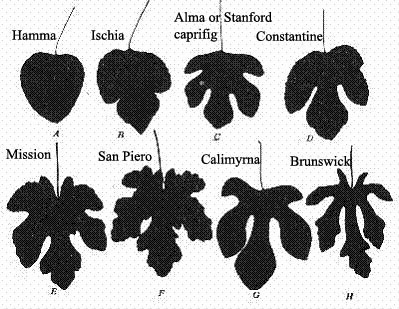
Fig leaves have a very tropical feel to them and come in a wide range of shapes and sizes.


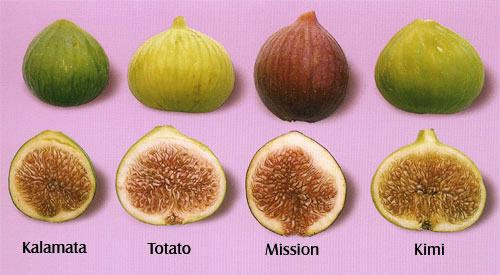
As do their fruits, This is only a small sample of the diversity of fruit shapes, colors and sizes.


Figs require full sun all day, Early morning sun is particularly important to dry dew from the leaves. Good drainage is important, and although drought tolerant, figs need 1 inch of water per week from rainfall or irrigation. Figs require little to no fertilization, excess nitrogen encourages leaf growth at the expense of fruit production. As a general rule, fertilize fig trees if the branches grew less than a foot the previous year.
Growing zones for figs are usually 6-9. There was a story of a fig growing in a zone 5, but it was growing next to a greenhouse and was fairly sheltered. If you want to grow a fig any further north, you will need a large container and some strong friends to move it inside each Winter.
Fig plants are usual propagated by cuttings. Take an 8 to 10 inch cutting of year-old wood in early spring. Dip the end of the cuttings in a rooting hormone and allow them to callus one week. Then place them in equal parts of Sand, Peat and Perlite. Keep them in bright light with lots of humidity and heat. When the roots appear, repot in growing medium and slowly acclimate them to their final growing place.
Figs must be allowed to ripen fully on the tree before they are picked. They will not ripen if picked when immature. A ripe fruit will be slightly soft and starting to bend at the neck. Birds may feed heavily on figs. Picking early in the morning will decrease bird damage. Netting can be used if this becomes a major problem.
Insects and diseases are rarely a serious problem on figs. Various wood boring insects may attack weak or dying trees. Root knot nematodes are the primary pest, particularly in sandy soils. They attack the roots, forming galls and stunting the trees. Nematode problems may go unnoticed for several years. As a heavy population builds up, the tree loses vigor and declines gradually. The nematodes are not readily noticed by the average person. To prevent root knot nematodes in figs, obtain nematode free plants and plant in nematode free soil. That is why I prefer growing mine in containers, I never have to worry about these.
There are many people out there that say figs can not be grown well in containers. Here is a picture of mine, In A Container!


Happy Growing!
Darren

Saturday, April 24, 2010

The First Invader has Arrived

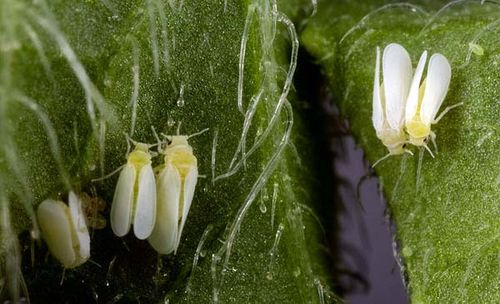
Every year it is a guessing game as to which invading pest will be the first to arrive in my yard. Some years it is Aphids, others Mealybugs....This year it's Whitefly.
There seems to be many more than I have ever seen before. They are all over the Citrus, Tomatoes, Potatoes and Peppers. I have the typical white cloud of fluttering insects when I water.
Whiteflies are not true flies as they are relatives of mealybugs, scales and aphids. All of these insects suck the life right out of your plant, literally. They are piercing insects that suck the juice from the plants tissue. They attack the leaves, buds and stems.
Adult Whiteflies are about 1/10 to 1/16 inch long and look like tiny moths.


Adult females usually lay between 200 and 400 eggs. Sometimes the eggs are deposited in a circular pattern in groups of 30 to 40 because the female will often keep her mouthparts in the plant to feed while moving her abdomen in a circle. How is THAT for lazy?!
Within about a week, the eggs hatch into flattened nymphs, called crawlers, that wander about the plant. Very soon after that, the crawlers insert their mouthparts and begin to feed. If your infestation is bad enough, you can literally have all generations present at the same time. Adults to eggs and all points in between.
It is the nymph and adult fly that cause the physical damage to the host plants. The plants can be seriously weakened and grow poorly, becoming stunted. Leaves often turn yellow, appear dry and drop prematurely, ultimately the plant can die. If this isn't bad enough, Whiteflies produce honeydew (like aphids) that can drip onto the plant encouraging the growth of sooty mold. They also can spread plant viruses. I am really NOT a fan of Whitefly.
The Silverleaf Whitefly has over 500 host plants, this is the one that has come to visit me. Many other Whitefly are more plant specific. Luckily, there are a number of natural predators. The Ladybug larvae will consume up to 1000 Whitefly eggs in its lifetime, and they also feeds on the nymphs. Green Lacewing, which is probably the most voracious, effective predator, eats them. Online, you can order the Delphastus beetle, a specific predator of Whiteflies. It has to eat them in order to reproduce. Other natural enemies are Minute Pirate Bugs, Big Eyed Bugs, and Damsel Bugs. There are also many songbirds, including swallows, that feed on Whitefly.
Some things that you can do to help your natural predators include: Use a seaweed spray to mist the leaves of your plants. Along with all the benefits plants derive from a seaweed spray it also seems to make the foliage undesirable for Whiteflies to reproduce on. Insecticidal soap is another alternative. White flies being soft-bodied insects can be successfully controlled and prevented with insect soap sprays. It basically dries them out. You can plant Marigolds around your prize plants, this may help some. I have not had much luck myself with this method, they still seem to show up. A light horticultural oil will work.There is one other safe control to try, this one really tickled me when I read about it. Use a vacuum to carefully suck up as many Whiteflies as you can. Dustbuster units are ideal for this. As a last resort, you can use Pyrethrum or Malathion sprays. The key to using these products is to directly spray the pests. Their location on the underside of the leaf makes it difficult to deliver insecticides to the site where they are found. Also, Whiteflies can rapidly develop resistance to the insecticides used against them. Always read and follow the label directions carefully.
Hopefully, you won't have to deal with this menace. At least if you do, you know how to handle them now. As for me, I am going to give Mother Nature a couple of days to take care of my little problem. If she fails, I have no problem bringing out the big guns.....Now what was the code for that nuke!?
Happy Growing!
Darren

Friday, April 23, 2010

Definitely NOT Chinese Food

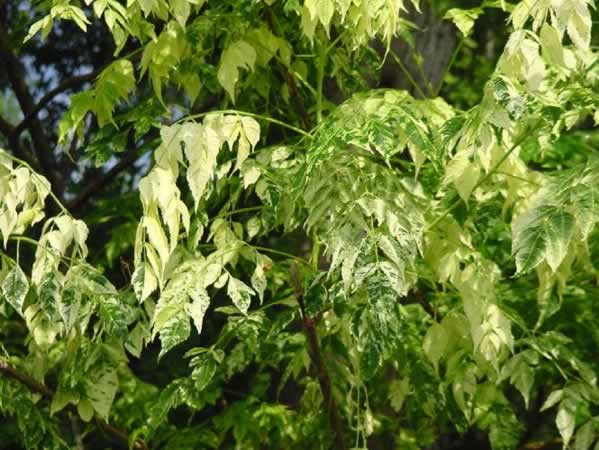
One of my favorite ornamental plants in my yard is my variegated Chinaberry (Melia azedarach 'Jade Snowflake') also known as the Texas umbrella tree. I have it in a 30 gallon container in the very front of my yard. It has blown through the bottom of the container and taken root right into the ground. The really neat thing about it this year, it has flowered for the first time. To me, the flowers look like little Orchids. Others say that it has lilac like flowers. Either way, they are very pretty.


They have a scent to them, to me they smell like a baby powder perfume. My wife says they stink. To each their own I guess.
I received this plant at one of my first plant swaps. My wife chose it because it was variegated, I liked the name , I figured it was another source of food.I was WRONG!
The Chinaberry is a native of Asia, it was brought to the U.S. in the late 1700’s by a French botanist. Over the years it has been used as an ornamental plant, shade tree, and fuel wood. It has traditionally been thought to bring good luck. Which is kind of funny as you will learn later on in this article. It is seen from Virginia to Florida and westward to Arizona and up into Washington State. Zones 7-10.
Chinaberry is listed as a Category I species by the Florida Exotic Pest Plant Council. This means that it is invading and disrupting natural communities in Florida. It also is reported to be invasive and disruptive in 11 other states, including Hawaii and Texas. It has all the qualities of a successful weed. It will adapt to many environmental conditions, is virtually disease and insect free. However, Scale, Whitefly and sooty mold will infest it on rare occasions. It has been known to form dense thickets in forests and marshes, displacing native vegetation as it grows.
Chinaberry is a deciduous tree with purplish, reddish bark. It is able to grow to 50 feet in height, although trees less than 30 feet in height are more common. It flowers in the Spring, and produces yellow to yellow-green round drupes after flowering. The fruits are sticky, with hard, round, marble like seeds. Birds eat the fruit and spread the seed. Because the seed is very hard, it may remain dormant in the soil for several months or years. The fruits and seeds are poisonous to humans and other mammals however.
It can be grown in everything from part shade/part sun to full sun. It can be grown in a wide range of soils, including both acidic and alkaline. It has a high tolerance to drought. It is even moderately tolerant of salt spray. This is one tough plant!
To me, the variegated leaves are very pretty.


There will be people that complain about the invasive tendencies of this plant. They will ask, "Why in the world are you growing it"? Believe it or not, you can buy seeds online for it! One of my favorite quotes I found when researching this tree is, "You will not find anyone that will recommend planting this tree, but, fine examples can be found growing in the worst soil". So, apparently it can have its place. In my little neighborhood, I don't foresee it becoming a problem. There are no forests or any real wooded areas in the area. Everybody is required to mow their yard at least once every two weeks. So there should be no way for it to get a foothold here. I enjoy the looks of my tree, it gives contrast to all my other plants. It is also one heck of a conversation starter because, nobody knows what in the world it is!
Happy Growing!
Darren

Thursday, April 22, 2010

Having Fun, Experimenting

I have been known to push the envelope a little. Okay, Okay, A LOT! I want to show you that a small space for gardening is only limited to your imagination. Today's blog is going to fit into the inspiration category.
I guess I should start by letting you in on a couple of not so secret, secrets. When it comes to food, it is only the wife and myself. We don't need a huge amount of food grown, though I do enjoy canning and preserving, so I grow a little more than we really need fresh. Second, I only live on about 1/4 acre of land. I tell you this so that you understand more the actual number of plants that I grow. We like a wide variety of things, so I grow more varieties of any one particular plant. It also gives me a better idea of what works and what doesn't.
Take this first picture for instance:


There are actually 10, 15 gallon containers here. You can't see one of them in the back, more on them later. Just to give you some perspective, the brown, beige trailer on the right is my neighbor. The containers are right on the property line.
Starting on the lower right of the picture is:
Cowpeas
Pole Beans
Green Okra
Red Okra
Bush Type Beans
Corn
I know I can grow the Cowpeas in a container, I did it last year. The green Okra as well. Everything else is a pure experiment. I purposely planted everything close together, I wanted to see if it effects yield. Plus, I was not sure of the germination rate that I was going to get, some of the seeds were rather old.
The pole beans have that weird looking contraption in the container with it. That is a homemade support.


It is made out of some bamboo poles and some round support wire mesh rings, for lack of a better description. I got all of the items at one of the big box stores, Altogether,I think it cost around $5-$6.
The last grouping of pots at the end is my corn.


Raise your hand if you think this is not going to work.
There is actually five different varieties there. In case you want to know what kinds, they are:
Chihuahua 7
Yellow Sweet
Peaches and Cream
Early June
Yellow Dent

Here is my thinking on planting corn like this.
1) The soil warmed up faster and germination was quicker
2) They are grouped close together so that they pollinate each other easily
3) I tend to remember growing up, the seed package always said "plant 2 inches apart and 8 inches wide", or something like that. It never made sense to me. I was told that it was from the days of animal drawn implements, they needed the room to get down the rows. SO, I figure they really don't need all that room if I am not using my OX. He was a little tired this year anyway.
4) Have you ever been to a corn maze? They plant them like 2 inches apart and still get corn, so why not try it in a container?
I really have nothing to lose and everything to gain.
That middle picture with the bean contraption also has my six different varieties of cucumber in the background.....please ignore the weeds, that is on the agenda to do this weekend.
The varieties of cucumber are:
Straight 8
Ukraine Cucumber
Hermaphrodite Cucumber from Israel
Chinese long or Mandarin Cucumber
Early Cucumber
Heishui or Black Fruit Cucumber from China

I have many contacts from around the world and get to try all kinds of neat and unusual things. I have an insatiable need for the unusual.
As time goes on, I will be showing you more of my yard and some of the unusual ways I grow things, or attempt to grow things. I really intend this to be an inspirational journey. To get you to try new things, think outside the garden box as it were. Just because things work in the past, doesn't mean you can't try new things. You never know when you are going to get put into an unusual situation that the norm isn't going to cut it. Something I learned in the Marine Corps might be relevant here, Improvise, Adapt and Overcome! I have used it in many aspects of my life, including gardening.
Happy Growing!
Darren

Wednesday, April 21, 2010

A Ramble on Brambles

Wow, Spring has definitely sprung! If you are not crazy busy this time of year, you either don't work in anything horticultural, or are not a gardener. Work has been extremely busy as of late, which is great! When I get home in the evening, I continue the same type of work in my own yard. Everything is flushing new growth and I love it!!
This year it looks like I am going to have a bumper crop of brambles. Brambles in case you were wondering and didn't know are, Blackberries, Raspberries, Boysenberries and such.
It has been well documented by me that I like to grow everything in containers. To recap why:
1) I rent
2) If they are not happy I can move them easily to someplace to make them happy
3) I have access to all kinds of sizes of containers and potting mix from work
4) Because I can
My bramble collection is no different. I have, Thornless Blackberries, Red Raspberries, Golden Raspberries, and Boysenberries. Do not ever let anybody tell you that they can not be grown in containers. On top of that, I am told that Raspberries do not grow well here in South Carolina.
Want some proof to show them? Check out these pictures.


As you can see, they are in containers. To save room, I use a teepee type of support.


This is just a small sample of the flowers on them already. This is the Thornless Blackberry


This is some of the Golden Raspberries. Not ripe of course, but they are coming along nicely.


Growing Brambles is rather easy. Though, just like everything else in the garden, it requires a little work. All brambles prefer full sunlight and grow best in well drained, sandy loam soils, rich in organic matter. They prefer a soil pH of 5.6 to 6.2. This gives me a good chance to remind you to have your soil tested. Check with your local extension agents to find out how.
Fertilization is a little trickier in containers, but don't let that scare you from trying. The general rule of thumb is, they should be fertilized each year in the early spring. This is the recommendation for in the ground. I feed mine about once every 6 weeks or so. 10-10-10 is a good choice, I use Tomato Miracle Gro.
Most cultivars require about one inch of water per week during the growing season. Of course, this is RELATIVE! It will depend on your weather conditions. Hot, dry and windy, will require more water. Lots of sand or a very well draining soil will need more water than one with lots of peat moss. The size and type of containers. This one is kind of a no brainer, a very small terracotta container will need more water than a larger plastic one. You want to make very certain that there is ample water during fruiting time also.
Pruning is vital! It is important if you grow them in the ground and have a good amount of room, but if you don't for whatever reason, it's not the end of the world.
In containers, you could be in trouble. The canes will create an unwieldy mess and it will cut down on your fruit production. I wait until the canes just start to flush a new growth in the Spring. I then proceed to cut out anything that is dead and thin it out a little. Then I re-stake the loose canes. This is also a good time to dig up the plantlets that have started growing on the ends of canes that were touching the ground. My Red Raspberry plant was really an over achiever this year. As I was working them this Spring, I ended up with 15 new plants! They were a hit at the plant swap.
You want to make sure to keep the planting area weed free to discourage insect pests and prevent competition for water and nutrients.
All bramble fruit is extremely perishable and should be harvested frequently.
Raspberries are ready to pick when they easily separate from their core. Blackberries do not separate from the core, so ripeness should be judged by color and taste. Darn, you will have to keep taste testing them to see if/when they are ripe. You will eventually learn just by looking at them.
Birds can be a problem. Netting is the best defense for them. There are a number of other pests, including tarnished plant bugs, fruitworms, sap beetles, Japanese beetles, and cane borers. Check with your local extension agent for the best product to use in your area.
Brambles are also susceptible to many diseases, I will do an article on them in the very near future. Here are some things you can do to prevent many of these diseases in the meanwhile:
1. Select disease resistant varieties and high quality, healthy stock.
2. Plant in places not recently cultivated with tomatoes, potatoes, eggplants, peppers, or strawberries.
3. Keep plantings free from weeds and plant debris.
4. Control aphids and other insects to prevent spread of diseases.
5. Remove canes that have fruited after harvest, and destroy all diseased canes.
6. Thin out plantings to allow for increased air circulation.

A well kept bramble can provide fruit for 10 to 20 years.
Hopefully, this year will be a bumper crop. My homegrown, homemade Boysenberry jam already has a backlog of orders.
Happy Growing!
Darren

Sunday, April 18, 2010

Tomatoes Up a Tree

In my never ending quest to find and grow exotic fruits and vegetables, I have stumbled across a doosey to introduce to you today.
Cyphomandra betacea or Tree Tomato. It is also known as the Tamarillo.
It is generally believed to be native to Peru and probably also, Chile, Ecuador and Bolivia. It is a subtropical fruit that does best where the temperature remains above 50 degrees. It is hardy to 25 degrees however.
The Tamarillo is a small, attractive, half-woody, evergreen or partially deciduous, shrub or small tree. It is also brittle and shallow-rooted, growing to a height of 10 to 18 ft. In colder climates it makes an excellent container grown plant.
They have 5 lobed, pale pink or lavender, fragrant flowers that are self pollinating. Flowers are usually produced in late Summer or early Fall, but may appear at any time.
The skin is somewhat tough and unpleasant in flavor, but the pulp surrounding the seed is soft, juicy, and sweet/tart. There are red varieties and yellow ones. The yellow types are usually a little sweeter.
They grow best in full sun, except where it is very hot and windy. Afternoon shade will be a benefit.
Tamarillos need a VERY well drained soil, they can not tolerate drought and must have ample water during dry periods. This being said, Water standing for even a few days may kill the plant. Drainage is crucial.
Newly planted, they should be pruned to a height of 3 to 4 feet to encourage branching.
Propagation is from seeds, cuttings or grafting.
If you are interested in obtaining some seeds of this fascinating fruit, check out this website:
http://www.tradewindsfruit.com/tree_tomato.htm

Here is what one of the Red varieties looks like:


One of the Yellow varieties:


Don't they look yummy!?
Ripe Tamarillos can be sliced in half lengthwise, sprinkled with sugar (and chilled if you like) and served by scooping out the flesh and pulp. They are deemed ripe when they develop the yellow or red color characteristic of the particular variety.
I soon will be getting some seeds, hopefully for both colors. I am in the process of working out a seed trade. I love trading. If you love experimenting with exotic fruits and veggies, I would suggest getting some Tamarillos. If nothing else, think of the fun you can have with your neighbors. What do you think of my Tomato tree, George?
Happy Growing!
Darren

Saturday, April 17, 2010

Warning for Pet Owners

I had a fellow Master Gardener send this to me. I have often thought how nice it would be to use this product. The smell would put me in Heaven. I am a chocoholic to the nth degree!
Cocoa Mulch is sold by many garden supply stores. It contains a lethal ingredient called 'Theobromine'. It is lethal to dogs. While it's equally toxic to cats, veterinarians say they are less likely to ingest cocoa products and therefore less at risk. I always knew cats were smarter than dogs! Sorry, I am a cat person, and I digress. It smells like chocolate and it really attracts dogs.. They will ingest this stuff and die.
Theobromine is in all chocolate, especially dark or baker's chocolate. Cocoa bean shells contain potentially toxic quantities of theobromine, a xanthine compound similar in effects to caffeine and theophylline. A dog that ingested a lethal quantity of garden mulch made from cocoa bean shells developed severe convulsions and died 17 hours later. Analysis of the stomach contents and the ingested cocoa bean shells revealed the presence of lethal amounts of theobromine.
This particular story seems to have some doubters.
The original story had to do with a dog named Calypso. The story being circulated about this young dog ingesting cocoa bean shell mulch may be true. However, Dr. Steve Hansen, Director of the American Society for the Prevention of Cruelty to Animals' Animal Poison Control Center has said, the cause of the dog's death is "highly suspect." The statement that she vomited a few times is consistent with such poisoning, but not the absence of other clinical signs until the next day, when the dog is said to have had a single seizure during her morning walk and died instantly.
He also said, "You get a progression of signs,vomiting, diarrhea, more vomiting, trembling, the heart rate kicks up, then it may progress to seizures if the dose is exceptionally high, with death being uncommon. There was probably an underlying condition that caused the dogs death".

Cocoa mulch contains 300-1200 mg of Theobromine, per ounce, making it a very strong concentration. It is true that studies have shown that 50% of the dogs that eat Cocoa Mulch can suffer physical harm to a variety of degrees (depending on each individual dog). However, 98% of all dogs won't eat it. I know of a couple of dogs that actually ate Chocolate and they were fine. I am not, BY ANY MEANS, advocating this, just an observation.
There are some benefits to using this kind of mulch. It is 100% organic. Cocoa Shell Mulch contains approximately 2.5% Nitrogen, 1% Phosphate and 3% Potash. It does not act like a wood based ground cover which removes nitrogen from the soil as it breaks down. There is also some research showing that it contains a natural gum that, when activated with water, the cocoa shells bond into a loosely knit porous mat. This enables cocoa shell mulch to do a better job of slowing soil moisture loss through evaporation and retarding weed growth. The texture of cocoa shells deters slugs and snails to help prevent plant damage. It has also been discovered to discourage termites. Plus it smells like Chocolate!!
So, I guess it boils down to a couple of things. If you are always outside with your dog and can keep an eye on what it gets into, go ahead and use it. If, on the other hand, your dog is outside by itself a lot and can get into the mulch, you may want to reconsider it and use some other kind, possibly Cedar or Pine.
I personally do not use a lot of mulch, but if I did, I would love to get some of this stuff. My dog NEVER goes outside without me or the wife, and having the smell of Chocolate greet us each time we walked outside would be wonderful!!
Happy Growing!
Darren