Friday, October 5, 2012

A Golden Native (I Almost Like)

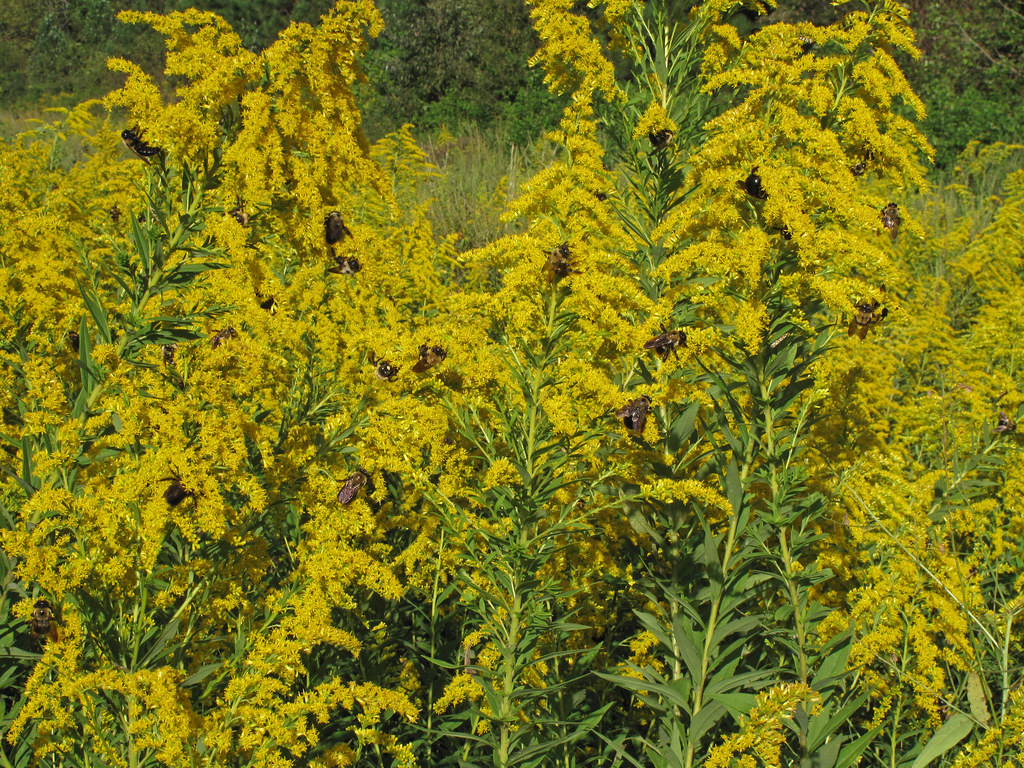
I receive a lot of flack from many of my Master Gardener friends because of my feeling towards Native Plants. The majority of them are just not pretty in my eyes. I know, they are beneficial and are adapted to growing here. There are a few, very few, that I like. The one I am going to discuss today is my signal that Fall is here. For many, that signal is Football, or maybe the leaves changing color, mine is when the Solidago altissima starts to bloom. The common name? Goldenrod or Tall Goldenrod.


Solidago altissima is the official wildflower of South Carolina. It became that on May 14th, 2003. Nancy Odom, State Wildflower Chairman for the Garden Club of South Carolina spearheaded this effort. Garden clubs throughout the state where asked about the idea of a state wildflower, to spark interest in native plantings. Queen Anne's lace was the big winner with the clubs, but it was determined that this plant was not native to South Carolina. Goldenrod had come in second, so by disqualification, it became the winner. This particular species of Solidago is actually native to much of North America. It grows profusely in fields, on roadsides, and along fence lines. Its bright yellow blooms appear in the Fall and attracts a large array of birds, insects, butterflies, and bees.


There are many species of Goldenrod, which grows throughout North America. Tall Goldenrod, is the largest of all the species. It grows upright to a height of 3 to 5 feet. Leaves grow in an alternating pattern all the way up the stem with larger leaves at the base of the stem and smaller leaves at the top. The lowest leaves usually dry up and fall off by the time the flowers appear in the Fall. The bloom is a shaped similar to a pyramid with a cluster of many tiny flowers. It can be 2 to 12 inches long. The flower petals are notched at the end. The flower cluster weighs so much that it makes the stem curve downward. Once Goldenrod becomes established, it can quickly spread over a large area.


Solidago has actually gotten a bad rap over the years. It is often blamed for allergies, hay-fever, and sneezing. This is not the case! The fact is, these problems are caused by ragweed, which looks similar and also blooms in the Fall. This is what the real culprit looks like:


It is a very small flower, but it produces huge amounts of very light weight pollen. Matter of fact, Goldenrod pollen is too heavy to be carried on the wind. I can not say it any better than a beekeeper in Hemingway, South Carolina explained it, "Goldenrod is NOT responsible for your allergies. The pollen is heavy and sticky, designed for insect pollination, not wind. The only way to get goldenrod pollen in your nasal passages is to stick the flower up your nose!"
And there it is.
Other than telling me it is almost Fall, there are many things that Solidago is good for or has been used for. The blooms provide food for bees, wasps, butterflies, and moths. Its long stems offer a nesting place for insects to lay their eggs. Birds and small field animals find homes and protection in masses of this pretty plant.
It even has some ancient uses.
The Native Americans that were indigenous to South Carolina called Goldenrod "Sun Medicine" because of its bright color. They would cook the leaves and flowers together and put the mixture directly on cuts and wounds to promote faster healing. They also made a tea from the leaves to ease stomach cramps. Because of its tradition as a healing plant, the scientific name for Goldenrod became Solidago which means "to make whole" in Latin.
Thomas Edison also had a liking to Goldenrod. He experimented with the plant to produce rubber, which it contains naturally. During WWI, the price of rubber rose from roughly 20 cents to more than two dollars a pound. It quickly became clear that depending on others for such an important commodity left the United States vulnerable – and we now needed more rubber than ever for the production of cars, trucks, and tanks. Henry Ford asked his good friend, Thomas Edison, to figure out how to make rubber domestically. After some years of experimenting, Edison found that the Goldenrod showed the greatest potential. Sadly, he died before he could bring his project into production, and soon afterward the government decided to invest in new German technology that made rubber synthetically from coal and petroleum products.
So as you can see, this native plant has had a great run so far. It has dabbled in medicine, history, and is a great friend to many different kinds of critters.
While I know I am going to get lots more flack for saying this, I think this is one of the few native plants that I can actually get to like.
Happy Growing!
Darren

Sunday, September 2, 2012

You Make The Call!

This article is going to anger a LOT of people, suffice it to say, that is okay.
I would like to start with a quote from that great philosopher "Popeye the Sailor Man",
He said, "That is all I can stands, cause me can't stands no more!"
I work very hard in my yard. There is more Blood, Sweat and Tears out there then I care to even imagine. I honestly do not mind sharing my harvest, but I have to have a harvest FIRST to share.
Take a look at these pictures:


Can you tell what this was at one time?
Probably not, because it was eaten to death! It was my Passion Vine. It actually had fruit on it at one time, until the deer got hold of it, that is a rant for another time.
The culprit?:


This is the larvae stage of the Agraulis vanillae, better known as the Gulf Fritillary Butterfly. The adult looks like this:


Pretty isn't it?
Let's set this one aside for the moment and focus on culprit number 2.
As you know, I am big into growing Citrus. Well, here is another enemy of mine:

Photo courtesy of Aggie Horticulture

This is the Orange Dog Caterpillar. A real nuisance to the Citrus Industry
They turn into these:


Again, pretty, right? These guys can do a number on Citrus trees. If you want to learn more about them, see one of my previous blogs here

Now, for our third and final culprit.
Meet, the Tobacco Hornworm:


This guy will put a Tomato plant down in no time flat, hurting your production.
I have previously written about these guys too, see it here
And its adult form:


I know, not as pretty as the previous culprits, but still interesting.
Why did I introduce you to these three thieving pests? Because that is exactly what they are, THIEVES!
All three of them will rob you of precious food. Now granted, Passion Fruit is not essential to life, nor is Citrus or Tomatoes for that matter. Then why do you grow them in your yard?
To eat, I would imagine. Homegrown is much better tasting, healthier and in the long run, cheaper.
Yet, I get chastised for wanting to rid my yard of the first two. The third one, Americans spend millions of dollars a year to get rid of these guys.
Why?
Because they devour our Tomato plants? What about the Gulf Fritillary, it devoured my Passion Vine, should I not get rid of it?
OH, I SEE....it's too pretty.
The same goes for the Orange Dog, it eats my Citrus tree, but I should not get rid of it because the butterfly is attractive.
The Tobacco Hornworm, ugly, go ahead and get rid of it.
Does this not seem WRONG to you?
Well, I have a solution....They are all going to go!
I honestly tried relocating them. I actually took a dozen of the Gulf Fritillaries to my friend, who works at a local Garden Center, for their Butterfly House. Literally two days later there was almost twice as many again. I kept hoping maybe the birds would get into the act and help.
Nope.
Maybe the Assassin Bugs would decide to wage war on them.
Again, nope.
So, I hoped and hoped, well now the plant is toast and I am fed up.
Next step in my war is Bacillus thuringiensis or Bt. This insecticide is most commonly used against some leaf and needle feeding caterpillars. It is a naturally occurring bacterial disease of insects and is considered safe to people and nontarget species, such as wildlife. It can be used on essentially all food crops.
If that doesn't work, Sevin dust or better known chemically as Carbaryl will be brought out. If YOU decide to go this route, make sure, as I do, to follow the label directions.
Mother Nature has not been playing fair this year. I try to work with her. I offer non-human food for the insects and other critters to eat and enjoy. I am even willing to share, as I stated at the beginning, but if she is not going to meet me halfway, then I am going to declare war. I work WAY to hard in my yard not to get paid in some fashion. This is not Darren's never ending buffet, I will get my rewards.
I hope this article rant makes you think a little before bashing my opinion. Do you want to have food on the table or do you want to be hungry watching the "pretty butterflies" go by?
You Make The Call!
Personally, I like a good Tomato Sandwich, a glass of Orange Juice for dinner and maybe a Passion Fruit Smoothie for desert.
Happy Growing!
Darren

Sunday, August 12, 2012

Doing the Citrus Split!

While folks out in the Midwest and other parts of the country are experiencing the worst drought in years, here in North Charleston, SC we are having LOTS of rain. Please do not get me wrong, I appreciate every drop we get and I hope and pray that the drought folks get some relieve SOON!
Unfortunately, it is causing a slightly different problem for me, Citrus Split.


This is a picture of one of the Republic of Texas Oranges that split and fell off.
Splitting is what is known as an Abiotic Disorder. That is a disorder that can not be attributed to any living organism, such as an insect or pathogen, but happens because of an environmental or cultural condition.
Splitting may start as early as July, with most occurring in late August and early September. It can be caused by a combination of factors including extreme fluctuations in temperature, humidity, soil moisture and fertilizer levels. I am pretty sure mine is happening because of extremes in my moisture level. Since the beginning of August, I have registered a little over 5 inches of rain in my yard. I usually try to keep a steady level, but it had been so hot just prior to this rain and I had gotten busy at work, so I was a little lax in my watering duties.


No variety of Citrus is immune to this, however, Navel Oranges are the worst, followed by Tangelos and other Oranges along with Mandarins. Grapefruit rarely split.
Usually the thinner skinned Citrus are more prone to this. Also, Citrus that have been sunburned or the skin has been damaged by some other means are very prone. I am not sure if you can tell from the pictures, but these particular fruit have major bird damage. The skin is all pecked and pitted.
This is the gist of what happens. If you allow the moisture level to drop too much, the tree starts to steal water from the fruit to survive. Splits occur when the excess water and sugars are transported from the roots of the tree to the ripening fruit, and the rind is unable to expand quickly enough to accommodate the added volume. It then bursts open under the pressure. The split usually starts at the blossom end of the fruit, which is the weakest point in the rind.
The split can be a shallow one or a deep one, exposing the juice vesicles, as seen here.


Fruit on young trees are more prone to fruit splitting than fruit on older trees, probably because there is more tree to absorb the excess water.
This situation is very disheartening, not only does it waste the fruit, it creates a good breeding ground for fruit flies and attracts other insect pests. The split fruit should be removed as soon as it is found and discarded as it may also harbor fungi or other bacteria.
The split fruit is edible, however most of the time it is not ripe enough to be usable.
I hope that you can learn something from my mistake this year. Had I been able to keep my moisture level at a more moderate level, I might not be losing as much fruit as I am. I am not at liberty to use a drip irrigation, I have way too many trees, all of which are in containers, but this could be an option for you.
There is a plus side to getting all this rain, my Banana is doing fantastic!


Happy Growing!
Darren

Sunday, August 5, 2012

Bad Mulch?

Mulch is one of those topics that everybody thinks it is a great thing. To a large extent that is true, however, there are bad things that can come from using Mulch that one should know about.
Let me start with the advantages of mulching your yard and plants.
Mulch conserves moisture and suppresses weeds. These two things alone one would consider a major bonus. With much of the country in a severe drought situation, conserving moisture would and should be the number one priority.
As for the suppression of weeds? I do actually know of a few people that enjoy pulling weeds. They tell me it is therapeutic. I sure do have a lot of therapy in my yard, but that is another story.
Soil temperature modification. It will keep your soil in a smaller range of temperatures without as many wild fluctuations.
Mulching can make a blah yard look a little more decorative and protect your plants from those evil lawnmowers and weedwhackers.


So you love the idea of the good things Mulch can do?
There are about as many different kinds of Mulch as there are personalities.
Let's touch on a few of the more common ones.
Pine Straw: Here in the Southeast and probably elsewhere, this is a biggie on the hit parade.


Some advantages to using Pine Straw are:
It doesn't float and wash away
Breaks down more slowly
It breathes better, doesn't compact as much as some, and allows for better water infiltration
It will also help your bird friends, because it is used frequently for bird nests and bird houses
I personally don't like it because it looks dull and faded very quickly. I also think it just looks messy, but that truly is just my opinion. I already know I will get letters saying things like, "you just need to see it applied correctly". I have, I still don't like it.

Tree Leaves: Tree leaves are Mother Nature's preferred mulch.


Leaves from trees such as Oak which have a thicker texture make a better mulch than the leaves of trees such as Maples which are thinner. The thin leaves can compact down together to form an impermeable layer. They will eventually break down, just as in the forest, but your plants may suffer. Again, not one I like, it looks as if you need to rake and the first good wind storm that comes through, your neighbors will just LOVE you.

Cedar Mulch: Cedar mulch is ground material derived from the wood and foliage of Cedar trees.


I actually like Cedar Mulch, it has two major advantages over other mulches. The oil in Cedar wood acts as a natural pest repellent, which, of course, also gives it that nice, evergreen smell that I adore. Of course, there are disadvantages. Being a hard wood mulch, cedar mulch, as well as the other hard woods, do break down over a long period of time. This decomposition can leach nitrogen from the soil and damage nitrogen-loving plants, which of course are pretty much ALL plants!
One other thing to consider about Cedar Mulch is, Cedar's positive qualities only remain active for as long as the mulch is relatively fresh. As the Cedar ages, the oil wears out, along with the scent and the pest-repelling quality.

There are, as I mentioned earlier, all kinds of mulches out there. Straw, Sawdust and Wood Shavings, Lava Rocks, Pebbles, Grass Clippings, the list seems almost endless. Each and every one of them has a list of Pro's and Con's, I just don't have the time or space to get into them all here.
There are two more mulches that I want to discuss however. They both are rather similar in appearance. They are made of two completely different materials, but I STRONGLY do not recommend using these when people ask.
They are Black Mulch and Rubber Mulch.


I will admit, the black looks really cool and it tends to set the color of the plants off, but there are many problems associated with them.
First off, I hear the recycling people now, "but Rubber Mulch is made from used tires, do you want them filling our landfills?"
There are other uses for them that will not effect my plants health and wallet.
Rubber mulches tend to be more expensive that traditional wood mulches; some cost even twice as much.
Rubber mulches have a very distinct odor that isn't pleasing to a lot of people. To be fair, it does disappear over time, how long depends on weather conditions.
Sometimes the steel wires are still contained inside the pieces. You need to wear heavy duty gloves to avoid being cut or stuck with possible protruding wires. I won't even get into the area of always needing to wear shoes around this stuff.
One other possible problem is, the chemicals that can leach from tires into your soil.
Rubber Mulch provide no nutrients to your soil, however, they also do not rob any either.
As for the dyed Black Mulch. The wood pieces are dyed using iron oxide or vegetable dyes. Just to be on the safe side, check the labels to see what they have been dyed with to make sure that it is safe for the type of plants you are using it around.
Another problem with Black Mulch is the issue of staining. Some dyes will come off during rain or snow, which will cause the dye to move from the mulch and into the ground. The mulch will appear ugly and dried out. During constant sun exposure, the black mulch will gradually fade to an unsightly gray.
One of the major things I point out to people when I am asked about Rubber or Black mulch is temperature. I stated earlier that mulches are used to moderate temperatures. If you use a black colored mulch, it absorbs sunlight and gets very hot. Think about walking outside onto a concrete path in the middle of the day barefoot. Hot, right? Now go walk out onto the asphalt street. Get my point?
The black colored mulch will have the same effect on the plants roots. It will become very hot underneath. This will cause the mulch to decay faster, the roots will actually use more water and the plant will generally not be happy. Let's say you use it up North. The middle of Winter, a nice sunny day, the ground would normally be frozen, but you have Black Mulch down. The soil is warming up, the plant thinks it's Spring and starts to grow. Then a blizzard hits and the plant gets killed because it broke dormancy due to the warm soil.
There are people that swear by this stuff, I say more power to them. This is just my two cents worth.
There are a few basics to keep in mind. Mulch should be 2 to 4 inches deep. Too deep and it will suffocate the roots. I know the "Fresh Look" is what people like, so they add layer on top of layer every year. If this is you, remember to remove the old mulch first.
Many mulches will float away in a heavy rainstorm, use some kind of edging if this is a problem.
Anyway, this article is not to persuade you not to use Mulch, it is a good thing to do. I just want you to think about your situation and use the correct material.
I will leave you with one last parting shot.
Beware of Volcanoes! In recent years, people have begun mounding mulch around the base of trees creating the 'Mulch Volcano'. Tree bark is meant to protect the trunk. It works best in the air and light. If you pile mulch onto the bark, it is now exposed to dark and moisture. Bark will begin to rot, and rotted bark cannot protect the tree from insects and diseases. In fact, diseases grow better in this type of environment. Keep the mulch at least a few inches away from the bottom of the tree.
Hopefully none of YOUR trees have this look about them:


Happy Growing!
Darren

Wednesday, July 11, 2012

One of my favorite Citrus trees.....

I was working a Master Gardener event this past weekend at Magnolia Gardens. I love being out there.
While a few of us were sitting in the booth waiting for clients, the discussion of Citrus came up. This is NOT unusual when I am around, see the name of this blog if you are wondering why.
Carolyn was telling me about her trees and how well the one that I gave her a couple of years ago was doing. She actually won it by answering a question at one of my lectures. Anyway, she was telling me that one of our mutual friends and fellow Master Gardeners, Ted, has been trying to talk her into buying and planting a Kumquat.
I COMPLETELY agreed with him.
Kumquats are a group of small fruit-bearing trees in the flowering plant family Rutaceae, and are in the the genus Fortunella. They are known as "The little gold gem of the citrus family".

NAGAMI KUMQUAT

The plant is native to South Asia and the Asia-Pacific region. The earliest historical reference to Kumquats appear in literature of China around 1178 A.D. They have long been cultivated in Japan, Taiwan, the Philippines, and Southeast Asia. They were introduced to Europe in 1846 by Robert Fortune, collector for the London Horticultural Society, and shortly thereafter into North America. Today they are grown mainly in California, Florida and Texas on a commercial basis, but show up in backyards as homeowners discover the many uses of this tangy little fruit.
The Kumquat is slow-growing, shrubby, and compact, attaining heights of 8 to 15 feet tall. Like the majority of its other relatives, it is evergreen.
They prefer full sun, which translates to 8-10 hours. Moist soil, not wet. I like to use the analogy of the soil moisture needing to be the consistency of a wrung out dish sponge.
Kumquats, again like all Citrus, are heavy Nitrogen feeders. I use an organic product put out by Espoma called Citrus-Tone. For in ground trees in my Zone 8, I apply about every six weeks starting around Valentine's Day and stopping about Labor Day. This gives the new growth time to harden off before the cold weather hits. If you are growing them in containers, I will have more on this in a minute, you can feed year round, especially if they are going to be protected or are in no danger of cold weather. If you can not find Citrus-Tone, Holly-Tone is an acceptable substitution. If you can't find that either, any of the water soluable fertilizers for Acid Loving plants are good too. I mentioned they are heavy Nitrogen feeders, if you want to give your tree an extra treat, spray Fish Emulsion as a foliar feeding every couple of weeks. Remember that this does have a fairly bad odor and if you are bringing your plant inside, you may want to skip this step or stop using it WELL before bringing it in.

NAGAMI KUMQUAT

It has been reported that the Kumquat can withstand temperatures of 10 to 15 degrees and frost without injury. It grows in the tea regions of China where the climate is too cold for other citrus fruits, even the Satsuma orange. I know I have seen them handle 18 degrees here in Charleston, SC without even blinking an eye.
This is completely a mute point if you can grow them in a container. Being that they attain heights of only 8-15 feet, they are very well adapted to being grown in a pot.
There are few things that you need to remember however. They still need the same amount of sunlight. With that many hours of sun, you will need to water much more frequently because the rootzone in a black container can easily reach 120 degrees, and that will dry it out much faster.
Any good potting mix will work. There are some labeled for Cactus and Citrus, I know, odd combination, but it does work. If I happen to be using one of the store bought soils I like to add a little bit more sand, more for weight and volume than any other purpose.
In container culture, you also need to be very aware of your plants fertilizer needs. I mentioned the Nitrogen. The Kumquat needs this is large amounts. I bet you can guess which nutrient leaches out of the soil the fastest? If you guessed Nitrogen, you would be correct! That is why I suggest feeding every 6 weeks or so.
Don't believe me that they can grow in a container? Check this out:


As you would imagine, there are different species of Kumquats and not really different cultivars.
The most common one is the 'Nagami', or Oval Kumquat (Fortunella margarita). I had a few pictures of these back towards the top of this article. This is the most often cultivated Kumquat in the United States and the one you usually see in the grocery store around Christmas. They are up to 1 and 3/4 inches long and 1 and 3/16 inches wide; the pulp is divided into 4 or 5 segments, containing 2 to 5 seeds. It is in season from October to January. A mature specimen at Oneco, Florida, in 1901, bore a crop of somewhere between 3,000 to 3,500 fruits.
The next most common one is the 'Meiwa', or Large Round Kumquat (Fortunella crassifolia). These are about 1 and 1/2 inches wide; the peel is orange-yellow and very thick. The sweet pulp is usually in 7 segments and are often seedless or with few seeds. This kumquat is the best for eating fresh.

MEIWA KUMQUAT

The 'Marumi', or Round Kumquat (Fortunella japonica) is much less seen. The fruit is about 1 and 1/2 inches wide. The peel is golden-yellow, smooth, with large oil glands. It is very aromatic and has a spicy pulp with 4 to 7 segments.

MARUMI KUMQUAT

When it comes to pests, in ground and container plants pretty much have the same pressures. Mealybugs, Aphids, Grasshoppers and Orange Dogs, just to name a few. Most of these can be handled with Insecticidal Soap or a light horticultural oil. The Orange Dogs can also have Bt used on them, they are caterpillars and if you have never seen one, take a look at this:


Yes, that really is a bug and not a bird that was taking aim.
Compared to other fruits like, Apples, Pears, Peaches, etc, Citrus are comparatively free of disease, but they have some doozies! I will not get into them here, you can check out my articles on one of the Citrus Diseases HERE and the Citrus Quaratines HERE .
Propagation of Kumquats can easily be done by planting the seeds from fresh fruit you obtain at the store. You will read some reports that they do not do well on their own roots, mine seem to do just fine and I have talked to others that say the same thing. I believe it is just how well you treat the tree as to how well it will grow.
First you will want to get the seed out of the fruit. If you are cutting the fruit, be careful not to cut the seed. Clean the seeds. Simple water and hand rubbing is all you will need. Kumquat seeds are polyembryonic, which means they have more than one embryo inside the seed. At least one of these will be identical to the mother tree! DO NOT DRY THE SEEDS! Sorry to yell, but drying out the seed can kill the seed embryo. Use moist potting soil in a small planting pot. Plant the seed about half again as long as the seed. Keep the pot covered in a warm spot. In 3-4 weeks they should germinate. After that you need to slowly get it use to more and more sunlight until it is getting the 8-10 hours. Within about 5-7 years you should start to get fruit, depending of course on how well you care for the tree.
You can also graft, but that is a topic for a whole other article.
While the most common use for the Kumquat fruit is to eat it whole, as is, peel and all, other popular uses for the fruit include adding pieces of it to fruit salads or to dessert recipes. Kumquats are also used to make jellies, jams and marmalades. I should mention here that I despise Marmalade, however, Kumquat Marmalade is amazing. Kumquats are also often pickled whole or preserved in syrups for future use. In recent years Kumquats have gained popularity as a garnish for cocktail beverages, including the martini, as a replacement for the more familiar olive. You might also even be able to purchase candied Kumquats at some ethnic grocery stores.
So as you can see, the Kumquat can be a very handy, decorative tree. It is easy to grow, produces a bountiful harvest and there are all kinds of things that can be done with the fruit. Why not make your next plant purchase a Kumquat tree?
If you are growing other Citrus, you could even possibly make a new hybrid. I only include this list as a parting shot because I get asked if they are at all related. Yes, these are TRUE plants out there and this will tell you who or what their parents were:

Limequat - key lime + kumquat
Orangequat - Satsuma mandarin + kumquat
Calamondin - tangerine + kumquat
Citrangequat - citrange + kumquat
Mandarinquat - mandarin + kumquat
Procimequat - limequat + kumquat
Sunquat - lemon + kumquat
Yuzuquat - yuzu + kumquat

Happy Growing!
Darren

Sunday, June 24, 2012

A Tangled Web........

Look, up in that tree.....is it a Spider? Is it a Fungus? No, It's a Tent Caterpillar!
Or is it?????
This time of year you may see web like tents in numerous trees. Most everybody has heard of the Tent Caterpillar (Malacosoma americanum). It has been reported to have been in the United States since the 1600's.
It looks like this:


This time of the year though, the Tent Caterpillar shares the tree tops with another web spinning caterpillar, the poorly named Fall Webworm (Hyphantria cunea). I say poorly named because it arrives in early Summer.
It looks like this:

Photo courtesy of University of Georgia.

The Fall Webworm is a native of North America, and feeds on many species of deciduous forest, shade, and fruit trees. It is one of the few American insect pests that has been introduced into Europe and Asia. Oops, sorry.
So how do you tell the difference? Look to see where the web or tent is.
If the webbing is in the crotches or forks of tree trunks and limbs, then it is the Eastern Tent Caterpillar.


Whereas the Fall Webworm prefers to just use the ends of branches.


Both of these insects can do a lot of damage to your tree by eating the leaves. An interesting tidbit of info though, and this is useful to remember when it comes time for controlling them, the Fall Webworm eats inside the protection of the web, they just keep expanding it. Eastern tent caterpillars typically feed during the day time and return to the nest at evening. They may remain in the nest during bad weather and eat later. The menu for both of these critters is a who's who of trees including, but not limited to...Birch, Crabapple, Ash, Blackgum, Willow and Ornamental Cherry trees, just to name a few.
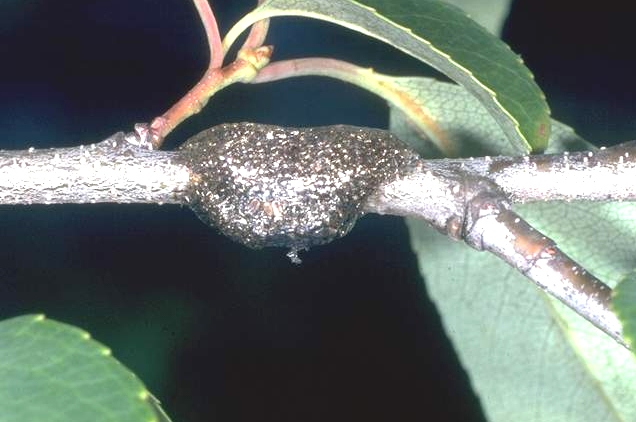
The Eastern Tent Caterpillar lays a mass of eggs that encircles the twigs of the host plant. The dark brown, oval mass contains between 150 - 350 eggs, and has a varnished appearance. This egg mass overwinters on those twigs.
One of the ways to control the Eastern Tent is by removing the egg mass before it hatches, just cut off the branch and destroy it. Once the leaves fall off it is much easier to see them, look for something resembling this:


In the Spring the larvae hatch. When they are fully grown, they leave the host tree and find a place to spin cocoons. They pupate inside the cocoons for about three weeks before transforming into reddish-brown moths.


The Fall Webworm has a slightly different life history. The pupae over Winter as cocoons in the ground. They may also be found under loose bark and in leaf litter or mulch.
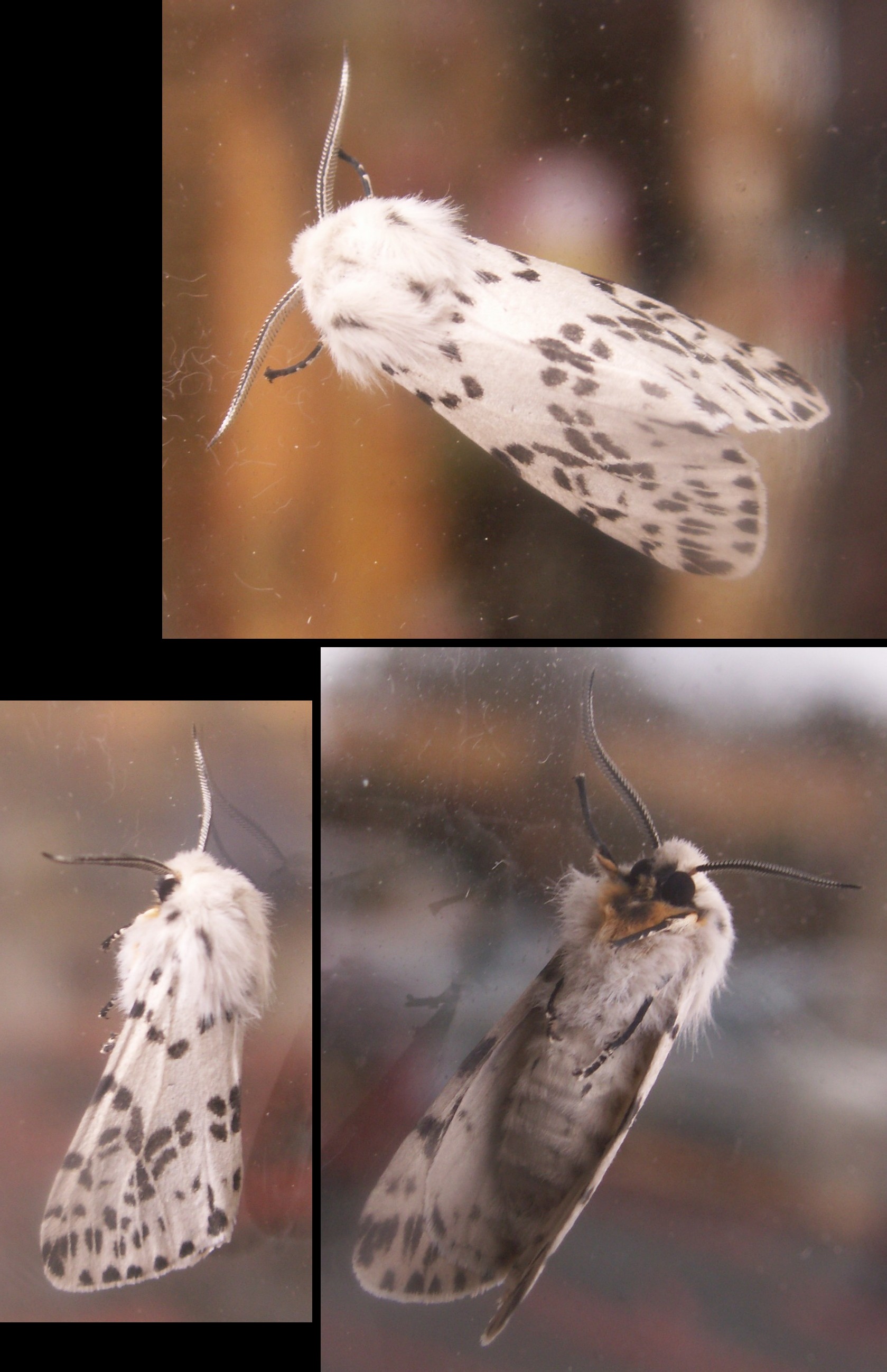
The Adult moth is also very different than the Tent Caterpillar.


Once the adults emerge they lay several hundred eggs that are deposited on the underside of leaves.


Here again controlling them can be as simple as cutting off the branch or leaf if you find an egg mass and destroy it.
Both of these insects have natural enemies, among them are birds, predatory stink bugs and toads. Some beneficial wasps will parasitize the eggs, larvae, and pupae.
If Mother Natures helpers are not doing a good enough job for you there is always Bacillus thuringiensis also known as Bt. It is a natural, organic product and works well to kill caterpillars if applied while the caterpillars are in the early stages of development and therefore small. Sprays are best applied in the early morning or late afternoon. Direct the sprays onto the foliage around the nests, as these leaves will likely be their next meal. Bt is the safest product to use and only kills caterpillars. It will not affect birds or beneficial insects that may be in the trees or feed on the caterpillars.
I know there are some people out there that really don't CARE which caterpillar is feasting on their prized ornamental Cherry tree, they just want them gone. I go back to an old military slogan, "To defeat your enemy, you need to KNOW your enemy". Having a name and where their eggs are and what the moths look like sounds like a good way to KNOW your enemy!
Happy Growing!
Darren

Sunday, June 10, 2012

You Put Your Leaf Foot In......

Every year there seems to be a different insect or other critter that comes into my yard and gives me headaches. Some years it is Aphids, (actually almost every year for this one), Mealies, Whitefly, Deer, Opossums, even Japanese Beetles only seem to raise their ugly heads occasionally. This time the culprit is higher in numbers than I have ever seen.....Do you recognize this insect?


If you guessed Leptoglossus phyllopus or Eastern Leaf Footed Bug, you would be correct!
Apparently many people are having a problem this year. Could it be because of the past mild Winter? Let's learn about this problematic pest.
Leaf footed bugs' common name comes from the hind legs that have a flattened, leaf-like expansion, you can see it in the above picture.
It is a very common insect in the Untied States, there are reported sightings as far north as Long Island, New York, and then they range south to Florida, west to Iowa and Kansas, and southwest through Texas to California.
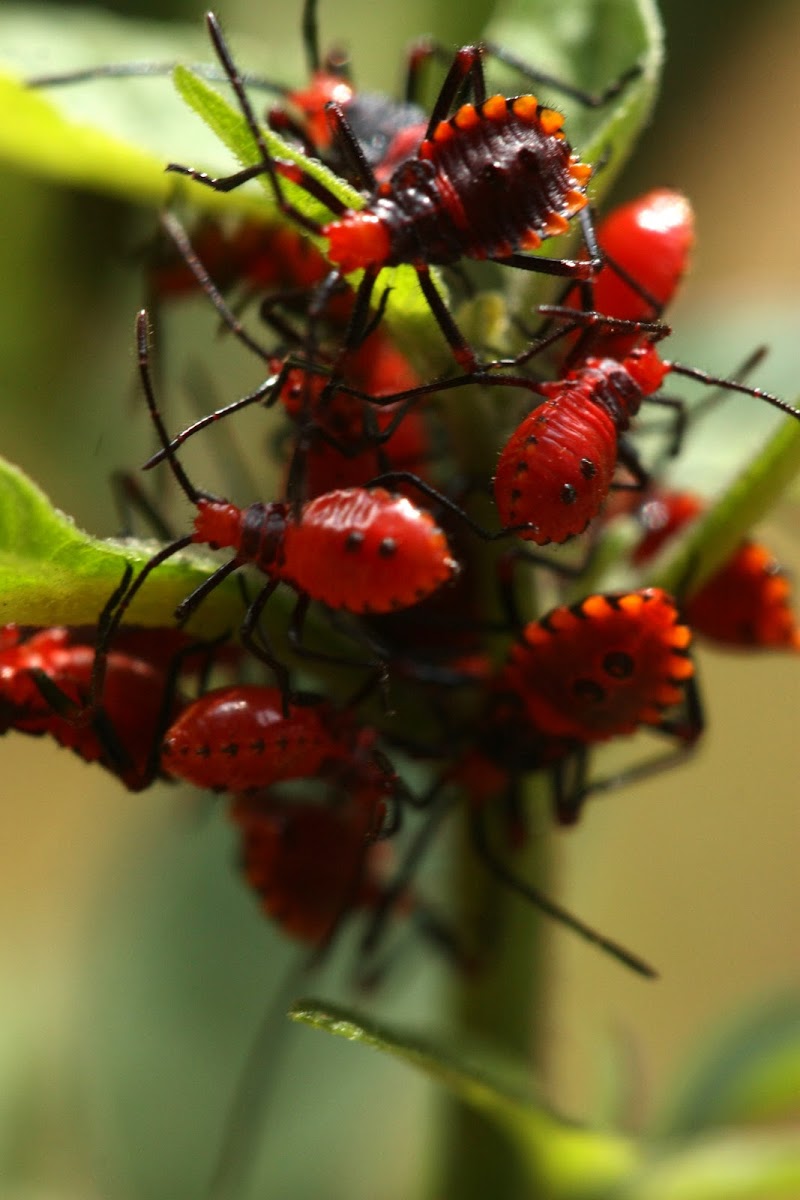
Adults are about 3/4 inch in length and are dark brown with a whitish to yellowish stripe across the central part of the back. The nymphs have much the same shape as adults, though they are usually a bright Orange and do not acquire the flattened leaf-like hind leg until they are almost full grown adults.

LEAF FOOTED NYMPHS

This pest has a wide range of plants that it likes to attack including: apple, bean, bell pepper, blueberry, blackberry, citrus, cowpea, cucurbits, eggplant, lychee, loquat, okra, peach, pear, persimmon, plum, pomegranate, potato, tomato, and sunflower....just to name a few.
Leaf footed bugs have piercing-sucking mouthparts. They stick the piercing part into their food material, use their saliva to dissolve the contents and then suck up the digesting mixture. Then as the puncture heals, the feeding site becomes hard and darkens. Damage early in development of the fruit or vegetable can lead to it falling off or at the very least cause severe deformities.
The Leaf Footed Bug can be controlled!!
With application of insecticides, cultural practices, a little help from Mother Nature and by hand picking.
The last one is obvious, pick the little buggers off by hand and either drown them in a bucket of soapy water or squash them.
Cultural controls include, keeping the weeds down in adjacent fields and replacing the mulch around your yard every year. They like to over Winter there.
Mother Nature might give you a helping hand, there are some species of birds that will eat Leaf Footed bugs. There are also some Parasitic wasps that attack the eggs and parasitic flies that attack the nymphs and adults. Some other helpers include: big-eyed bugs (Geocoris spp.), damsel bugs (Nabis spp.) and spiders.
I saved the Chemical control for last because hopefully that would be your last resort. If the threshold of damage to your crop has been reached then it is time to reach for the bottle. The insecticides used most often to control these bugs include the pyrethroid insecticides, carbaryl and endosulfan. Look for these ingredients on the label. Then make sure that what you want to use it on is also listed, i.e. Tomatoes, Citrus, Sunflowers, etc. The label is the law!!
A few side notes to keep in mind when confronting Leaf Footed bugs. They are very skiddish. The adults will fly away when disturbed, but will quickly return when the disturbance is gone. The nymphs will try to run away and hide on the other side of the plant.
You may also notice that the really like to hang out together.


One of the odd things about this behavior is, you may see a herd of them like above on one plant and yet a plant right next door will have none.
When you will see these is variable. Adults have been taken during all months of the year in the deep South, but populations are highest during the warmer months.
I should also warn you of one other thing and sadly, I fell for this. The nymphs of Leaf Footed Bugs look VERY much like our friends the Assassin Bugs.

ASSASSIN BUG

The abdomen of the Leaf Footed bug tends to be a little wider.
One other good way to tell is, if you see a bunch of them clustered together or if they are hanging out with adults, then they’re Leaf Footed bugs. This is NOT always the case but it might give you a better idea.
Happy Growing!
Darren