Everybody knows what the leaf of a plant is. They are the parts that contain chlorophyll which converts carbon dioxide and water to simple glucose sugars in the presence of sunlight. Simple, right?
Now, I have talked to some folks, and we have debated the question, are the leaves the heart of the plant? Some think it is the roots, others think it is the stems, others say the sum of all the parts are the heart. I am not going to go into that here, though someday it might make for an interesting poll question.
No, today, I want to talk about "what the leaves are telling us". If there is some kind of issue going on with the plant, be it insect, disease, or some other pressure and you know what to look for, then you can take appropriate actions.
Let's start with one, very briefly, that I have discussed before.....Citrus Leaf Minor. I get folks calling me in a panic because they think that they have some terrible Citrus disease because their leaves are all curly and have weird squiggles in them. Very often they look like this:
or this:
Thankfully, it is just cosmetic damage, a plant this size will be fine. You can read my article on this particular pest HERE
Another cosmetic damage producing insect is from the Megachile spp. family, better known as the Leafcutter Bee.
If you have ever grown a Red Bud Tree (Cercis canadensis), then you know what the leaf looks like:
But, have you ever seen a leaf that looks like this?
This is caused by the Leafcutter Bee. They don't actually eat the cut pieces of leaves that they
remove. The female uses them to line her nest. Leafcutting bees construct these nests in soil, in holes in wood, or in plant stems. Actually any small hole will work
such as shells of dead snails, holes in concrete walls (like those
produced for hurricane shutters) and other holes in man-made objects are
used as nesting sites. I actually found a nest one time in the drainage hole of one of my potted plants.
Leafcutting bees are found throughout the world and are common in North America. In Florida alone,
there are approximately 63 different species!!
Most of the common Leafcutter Bees are approximately the
size of the common honeybee, although they are somewhat darker with
light bands on the abdomen.They are solitary creatures and are not aggressive. They sting only when handled. If you do happen to get stung, the sting is very mild, much less painful than that of honeybees or
yellowjacket wasps.There is no need to try and control them, they are actually our friends, other than the cosmetic damage they create, they are important pollinators of wildflowers, fruits, vegetables and other crops. So if you see some damage like this, just know that you are helping a mommy bee rear some new young that will eventually help you produce something to eat.
Well then, we have discussed two different kinds of insect pests, now lets discuss a fungal problem.
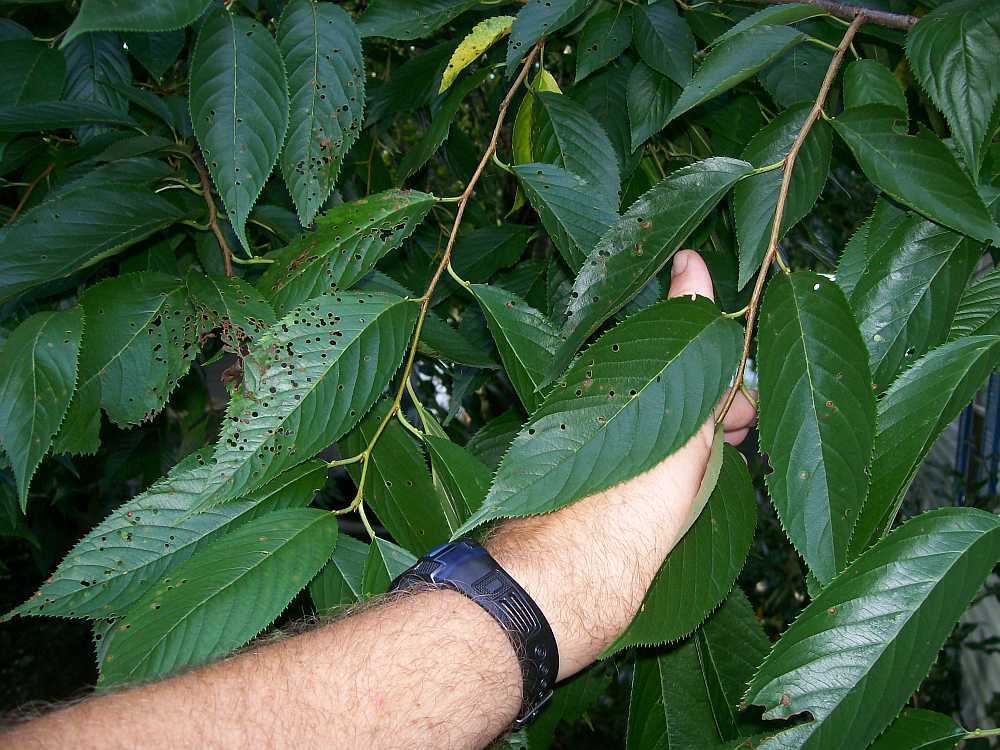
I am sure this probably affects other trees, but the main ones are Cherry (sweet, sour and ornamental), Plum, Peach, Apricot and all other stone fruits. The problem? It looks like somebody has been practicing with a shotgun:
No, your next door neighbor's child has not been out with their BB gun either. This is caused by the fungus Blumeriella jaapii, also known as Cherry leaf spot, or shot hole disease. Initial symptoms appear as reddish to purple spots on the leaves. After several days, the spots turn brown and drop out of the leaf, thus, forming a "shot hole". Infected leaves eventually turn yellow and fall from the tree. Shot hole fungus commonly overwinters inside the infected buds, as well
as twig lesions, where the spores may thrive for several months. Infections can occur anytime between Fall and Spring, but is usually
most severe following wet Winters. Prolonged Spring rains can also
encourage this disease, as spores are spread from the splashing rain.
This disease is difficult to control, and chemical sprays are not practical for the home gardener.
These are just a few things that leaves can tell us. It may not always be as obvious as the examples above. Sometimes it might just be a small variation in color or the leaf might be a different size then it should be. The best habit I can suggest to you is, inspect your plants on a regular basis, that way when something odd starts to occur, you will be on top of it.
If you find something odd on your leaves, please don't hesitate to ask me what it might be. You can send
your questions and pictures to TheCitrusGuy@netzero.com. If at all possible, pictures are the best thing you can send me to help identify the issue.
There is one other thing that you can try. If there is a problem discovered, you can look at the plant and scream...."Leave the Leaves Alone"!!!
Happy Growing!
Darren
Saturday, July 6, 2013
Sunday, June 23, 2013
Respecting the Elders
With my job at the nursery, I get to drive around a lot. I get to meet all sorts of different people and see different plants. I have noticed this year, with the abundant amounts of rain that have been falling, that many plants are doing very, very well, except the Gardenias that I have seen, that is a story for another day.
One of the things that seem to be doing exceptionally well are the Elderberries (Sambucus spp.).
If you are not familiar with this plant, you have probably driven by some without even knowing it. Have you seen anything like this along your travels?
These North American natives are often found growing wild along roadsides, forest edges, and abandoned fields. Elderberries are so common, people have considered them a "ditch weed".
They are attractive and easy to grow. They are at home in a Country Garden style landscape or a formal one. Not only does the plant look nice, the flowers and fruit are edible.
Elderberries grow best in a moist, fertile, well-drained soil with a pH between 5.5 and 6.5, but will tolerate a wide range of soils. It's a myth that they prefer swampy areas. In fact, they do not tolerate poor drainage.
In the wild they can range in height from about six feet to sixteen feet. The ones I have in my containers are still fairly young, 3-4 years old. They have never gotten above 5 feet before the cold knocks them back.
They grow well in full to partial sun locations and respond well to fertilization. The need for fertilizers can be judged by looking at the plant. If the bush is very vigorous, producing a lot of new growth, no fertilizer is needed. If few new canes are produced and growth appears poor, you may need to feed it. They grow best when fertilized annually with compost.
Elderberries have very shallow roots, so weeds can be a problem. Use mulch for weed control and weed them by hand the first year or two. They will eventually form a dense enough shrub that will choke out the weeds themselves.
When it comes to the pruning of elderberries it is generally very simple. Weak, dead or broken canes should be pruned out, leaving six to eight vigorous canes to a plant. In late Winter, prune out branches more than 3 years old since these are less productive. Flowers and fruit develop on the tips of the current season's growth, often on the new canes but especially on laterals. Second-year elderberry canes with good lateral development are the most fruitful.
Speaking of fruit, just take a look at this:
Isn't that beautiful?
They are used for wines, pies, jams and many other tasty treats. I have heard of folks using Elderberries in place of blueberries in recipes and it was fantastic. These things raw are not very edible, though there are folks that like them that way, there are also people that like Justin Beiber, so there is no accounting for taste. I have read that drying them makes them a little more palatable too, so it might be worth a try.
If you are hungry and just don't want to wait until the fruit ripens in late Summer, eat the flowers.
The white flower clusters make delicious fritters
Basically you dip them in batter and deep fry. There are all kinds of recipes online, search them out and give it a try.
These plants are really pest free, there are very few things that bother it.
You can propagate new plants from softwood cuttings in the Spring, semi-hardwood in the Summer or from Winter hardwood. Elderberry plants can spread by rhizomes, you can also use layering, or dig up the suckers. There are numerous cultivars available at some nurseries, you will probably need to search out a Native Plant nursery to find them. A few to look for would be 'York' and 'Nova'. It is recommended that you have two different varieties for better fruit production. My feeling is, they are all over the place, if you don't have room in your yard for more than one, there is probably some just down the road from you.
I have met people that just do not like the taste of Elderberries, no matter what you do to them. If you just like the looks of the plant and the flowers and such, no problem, the birds will eagerly accept the fruit.
As a final thought, if you want to really make a statement, look for the cultivar 'Black Lace'. It is a black leaf plant that has light pinkish flowers and looks like this:
Happy Growing!
Darren
One of the things that seem to be doing exceptionally well are the Elderberries (Sambucus spp.).
If you are not familiar with this plant, you have probably driven by some without even knowing it. Have you seen anything like this along your travels?
These North American natives are often found growing wild along roadsides, forest edges, and abandoned fields. Elderberries are so common, people have considered them a "ditch weed".
They are attractive and easy to grow. They are at home in a Country Garden style landscape or a formal one. Not only does the plant look nice, the flowers and fruit are edible.
Elderberries grow best in a moist, fertile, well-drained soil with a pH between 5.5 and 6.5, but will tolerate a wide range of soils. It's a myth that they prefer swampy areas. In fact, they do not tolerate poor drainage.
In the wild they can range in height from about six feet to sixteen feet. The ones I have in my containers are still fairly young, 3-4 years old. They have never gotten above 5 feet before the cold knocks them back.
They grow well in full to partial sun locations and respond well to fertilization. The need for fertilizers can be judged by looking at the plant. If the bush is very vigorous, producing a lot of new growth, no fertilizer is needed. If few new canes are produced and growth appears poor, you may need to feed it. They grow best when fertilized annually with compost.
Elderberries have very shallow roots, so weeds can be a problem. Use mulch for weed control and weed them by hand the first year or two. They will eventually form a dense enough shrub that will choke out the weeds themselves.
When it comes to the pruning of elderberries it is generally very simple. Weak, dead or broken canes should be pruned out, leaving six to eight vigorous canes to a plant. In late Winter, prune out branches more than 3 years old since these are less productive. Flowers and fruit develop on the tips of the current season's growth, often on the new canes but especially on laterals. Second-year elderberry canes with good lateral development are the most fruitful.
Speaking of fruit, just take a look at this:
Isn't that beautiful?
They are used for wines, pies, jams and many other tasty treats. I have heard of folks using Elderberries in place of blueberries in recipes and it was fantastic. These things raw are not very edible, though there are folks that like them that way, there are also people that like Justin Beiber, so there is no accounting for taste. I have read that drying them makes them a little more palatable too, so it might be worth a try.
If you are hungry and just don't want to wait until the fruit ripens in late Summer, eat the flowers.
The white flower clusters make delicious fritters
Basically you dip them in batter and deep fry. There are all kinds of recipes online, search them out and give it a try.
These plants are really pest free, there are very few things that bother it.
You can propagate new plants from softwood cuttings in the Spring, semi-hardwood in the Summer or from Winter hardwood. Elderberry plants can spread by rhizomes, you can also use layering, or dig up the suckers. There are numerous cultivars available at some nurseries, you will probably need to search out a Native Plant nursery to find them. A few to look for would be 'York' and 'Nova'. It is recommended that you have two different varieties for better fruit production. My feeling is, they are all over the place, if you don't have room in your yard for more than one, there is probably some just down the road from you.
I have met people that just do not like the taste of Elderberries, no matter what you do to them. If you just like the looks of the plant and the flowers and such, no problem, the birds will eagerly accept the fruit.
As a final thought, if you want to really make a statement, look for the cultivar 'Black Lace'. It is a black leaf plant that has light pinkish flowers and looks like this:
Happy Growing!
Darren
Sunday, May 26, 2013
The Confederates
Being a Yankee by birth (New Jersey) and living in the South, I tend to get teased a lot. It is nothing serious, I know it is in fun (I hope), and I usually throw it right back. I currently live in Charleston, SC the birthplace, for all intents and purposes, of the Civil War. That war began with the firing on Fort Sumter, April 12, 1861.
South Carolina was one of the Confederate States of America which consisted of the governments of 11 Southern states that seceded from the Union in 1860-61. So it is fitting that I use this background to introduce today's topic. The Confederates.
There are some plants that use Confederate in their common name, which can actually get confusing, and I will discuss this in a moment.
The first Confederate I want to discuss is Confederate Jasmine (Trachelospermum jasminoides).
Contrary to its name, Confederate Jasmine is not native to the Southeast, nor is it a true jasmine. It is actually native to China. When supported, this twisting, twining vine can reach up to 20 feet or more. Without support and with some tip-pinching and pruning, it can be a spreading shrub or groundcover.
It is a fast-growing vine that can be grown on lamp posts, trellises, or arbors. It will easily twine through chain link fences and makes a great, evergreen screen.
In early Spring and Summer, Confederate Jasmine produces clusters of small, white, VERY fragrant flowers that look like tiny pinwheels. This plant prefers full sun to partial shade. It likes a moist but well-drained soil, however it is drought resistant. It is relatively problem-free, though rabbits have been known to graze on it. It is primarily grown in USDA Zones 8 - 10. There are a few cultivars that are hardy to Zone 7. Propagation is done by cuttings as they root easily when taken in the Spring. This is probably the South's favorite flowering vine. I highly recommended Confederate Jasmine to new gardeners. It is easy to grow and satisfies with quick growth and a fabulous floral display. Who wouldn't want to come home to this?
The next Confederate I would like to discuss is the start of the confusing ones. Confederate Rose.
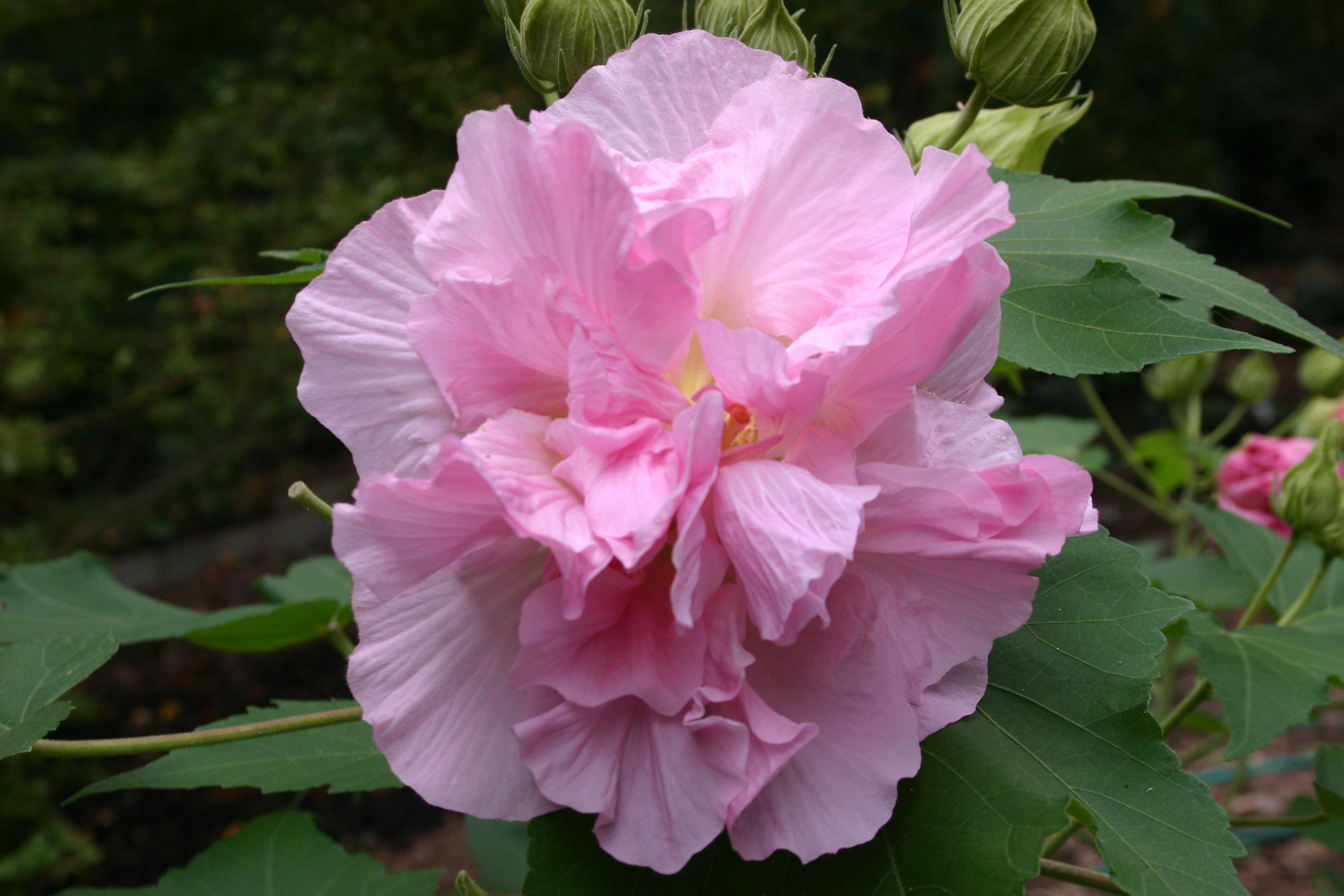
Botanically this is Hibiscus mutabilis. As with the Confederate Jasmine this is neither a confederate, it too is originally from China, nor is it a rose, it is in the Hibiscus family.
One of the most interesting things about this flowering shrub are the flowers themselves. Three distinct colors appear on the bush simultaneously as the blooms color cycle independent of one another. They open white or pink, and change to deep red by evening.
This can be a large shrub or small multi-stemmed tree that grows to 15 ft high with about a 10 ft spread. USDA Zones 7-9
This plant likes full sun to partial shade. It thrives on regular watering but is very drought tolerant. It is propagated very easily by cuttings.
This is a great plant to add to your landscape as little to no care is required. This shrub truly takes care of itself and is adaptable to most locations and soil conditions. One last tidbit about the Confederate Rose. You can learn a lot by the plants botanical name, (mutabilis), it is mutable, it's flowers changing color with age.
The last plant I would like to discuss is the Confederate Rose.
I know, I did that one already. This is the Confederate Rose Agave. See how common names can screw you up?
There is some confusion as to the exact botanical name, it is believed to be a hybrid, possibly a cross of Agave parrasana and Agave Parryii.
Either way, it is a very nice plant. It is considered a medium sized Agave which grows in clustering rosettes up to 1 foot across and 1-2 feet high. It has deep blue/gray short, stubby leaves, with sharp reddish teeth on each leaf. USDA Zones 8-11
As with all succulents this thing is VERY drought tolerant. However, many people do not realize that this plant is so tough that it is highly frost tolerant, it can handle down to below 20 degrees and withstand the blazing hot summer sun. Propagation is usually done by the pups that it sends out.
So there you have it, The Confederates.
Not a story of division between the states nor a story of war. Just some very good, relatively problem free, plants for a Southern Landscape.
I hope you enjoyed this article, for now, this Yankee is off to feed some Southern mosquitoes, rumor has it that they think Yankees are delicious.
Happy Growing!
Darren
South Carolina was one of the Confederate States of America which consisted of the governments of 11 Southern states that seceded from the Union in 1860-61. So it is fitting that I use this background to introduce today's topic. The Confederates.
There are some plants that use Confederate in their common name, which can actually get confusing, and I will discuss this in a moment.
The first Confederate I want to discuss is Confederate Jasmine (Trachelospermum jasminoides).
Contrary to its name, Confederate Jasmine is not native to the Southeast, nor is it a true jasmine. It is actually native to China. When supported, this twisting, twining vine can reach up to 20 feet or more. Without support and with some tip-pinching and pruning, it can be a spreading shrub or groundcover.
It is a fast-growing vine that can be grown on lamp posts, trellises, or arbors. It will easily twine through chain link fences and makes a great, evergreen screen.
In early Spring and Summer, Confederate Jasmine produces clusters of small, white, VERY fragrant flowers that look like tiny pinwheels. This plant prefers full sun to partial shade. It likes a moist but well-drained soil, however it is drought resistant. It is relatively problem-free, though rabbits have been known to graze on it. It is primarily grown in USDA Zones 8 - 10. There are a few cultivars that are hardy to Zone 7. Propagation is done by cuttings as they root easily when taken in the Spring. This is probably the South's favorite flowering vine. I highly recommended Confederate Jasmine to new gardeners. It is easy to grow and satisfies with quick growth and a fabulous floral display. Who wouldn't want to come home to this?
The next Confederate I would like to discuss is the start of the confusing ones. Confederate Rose.
Botanically this is Hibiscus mutabilis. As with the Confederate Jasmine this is neither a confederate, it too is originally from China, nor is it a rose, it is in the Hibiscus family.
One of the most interesting things about this flowering shrub are the flowers themselves. Three distinct colors appear on the bush simultaneously as the blooms color cycle independent of one another. They open white or pink, and change to deep red by evening.
This can be a large shrub or small multi-stemmed tree that grows to 15 ft high with about a 10 ft spread. USDA Zones 7-9
This plant likes full sun to partial shade. It thrives on regular watering but is very drought tolerant. It is propagated very easily by cuttings.
This is a great plant to add to your landscape as little to no care is required. This shrub truly takes care of itself and is adaptable to most locations and soil conditions. One last tidbit about the Confederate Rose. You can learn a lot by the plants botanical name, (mutabilis), it is mutable, it's flowers changing color with age.
The last plant I would like to discuss is the Confederate Rose.
I know, I did that one already. This is the Confederate Rose Agave. See how common names can screw you up?
There is some confusion as to the exact botanical name, it is believed to be a hybrid, possibly a cross of Agave parrasana and Agave Parryii.
Either way, it is a very nice plant. It is considered a medium sized Agave which grows in clustering rosettes up to 1 foot across and 1-2 feet high. It has deep blue/gray short, stubby leaves, with sharp reddish teeth on each leaf. USDA Zones 8-11
As with all succulents this thing is VERY drought tolerant. However, many people do not realize that this plant is so tough that it is highly frost tolerant, it can handle down to below 20 degrees and withstand the blazing hot summer sun. Propagation is usually done by the pups that it sends out.
So there you have it, The Confederates.
Not a story of division between the states nor a story of war. Just some very good, relatively problem free, plants for a Southern Landscape.
I hope you enjoyed this article, for now, this Yankee is off to feed some Southern mosquitoes, rumor has it that they think Yankees are delicious.
Happy Growing!
Darren
Saturday, May 11, 2013
Mothers Day
Twas the night before Mothers Day 2013. As I ponder what my mother went through as I was growing up, it still amazes me. I always wish I could come up with the perfect gift to say Thank You for all you did for me, and STILL do!!
There is no amount of money in the world that could ever repay you. So, as I sit here thinking, I remember the blog that I wrote two years ago.
To my dearest Mother, these words still ring as true today as they did two years ago.
FROM THE CITRUS GUY, 2011
A little change of pace. Today is Mothers Day in the United States, I don't know if any other country observes this, if they don't, they should. Everybody out there will tell you that Mothers are "superwomen" or that their Mother is the best. Well, let me tell you, if you REALLY want a Super Mom, mine wins hands down!
Most people that know me don't know that my Father passed away when I was in 2nd grade, making me all of 7 or 8 years old. At the time, I had only 1 younger brother and 1 younger sister...My littlest brother came from another marriage. So, at the ripe old age of 27, my Mother was now alone with three very young children...ages 8-5-3.
To this day, I have NO IDEA how she managed to raise us. Yes, her parents helped some, we saw my grandparents on the weekends, but that was about all. We lived in an old farmhouse, when I say old, it was 100+ years old then. This was up in New Jersey. The house was basically in the woods, we had a few neighbors across the street, but they were much older. There were no kids around to play with, other than each other.
Thinking back, we always had food on the table. Christmas and Birthdays were amazing. Every year just before school started we went shopping for new clothes, remember this was LONG before Wal-Mart came on the scene, we went to Sears, that was the only place that had clothes to fit my skinny brother and my fat bleep.
This was also back when they had classroom Mothers. These Mothers would come in and assist with classroom birthday parties, arts and crafts, and who knows what else behind the scenes. My Mother was at every function I can think of!
Abraham Lincoln once said: “All that I am, or hope to be, I owe to my angel mother”. No truer words have ever been spoken. My mother taught us about friendship, safety, kindness, nature and gardening....now you know where I got THAT part of my life from. She also taught us about laughter. I mentioned above some of the things she taught me, let me demonstrate:
My sense of clothes:
Safety, it was dangerous to ride wild animals:
And of course, cleanliness:
I mentioned laughter, I got her sense of humor too, warped!
But seriously, there is a part of Mothers Day that I hate. Every jewelry store, department store, and any other store you can think of, tell you to buy your Mother this, that or the other thing to show her how much you love her. I would love to if I could afford it, I would buy her everything under the sun, but it wouldn't mean anything. Abraham Lincoln also said one other great thing: “No gift to your mother can ever equal her gift to you - life”.
Mother because of you, I am what I am...I had an absolute wonderful childhood, and I would not change it for anything......There is also no way in the world I can ever Thank You enough!!!
I LOVE YOU!!
Darren
p.s. She will kill me for this picture, but I had to end today with my two favorite flowers:
Wife on the left, Mother on the right.
I know this is a repeat, but I could never write anything ever again that tells the world exactly how I feel. Happy Mothers Day....Mom!
There is no amount of money in the world that could ever repay you. So, as I sit here thinking, I remember the blog that I wrote two years ago.
To my dearest Mother, these words still ring as true today as they did two years ago.
FROM THE CITRUS GUY, 2011
A little change of pace. Today is Mothers Day in the United States, I don't know if any other country observes this, if they don't, they should. Everybody out there will tell you that Mothers are "superwomen" or that their Mother is the best. Well, let me tell you, if you REALLY want a Super Mom, mine wins hands down!
Most people that know me don't know that my Father passed away when I was in 2nd grade, making me all of 7 or 8 years old. At the time, I had only 1 younger brother and 1 younger sister...My littlest brother came from another marriage. So, at the ripe old age of 27, my Mother was now alone with three very young children...ages 8-5-3.
To this day, I have NO IDEA how she managed to raise us. Yes, her parents helped some, we saw my grandparents on the weekends, but that was about all. We lived in an old farmhouse, when I say old, it was 100+ years old then. This was up in New Jersey. The house was basically in the woods, we had a few neighbors across the street, but they were much older. There were no kids around to play with, other than each other.
Thinking back, we always had food on the table. Christmas and Birthdays were amazing. Every year just before school started we went shopping for new clothes, remember this was LONG before Wal-Mart came on the scene, we went to Sears, that was the only place that had clothes to fit my skinny brother and my fat bleep.
This was also back when they had classroom Mothers. These Mothers would come in and assist with classroom birthday parties, arts and crafts, and who knows what else behind the scenes. My Mother was at every function I can think of!
Abraham Lincoln once said: “All that I am, or hope to be, I owe to my angel mother”. No truer words have ever been spoken. My mother taught us about friendship, safety, kindness, nature and gardening....now you know where I got THAT part of my life from. She also taught us about laughter. I mentioned above some of the things she taught me, let me demonstrate:
My sense of clothes:
Safety, it was dangerous to ride wild animals:
And of course, cleanliness:
I mentioned laughter, I got her sense of humor too, warped!
But seriously, there is a part of Mothers Day that I hate. Every jewelry store, department store, and any other store you can think of, tell you to buy your Mother this, that or the other thing to show her how much you love her. I would love to if I could afford it, I would buy her everything under the sun, but it wouldn't mean anything. Abraham Lincoln also said one other great thing: “No gift to your mother can ever equal her gift to you - life”.
Mother because of you, I am what I am...I had an absolute wonderful childhood, and I would not change it for anything......There is also no way in the world I can ever Thank You enough!!!
I LOVE YOU!!
Darren
p.s. She will kill me for this picture, but I had to end today with my two favorite flowers:
Wife on the left, Mother on the right.
I know this is a repeat, but I could never write anything ever again that tells the world exactly how I feel. Happy Mothers Day....Mom!
Sunday, May 5, 2013
Roll Out The Barrel
Since the start of my fruit group, the Lowcountry Fruit Growers Society (check us out HERE ) back in November. I have been doing a lot of lectures on growing different kinds of fruit for garden clubs. I have so much in store for this group that it almost scares me!
Anyway, I was doing one of my talks a couple of weeks ago and the topic of Strawberries came up. Let me pause here to remind my followers and let some of the new folks in on a piece of information, the majority of the plants I grow are in containers of some kind, this includes all my Citrus, Figs and other fruits. My Strawberries are no exception. They are grown in a plastic barrel. It looks like this:
This was my first attempt at one, it has problems that we will discuss in a minute. Anyway, this was a lecture where I did not have the luxury of using a powerpoint presentation, so there were no pictures. I explained my barrels to the audience. There was one woman that was having problems understanding what I was talking about and how to go about doing one. Hence, the topic for today's article.
There are numerous places that I know of to get these. The one above was from a wholesale florist that I once worked at. The floralife liquid that we used to keep the flowers fresh came in it. That might be a good place to start if you have one close to you. Another starting point might be a local carwash. The soap comes in large barrels. My other barrel, the blue one below, came from a large landscaping company that used large amounts of liquid iron. I am sure there are other places to get them, just use your imagination. You will want to steer clear of ones that have contained harsh chemicals. The plastic will absorb them and could transfer it to your soil. My cost for each of these barrels? Zero
I mentioned that the one above has problems. Let's discuss them.
First, the holes are just a tad too big. I was actually doing it freehand with a jigsaw. I DO NOT recommend trying this at home. The soil tends to run out of the holes and sometimes the plants start to fall out. The best thing to use is a 2" drill bit, designed to cut nice round holes.
The next problem is, they are spread too far apart. There is a LOT of wasted space there. Now, what should the ideal spacing be? That will probably depend more on the look you want. If you want the plants to completely cover the barrel, maybe 2" apart.
This is what my new and improved barrel looks like:
I only had a few plants to put in, it is still a work in progress.
This is a little closer view of the holes. As you can see by the ripe fruit, it works pretty well.
I enjoy writing this blog so people can learn from my trials and mistakes. I wish I had more plants to put in when I was making it, but they are easy enough to put in, even after some die off or whatever happens.
I will walk you through the steps and show you how easy this all is.
I will assume you have your barrel and know what kind of look you want.
The first thing to do is cut off the top. This is where you can use the jigsaw. Create a hole with a 1/2" drill bit then jigsaw the top off. You will also want to drill a few small holes in the bottom for drainage.
Next, start drilling your side holes. Start at the bottom, go all the way around however far apart you want.
The next row up, stagger the holes in between the ones from the first row. Continue all the way to the top in this fashion.
So far, so good?
Now, the fun part. Learn from my mistakes. Count your holes and get that many plants, plus four or five more. You will also need LOTS of potting soil, compost or whatever other soil amendments you prefer. Just make sure that it drains very well, yet retains some moisture.
Starting at the bottom, fill the soil up to the first row of holes. Place the roots of the plants through each hole, make sure you don't bury the crown of the plant too deep, then fill with soil up to the next row. Repeat this process all the way to the top. Then use those four or five extra ones to plant into the top.
Pretty easy, right?
Depending on what part of the country you live in and when you want your Strawberries to be ripe will determine what variety to get.
Just to give you a little bit of an idea of what is out there, I will discuss a few here.
The main type of Strawberry suited for me here in my South Carolina garden is called a June-bearer. The name June-bearer is somewhat confusing since these varieties bear most of their crop in May. June-bearers produce a single crop in the Spring.
Then, there are 'Everbearing' or 'Day-Neutral' types which produce a crop in the Spring, another in late Summer and until frost in the Fall. All of the Everbearing strawberries advertised in nursery catalogs originated in the northern states; therefore, they succeed better for any of my followers up there.
There are some advantages and disadvantages to growing Strawberries in a barrel like this.
Watering can be tricky. This is where a very well draining, but does hold some moisture, soil is critical. As you can imagine, the plants at the top of the barrel will dry out faster than the ones in the bottom. I keep an eye on it and will stick my finger in some of the bottom holes. If it feels very wet, I will not water, if it is just slightly damp, I water. As long as the soil is good and you have enough drainage holes, there should not be a problem.
You also have to be careful when fertilizing. If you apply too much fertilizer, you will get excessive leaf growth and poor production. A water soluable food, given right after harvest is what works best for me.
The color of the barrel should also be considered. Strawberries need full sun, 6 hours minimum. I have never seen any, but avoid using a dark colored one. Black, dark blue or even a dark green can absorb the sunlight and get too hot. I like the white and light blue myself. If you want something that blends in a little more to your landscape, painting the barrel a light green or even beige will soften the appearance. You will need to consider this before planting.
Some of the advantages are things like space saving. As you can imagine, 35-40 plants that one of my barrels can hold, would take up a LOT of space in the garden. Having them "up" off the ground also keeps the fruit cleaner and easier to pick.
I will not sugar coat this, Strawberries are also one of the most problematic fruits that you can grow.
They are subject to many diseases, which I will not go into here: fruit rots (gray mold, anthracnose), leaf diseases (leaf spot, leaf scorch, leaf blight), crown diseases, root diseases (red stele, black rot) and viruses.
Some of the best pieces of advice I can give you when it comes to these problems is, plant only certified disease-free plants, look for resistant varieties and sanitation, sanitation, sanitation. Make sure you remove any diseased or dead foliage and ripe or rotten fruit.
Root weevils, aphids, mites, slugs and snails are among potential pests. Birds are also a huge problem. Netting is about the only sure fire way to foil them. The net will have to be anchored all the way around the barrel, otherwise the birds will walk under it.
Please don't get me wrong, I certainly do not want to dissuade you from growing your own Strawberries, I just wanted to give you all the information. Strawberries can and are one of the most rewarding food crops to grow in a small home garden. Homegrown berries taste far better than the store-bought ones and you can save some serious money by not having to pay supermarket prices. They are the first to ripen in the Spring, berries begin to ripen four to five weeks after the first flowers open and continue to ripen for about three weeks, they also bring a sigh of relieve after a long dreary Winter.
With some luck and good horticultural practices, these guys will even help you with replanting, which should be done every 3-4 years as the plants get older and non-productive. They will send out runners that root very easy and can be trained and held in place in the soil of different holes around the barrel.
Hopefully this will inspire you to try your hand at Strawberries and you will be able to find yourself a barrel (or two) and grow some healthy, tasty fruit.
As always, if you have any questions or comments, please feel free to contact me.
Happy Growing!
Darren
Anyway, I was doing one of my talks a couple of weeks ago and the topic of Strawberries came up. Let me pause here to remind my followers and let some of the new folks in on a piece of information, the majority of the plants I grow are in containers of some kind, this includes all my Citrus, Figs and other fruits. My Strawberries are no exception. They are grown in a plastic barrel. It looks like this:
This was my first attempt at one, it has problems that we will discuss in a minute. Anyway, this was a lecture where I did not have the luxury of using a powerpoint presentation, so there were no pictures. I explained my barrels to the audience. There was one woman that was having problems understanding what I was talking about and how to go about doing one. Hence, the topic for today's article.
There are numerous places that I know of to get these. The one above was from a wholesale florist that I once worked at. The floralife liquid that we used to keep the flowers fresh came in it. That might be a good place to start if you have one close to you. Another starting point might be a local carwash. The soap comes in large barrels. My other barrel, the blue one below, came from a large landscaping company that used large amounts of liquid iron. I am sure there are other places to get them, just use your imagination. You will want to steer clear of ones that have contained harsh chemicals. The plastic will absorb them and could transfer it to your soil. My cost for each of these barrels? Zero
I mentioned that the one above has problems. Let's discuss them.
First, the holes are just a tad too big. I was actually doing it freehand with a jigsaw. I DO NOT recommend trying this at home. The soil tends to run out of the holes and sometimes the plants start to fall out. The best thing to use is a 2" drill bit, designed to cut nice round holes.
The next problem is, they are spread too far apart. There is a LOT of wasted space there. Now, what should the ideal spacing be? That will probably depend more on the look you want. If you want the plants to completely cover the barrel, maybe 2" apart.
This is what my new and improved barrel looks like:
I only had a few plants to put in, it is still a work in progress.
This is a little closer view of the holes. As you can see by the ripe fruit, it works pretty well.
I enjoy writing this blog so people can learn from my trials and mistakes. I wish I had more plants to put in when I was making it, but they are easy enough to put in, even after some die off or whatever happens.
I will walk you through the steps and show you how easy this all is.
I will assume you have your barrel and know what kind of look you want.
The first thing to do is cut off the top. This is where you can use the jigsaw. Create a hole with a 1/2" drill bit then jigsaw the top off. You will also want to drill a few small holes in the bottom for drainage.
Next, start drilling your side holes. Start at the bottom, go all the way around however far apart you want.
The next row up, stagger the holes in between the ones from the first row. Continue all the way to the top in this fashion.
So far, so good?
Now, the fun part. Learn from my mistakes. Count your holes and get that many plants, plus four or five more. You will also need LOTS of potting soil, compost or whatever other soil amendments you prefer. Just make sure that it drains very well, yet retains some moisture.
Starting at the bottom, fill the soil up to the first row of holes. Place the roots of the plants through each hole, make sure you don't bury the crown of the plant too deep, then fill with soil up to the next row. Repeat this process all the way to the top. Then use those four or five extra ones to plant into the top.
Pretty easy, right?
Depending on what part of the country you live in and when you want your Strawberries to be ripe will determine what variety to get.
Just to give you a little bit of an idea of what is out there, I will discuss a few here.
The main type of Strawberry suited for me here in my South Carolina garden is called a June-bearer. The name June-bearer is somewhat confusing since these varieties bear most of their crop in May. June-bearers produce a single crop in the Spring.
Then, there are 'Everbearing' or 'Day-Neutral' types which produce a crop in the Spring, another in late Summer and until frost in the Fall. All of the Everbearing strawberries advertised in nursery catalogs originated in the northern states; therefore, they succeed better for any of my followers up there.
There are some advantages and disadvantages to growing Strawberries in a barrel like this.
Watering can be tricky. This is where a very well draining, but does hold some moisture, soil is critical. As you can imagine, the plants at the top of the barrel will dry out faster than the ones in the bottom. I keep an eye on it and will stick my finger in some of the bottom holes. If it feels very wet, I will not water, if it is just slightly damp, I water. As long as the soil is good and you have enough drainage holes, there should not be a problem.
You also have to be careful when fertilizing. If you apply too much fertilizer, you will get excessive leaf growth and poor production. A water soluable food, given right after harvest is what works best for me.
The color of the barrel should also be considered. Strawberries need full sun, 6 hours minimum. I have never seen any, but avoid using a dark colored one. Black, dark blue or even a dark green can absorb the sunlight and get too hot. I like the white and light blue myself. If you want something that blends in a little more to your landscape, painting the barrel a light green or even beige will soften the appearance. You will need to consider this before planting.
Some of the advantages are things like space saving. As you can imagine, 35-40 plants that one of my barrels can hold, would take up a LOT of space in the garden. Having them "up" off the ground also keeps the fruit cleaner and easier to pick.
I will not sugar coat this, Strawberries are also one of the most problematic fruits that you can grow.
They are subject to many diseases, which I will not go into here: fruit rots (gray mold, anthracnose), leaf diseases (leaf spot, leaf scorch, leaf blight), crown diseases, root diseases (red stele, black rot) and viruses.
Some of the best pieces of advice I can give you when it comes to these problems is, plant only certified disease-free plants, look for resistant varieties and sanitation, sanitation, sanitation. Make sure you remove any diseased or dead foliage and ripe or rotten fruit.
Root weevils, aphids, mites, slugs and snails are among potential pests. Birds are also a huge problem. Netting is about the only sure fire way to foil them. The net will have to be anchored all the way around the barrel, otherwise the birds will walk under it.
Please don't get me wrong, I certainly do not want to dissuade you from growing your own Strawberries, I just wanted to give you all the information. Strawberries can and are one of the most rewarding food crops to grow in a small home garden. Homegrown berries taste far better than the store-bought ones and you can save some serious money by not having to pay supermarket prices. They are the first to ripen in the Spring, berries begin to ripen four to five weeks after the first flowers open and continue to ripen for about three weeks, they also bring a sigh of relieve after a long dreary Winter.
With some luck and good horticultural practices, these guys will even help you with replanting, which should be done every 3-4 years as the plants get older and non-productive. They will send out runners that root very easy and can be trained and held in place in the soil of different holes around the barrel.
Hopefully this will inspire you to try your hand at Strawberries and you will be able to find yourself a barrel (or two) and grow some healthy, tasty fruit.
As always, if you have any questions or comments, please feel free to contact me.
Happy Growing!
Darren
Thursday, April 4, 2013
MAGS
To say that this Spring has been busy, would be an under statement. The nursery that I work for, if we didn't set a sales record for the month of March, we were REALLY close!
Here in the greater Charleston, SC area, we have been lucky. Yes, the economy has been bad, but I don't think we have been as hard hit as some of the rest of the nation. That is one of the main reasons we have been so busy.
I have actually enjoyed being this busy. The money has been good, I get to talk to lots of people in the horticultural business, plus I get to play with plants all day!
I was making a couple of deliveries today, both contained the topic for today's post, Magnolia trees.
I decided on this topic for a couple of reasons:
1) Magnolia trees are a staple of the southern landscape, hence they are often asked about.
2) The particular cultivar that I was delivering was D.D. Blanchard and I wanted to research why it was named that..
Magnolia grandiflora. There are estimated to be between 80 and 100 species of Magnolia that are native to the eastern United States and southeastern Asia. The grandiflora being the most common and thought about here.
These are not for the small garden. They can tower to a height of 60-80 feet, 30-50 feet wide and have leaves as long as a foot. These things demand attention in a landscape. Those foot long leaves are a dark, deep green and the undersides might be a lighter green or fuzzy, rust brown. The Magnolia is considered an evergreen, though there are a few species that are not.
The flower is something amazing too. They can be as large as 14 inches across. The smell is a clean, crisp fragrance. They usually flower in May and June. Everybody is probably familiar with what they look like:
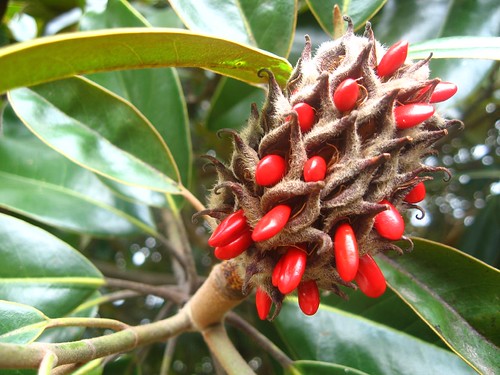
After flowering, it will produce a fuzzy, brown fruit that is 3 to 8 inches long. The bright red-orange seeds inside are exposed September through November. The fruit fall in November and December.
Magnolias can be grown from these seeds. They should be collected as soon as possible after the fruit is mature and planted. The seeds should be covered with about l/4" of soil and mulched to prevent drying. Seedbeds should be kept moist until germination is complete. Partial shade should also be provided the first Summer for seedlings.
The growing range for Magnolias is from eastern North Carolina, south along the Atlantic Coast, to central Florida, then westward through roughly the southern half of Georgia, Alabama, and Mississippi, and across Louisiana into southeast Texas. Now, of course, this is on the assumption that the trees did not read the book or peruse the internet much. I know of a few trees outside of this "range", so take it with a grain of salt.
These majestic beauties are relatively easy to care for.
The ideal soil for most Magnolias is rich, slightly acidic (pH 5.0 to 6.5) and well-drained. They will tolerate moderate drought and even tolerate wet soils.They prefer an even moisture level however. Plant in full sun or partial shade. They will flower better in full sun.
When it comes to feeding your Magnolia, the first three years are when it is needed. Any well balanced fertilizer, such as 10-10-10 can be used. It should be done in March, May and July. By the fourth year, the tree should have a well-established root system and should be able to forage for nutrients on its own. Magnolia roots have been shown to grow more than three times further than the canopy width of the tree, so they can obtain nutrients applied to any nearby plants or lawn.
Magnolias are generally pest-free. They may be troubled by various types of scales, which can infest twigs and leaves. If the tree is still small, this can be taken care of with insecticidal soap or a horticultural oil. If the tree is very large, this will be difficult and probably not needed anyway. If the thought of these insects on your larger tree bother you, look into one of the systemic insecticides. These are taken up by the trees roots and into the leaves, thus killing the pest. Just make sure it is labeled for Magnolias. The label is the law and should be followed exactly. They are also subject to leaf spots, black mildew, blights, scab and canker, caused by various fungi or bacteria. Control is not generally warranted unless it is so severe that the health of the tree is declining. You may want to consider consulting with an arborist in this case.
I guess I should mention that if you do have a small yard and are just dieing to have a Magnolia tree, there is a solution for you. Magnolia grandiflora 'Little Gem' - This is compact and upright, more like a dense shrub (20 feet tall, 10 feet wide). Leaves are small (4 inches) and lustrous, dark green and bronze. Flowers are much smaller (3 to 4 inches). It blooms at an early age and sporadically throughout the growing season.
As many of you know, I like to occasionally give out some facts that, if you are ever on Jeopardy, might just win you lots of money. So here is some trivia you might enjoy:
The Magnolia is the official state flower of both Mississippi and Louisiana.
Mississippi's nickname is the "Magnolia State."
Magnolia flowers do not yield true nectar; instead they produce pollen in very large quantities.
The Magnolia is one of the oldest plant species, with fossil remains dating back 36 to 58 million years ago.
Well, I hope this little article on Magnolias was interesting and useful. It truly is a Southern staple and deserves a place in any formal garden or where a large specimen is required.
Consider one if you can.
Happy Grow......What's that you asked? I never told you where the name D.D. Blanchard came from?
After searching high and low, pouring through numerous websites, the answer is:
I have no idea.
If somebody out there knows, please tell me. I hate not knowing something!
Happy Growing!
Darren
Here in the greater Charleston, SC area, we have been lucky. Yes, the economy has been bad, but I don't think we have been as hard hit as some of the rest of the nation. That is one of the main reasons we have been so busy.
I have actually enjoyed being this busy. The money has been good, I get to talk to lots of people in the horticultural business, plus I get to play with plants all day!
I was making a couple of deliveries today, both contained the topic for today's post, Magnolia trees.
I decided on this topic for a couple of reasons:
1) Magnolia trees are a staple of the southern landscape, hence they are often asked about.
2) The particular cultivar that I was delivering was D.D. Blanchard and I wanted to research why it was named that..
Magnolia grandiflora. There are estimated to be between 80 and 100 species of Magnolia that are native to the eastern United States and southeastern Asia. The grandiflora being the most common and thought about here.
These are not for the small garden. They can tower to a height of 60-80 feet, 30-50 feet wide and have leaves as long as a foot. These things demand attention in a landscape. Those foot long leaves are a dark, deep green and the undersides might be a lighter green or fuzzy, rust brown. The Magnolia is considered an evergreen, though there are a few species that are not.
The flower is something amazing too. They can be as large as 14 inches across. The smell is a clean, crisp fragrance. They usually flower in May and June. Everybody is probably familiar with what they look like:
After flowering, it will produce a fuzzy, brown fruit that is 3 to 8 inches long. The bright red-orange seeds inside are exposed September through November. The fruit fall in November and December.
Magnolias can be grown from these seeds. They should be collected as soon as possible after the fruit is mature and planted. The seeds should be covered with about l/4" of soil and mulched to prevent drying. Seedbeds should be kept moist until germination is complete. Partial shade should also be provided the first Summer for seedlings.
The growing range for Magnolias is from eastern North Carolina, south along the Atlantic Coast, to central Florida, then westward through roughly the southern half of Georgia, Alabama, and Mississippi, and across Louisiana into southeast Texas. Now, of course, this is on the assumption that the trees did not read the book or peruse the internet much. I know of a few trees outside of this "range", so take it with a grain of salt.
These majestic beauties are relatively easy to care for.
The ideal soil for most Magnolias is rich, slightly acidic (pH 5.0 to 6.5) and well-drained. They will tolerate moderate drought and even tolerate wet soils.They prefer an even moisture level however. Plant in full sun or partial shade. They will flower better in full sun.
When it comes to feeding your Magnolia, the first three years are when it is needed. Any well balanced fertilizer, such as 10-10-10 can be used. It should be done in March, May and July. By the fourth year, the tree should have a well-established root system and should be able to forage for nutrients on its own. Magnolia roots have been shown to grow more than three times further than the canopy width of the tree, so they can obtain nutrients applied to any nearby plants or lawn.
Magnolias are generally pest-free. They may be troubled by various types of scales, which can infest twigs and leaves. If the tree is still small, this can be taken care of with insecticidal soap or a horticultural oil. If the tree is very large, this will be difficult and probably not needed anyway. If the thought of these insects on your larger tree bother you, look into one of the systemic insecticides. These are taken up by the trees roots and into the leaves, thus killing the pest. Just make sure it is labeled for Magnolias. The label is the law and should be followed exactly. They are also subject to leaf spots, black mildew, blights, scab and canker, caused by various fungi or bacteria. Control is not generally warranted unless it is so severe that the health of the tree is declining. You may want to consider consulting with an arborist in this case.
I guess I should mention that if you do have a small yard and are just dieing to have a Magnolia tree, there is a solution for you. Magnolia grandiflora 'Little Gem' - This is compact and upright, more like a dense shrub (20 feet tall, 10 feet wide). Leaves are small (4 inches) and lustrous, dark green and bronze. Flowers are much smaller (3 to 4 inches). It blooms at an early age and sporadically throughout the growing season.
As many of you know, I like to occasionally give out some facts that, if you are ever on Jeopardy, might just win you lots of money. So here is some trivia you might enjoy:
The Magnolia is the official state flower of both Mississippi and Louisiana.
Mississippi's nickname is the "Magnolia State."
Magnolia flowers do not yield true nectar; instead they produce pollen in very large quantities.
The Magnolia is one of the oldest plant species, with fossil remains dating back 36 to 58 million years ago.
Well, I hope this little article on Magnolias was interesting and useful. It truly is a Southern staple and deserves a place in any formal garden or where a large specimen is required.
Consider one if you can.
Happy Grow......What's that you asked? I never told you where the name D.D. Blanchard came from?
After searching high and low, pouring through numerous websites, the answer is:
I have no idea.
If somebody out there knows, please tell me. I hate not knowing something!
Happy Growing!
Darren
Sunday, February 24, 2013
Stepping Up
Welcome Back!!
Actually, that is probably what you are saying to me. I have
been absent for quite sometime now. No, I haven't been on vacation, nor have I
been sick. The truth of the matter is, I got incredibly busy (I won't bore you
with all the details) and I also had a severe case of writers block. I thought
I had come up with a good topic a couple of times, then, when I sat down to
write it, there was nothing there.
Hopefully, that time off has fixed my head.....Yes, I wrote
that so you can fill in your own jokes.
Spring is quickly approaching, at least the calender says so.
Mother Nature may have a thing or two to say about that, especially for those
of you buried in snow or expecting more!
Either way, it will soon be time to repot many of your plants that have
been sitting there all Winter.
Are you ready?
I could write an entire article on how do you know when it is
time to repot a plant and I might just do that in the near future. Here is a
brief idea of how you can tell. If you can see roots on the surface of the soil
or emerging from the drainage hole in the bottom of the pot. If your plant is
just not looking well or has completely stopped growing, especially in the
growing season it is probably time to repot.
Today however, I want to talk about pot size and which one
you should go up to.
I found this picture of the industry standard pot sizes.
There are, of course, many in between sizes and the 25 looks more like a 30 to
me, but it at least gives you an idea of comparison.
I have been in many discussions about what size pot to use
when repotting a plant. The conventional wisdom is, The new pot should be no
more than 2 inches wider at the rim or 2 inches deeper than the old pot.
Why, you might be asking.
There are a couple of reasons.
1)
A pot that is much larger gives the roots too
much space to grow into.
2)
A too-large container will also hold too much
water and can cause root rot.
3)
It will stunt the plant and make it not grow for
a while.
I guess these can be good reasons, though, as in life, every
rule has an exception.
Personally, I like to go a couple of sizes up, if possible. A
few reasons I might not be able to at any given time would be things like, I
don't have a much bigger pot or I don't have enough potting mix.
Yes, I know, then just wait until I do. Time is not always on
my side and that plant REALLY needs to be repotted.
Here is my thinking for going ahead and putting them into a
bigger pot. I will debunk the above reasons as we go.
“ A pot that is much
larger gives the roots too much space to grow into”. Well then, what happens
when you put the plant into the ground? That is a MIGHTY big pot!
It was explained to me like this. If you move into a new,
much bigger house than you were living in, you will fill it with stuff. The
plant will do the same thing.
With a dumb founded look I said, “AND”!?!
Is that not the purpose of the plant? To grow and produce
lots of roots? That person walked away. I am not sure if I ticked them off, or
they went off to ponder that. The roots of the plant want to reach out and
grow. They have a couple of reasons for their existence, to provide food to the
plant and to anchor the plant. The more area they cover, the more secure the
plant is in the soil.
“A too-large container will also hold too much water and can
cause root rot”. I can almost see this. If you use a very water retentive soil
mix and repot a Cactus or some other water sensitive plant, then yes, you are
correct. However, if you use a very well draining soil, with lots of perlite or
some other course additive, there should be no problem. The container should
also have lots of good drainage.
You can also throw into this mix, the difference between clay
pots and plastic pots. Plastic will hold water a little better than the clay. I
still like the plastic pots better, they are much lighter.
“It will stunt the plant and make it not grow for a while”.
I have actually never seen any evidence of this. It is
possible that people that have had this problem injured the roots in some
manner. The plant was in shock and had to replenish the root system. While
there is active root growth, there will not be any top growth. So it makes
sense that the roots are hurt, they are trying to fix themselves and the plant
is not growing.
Another reason I tend to go to a much larger pot is plant
size. I had a Citrus tree last year that was in a three gallon pot. The tree
itself was very tall, but not terribly rootbound, though it was getting there.
Every time the least little amount of wind blew, it would tip over. So, I
repotted it. I put it in the next size up, a seven gallon. The next day, after
some heavy wind overnight, there it was on the ground again. So, needless to
say, it was in a fifteen gallon that afternoon. Hasn't tipped over since.
I mentioned I have gotten extremely busy earlier. So, as the
old expression goes, “The shoemakers daughter goes barefoot”, I do not always
have time to work my yard like I want to. So, when I do have time, and I have a
plant that needs to be repotted, I put it in a much bigger pot, it will then be
set for a longer period of time.
I know there will be LOTS of disagreement with my thinking on
this whole subject. That is fine. Hopefully it will cause some thinking and
maybe help somebody that is on the fence about what size they should use.
As always, if you have any questions, or if you want to
discuss this further with me, I am only an e-mail away....TheCitrusGuy@netzero.com
Happy Growing!
Darren
Subscribe to:
Posts (Atom)