Showing posts with label Container. Show all posts

Saturday, April 3, 2010

How to Train Your Dragon......Fruit

I am always looking for neat and unusual plants to try and grow. If they produce food of any kind even better. I tend to lean towards fruit however, just the sweet tooth talking I guess. I learned about Dragon Fruit from my Cactus studies. They are in the genus Hylocereus.
Believe it or not, you may actually have a Dragon Fruit plant growing in your house right now! If not, you have probably seen one numerous times. Remember seeing something that looks like this?

Photo courtesy of W. Chow ( http://www.vivapitaya.com ) He has a GREAT website to learn more about this unusual fruit.
The green rootstock is Dragon Fruit or Hylocereus undatus. I have actually done this before, you can just cut the top part off.....the yellow, orange or red Cactus. Unfortunately, it will not live on its own. That cactus can not produce chlorophyll, that is why it is grafted onto something that can. Another option is to wait until the rootstock sends out a shoot and root it. This is very simple. Once the shoot is large enough to cut off, dip the cut end into a little root hormone and place in a pot with some potting mix. Keep soil barely damp. It should root in a couple of weeks.
These plants can very easily be grown in pots. Roger Washington down in Florida grows them in containers at his farm. He runs a company called Reddragonfruit.com


Dragon Fruit is native to South and Central America, it is commercially grown successfully in both Thailand and Vietnam. Southern California and parts of Florida are very good for growing Dragons. So, looking at these places, you can tell that they are not looking to live in the Sahara Desert. If you don't live in a tropical environment, they can be grown in a greenhouse.
They enjoy temperatures between 31 degrees and 100 degrees, either side of these extremes will hurt the plant. They can grow on a wide range of soil types, as long as it has good drainage. Although Dragons are members of the cactus family and may withstand dry periods, they have a fairly high water requirement. The plants should be planted in full or almost full sun (very light shade) for best growth and fruit production. An application of a 6-6-6 type fertilizer every two months is recommended.
As for many fruiting plants, the very young plants will not liberally flower or fruit at all until they have gotten much older and larger. These things need to put on quite a bit of weight, average of ten pounds worth of vines usually before they even think about flowering and fruiting. This can actually be attained in just a couple of years, depending on the size of the cutting used.
Lets say you have gotten yours to pretty good size, yet you see no flowers. It might be time to go on a midnight raid. Dragon Fruit plants bloom only at night, and unless you have a lot of bats or moths that pollinate Dragons, you are going to have to do it. I know, why not wait until morning? The flower will be gone by then, the first inkling of daybreak and the flower fades. The good news is that the plant tends to flower a couple of times a year. Even so called self pollinating Dragons will fail to produce fruit without the help of Bats, Moths or you. If you can, you need to plant a couple of them to help with cross pollination.
How is this for a beautiful flower?
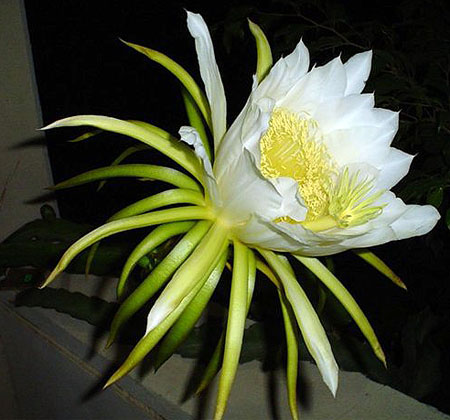

It is worth growing just for the scent and beauty.
If you can get it to produce and are good at pollinating, it is not unreasonable for 3 to 4 year old plants to produce about 220 lbs of fruit per year. The average life expectancy is around 20 years.
To support your Dragon, I found this useful information from the University of Florida. Dragon Fruit plants may become quite large and spreading, and therefore individual plants should be planted 15 to 25 ft or more away from trees, structures, and electrical lines. A strong trellis should be established that may withstand several hundred pounds of stem weight. A weak trellis may buckle under the weight of a mature plant. Do not use wires on the trellis because they may cut or damage the stems. If wire is used, it should be covered by hoses. For the home landscape, consider a trellis for individual plants which should consists of a post and a structure at the top of the post to support the plant. An arbor type trellis may also be constructed. Individual plants growing on a short tree or on a pile of rocks or blocks could also be used as supports for a few plants.
I created the post with a structure on top to support mine. I am hoping for some rapid growth this year.
In case you were wondering what the fruit looked like, here it is:

There are actually a few different varieties.
Red, with white pulp like above.
Red, with red pulp:


And a Yellow, with white pulp:


To top all this off, eating Dragon fruit is good for you. It is high in Vitamin C and dietary fiber. There are also reports that it aids in type 2 diabetes glucose level control.
I hope this encourages you to go out and try to find a Dragon Fruit plant. Maybe then you can make your OWN movie of how you Trained your dragon.
Happy Growing!
Darren

UPDATE: This has actually been one of my most popular posts! I have received many, many questions and comments regarding this one.
I have also received pictures of success that folks have had, such as this one from Irene W.


She lives in California. This is a nice harvest! Great job Irene!!

Tuesday, March 30, 2010

Not a Palm Reader

I was perusing my e-mail today, when I got one from a friend of mine about Sago Palms (Cycas revoluta). I know a little bit about them, but decided to do more research on them anyway.
Sago palms (which are not true palms) are evergreen plants with stiff, palm-like fronds that radiate outward from a slow-growing usually non-branched trunk. They are very slow-growing and long-lived. It can reach a height of 10 feet, although 3 to 5 feet is more common. They are native to Japan's southern most islands. And is thought to be a plant that has been around since the time of the dinosaurs.


Sago's are evergreen here in South Carolina. It is considered a Zone 8-10 plant. I have seen it growing in a Zone 7, though the fronds usually get burned in the Winter. It actually got hit pretty hard this past Winter here.
They like sandy, fast draining soil, preferably with some organic matter. Also recommended is a light mulch of bark or leaf mold. Plants appreciate light feedings of balanced, slow release fertilizer or liquid fertilizers. They are drought resistant when mature. Their light requirements are everything from bright conditions including full sun to full shade with no ill effect (its leaves grown larger in the shade).
They can be propagated from offsets or seeds. The seeds should be allowed to age for a couple of months in a cool place before planting. New plants can also be obtained by removing offsets from the base of the trunks. Remove the leaves and plant in moist, well drained soil. This is most successful when done in the Winter when the plant is dormant.
Sago's also make an excellent container plant for use outdoors and in the home. It has been a popular house plant in the west for over a century and in Japan for even longer. In Japan the Sago is also used as a bonsai subject. Dwarfs of great value are produced by withholding moisture and packing the plant in sand. These often have very thin trunks or interesting deformities and are sometimes sold under the name Cycas nana.
Animals that graze on Cycas leaves may exhibit permanent nuerological disorders. Sago seeds are sometimes suggested as a natural remedy for certain conditions - do not use it! All parts of this plant are toxic. The symptoms of Sago poisoning include, vomiting, diarrhea, headache, dizziness, seizures.
They make extremely nice focal plants, I encourage you to grow one if you can in your yard. If not, take a crack at containerizing one.


Happy Growing!
Darren

Saturday, March 27, 2010

With a Cherry On Top

While working in the yard today, it was nice to see things starting to flush new growth and flowering. I was especially excited to see that my Surinam Cherry (Eugenia uniflora) is still alive. The one had lost all it's leaves and I thought for sure it was a goner.


The Surinam Cherry is a very interesting plant. It is also called Brazil or Brazilian cherry. The plant is native from Surinam, Guyana and French Guiana to southern Brazil and to northern, eastern and central Uruguay. It usually only reaches a height of 25 feet. In Florida, the Surinam cherry is one of the most common hedge plants throughout the central and southern parts of the state and the Florida Keys. Young plants are supposedly damaged by temperatures below 28 degrees,I have not pushed the limit myself. Well established plants are suppose to be hardy to 22 degrees. I, of course grow mine in containers. They need full sun and are relatively drought tolerant. The Surinam Cherry will do well in just about any soil type, but does not do well with salt.
Propagation is usually done by seeds. They remain viable for not much longer than a month and germinate in 3 to 4 weeks. They can usually be found online at http://www.tradewindsfruit.com/surinam_cherry.htm
But of course when I checked, they were out. Check again often. From seed you can get fruit any where from 2-6 years, depending on growing conditions. The plant is said to be bothered by scale and caterpillars, but I have not had any problem. The fruits are today mostly eaten by children. In the past, many people allowed the tree to grow naturally and harvested the fruits for culinary use.
The fruit can be used as a substitute for strawberries on shortcake and topped with whipped cream. They are an excellent addition to fruit cups and salads and can be made into pie or sauce or preserved whole in syrup. They are often made into jams or jelly. Brazilians ferment the juice into vinegar or wine, and sometimes prepare a distilled liquor.
This plant will make an excellent conversation starter and will definitely add a flair of the tropics to your patio. I encourage you to locate some seeds and give them a try!
Happy Growing!
Darren