I often have conversations with many of my fellow Master Gardeners and other gardeners about planting native species, or don't plant this or that, due to certain conditions. One of the big ones I get fussed at is my defense of the poor Bradford Pear. I know they have their problems, but I think they are also getting a bad rap.
Bradford Pears are a variety of a pear native to Korea and China, Pyrus calleryana, which was first introduced to Western horticulture in 1908. The actual cultivar 'Bradford' dates back to 1963, when the USDA introduced it commercially. It was first brought here in 1919.
The tree was supposed to be the perfect street tree, with profuse early bloom, a restricted pyramidal shape, and good fall color.
If you have never seen them in bloom, look at this:
Pretty nice huh?
I will admit, there is some objection to the odor all those flowers put out, but I don't find it that bad.
Fall Color? Check this out:
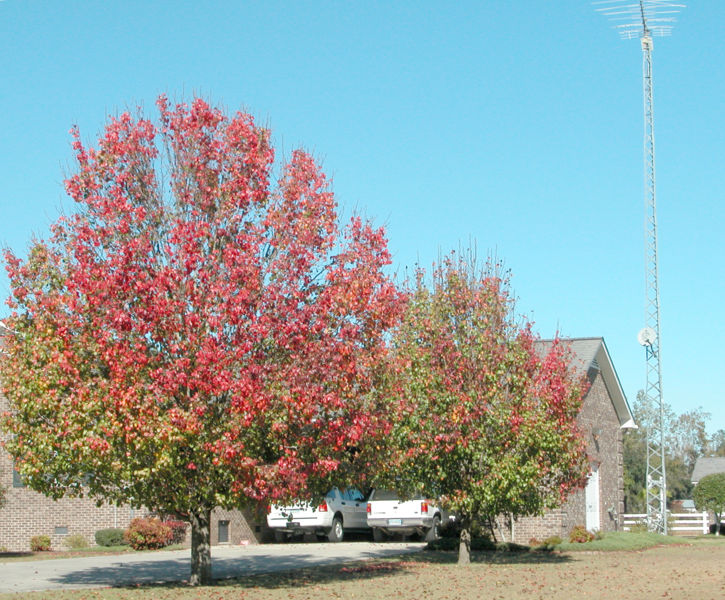
Many landscapers, and homeowners agreed with this thinking and today it can be found almost everywhere.
So why then do so many people have a problem with this tree?
A combination of plant physiology and physics makes the Bradford very susceptible to wind and ice damage. The angle of the Bradford's branches is generally too narrow, and as the tightly-crowded branches grow in girth, the tree begins to push itself apart. At the first strong wind or heavy ice storm, the tree self-destructs.
Average lifespan is about 20-25 years.
Fully grown the Bradford Pear grows 30 to 50 feet tall and 20 to 30 feet wide. It is a very fast grower, averaging 1.5 feet per year. This is part of the problem with it having weak wood. They grow best in full sun but will tolerate part shade. It can handle all kinds of soil types and will tolerate drought and very wet conditions for a short period of time.
Bradford Pear is fairly resistant, although not immune, to most diseases, including fire blight. Fire blight is a common problem of ornamental and edible pears. This is where the ends of twigs and leaves become blackened as the disease progresses further down the branches. The Bradford pear is relatively free of insect problems.
One reason I have these discussions and get fussed at with people is because Pyrus calleryana and other varieties of ornamental pears are on the Invasive Plant Pest Species of South Carolina list. Although the ‘Bradford’ pear was originally bred as sterile and thorn-less, they readily cross-pollinate with other varieties of callery pears, and subsequently produce fruit. The ripened fruit are eaten and spread around by birds, which supposedly results in very thorny thickets of wild pear trees. I personally have not seen these thickets.
Yes, they do produce fruit:
And the birds do love them! Check out this Cardinal enjoying lunch in one of my trees:
They also love to nest in them. A female Dove made her home in mine this past April:
Aren't we suppose to help our fellow creatures? That is always my argument. You feed birds sunflower seeds, those things pop up EVERYWHERE, but nobody argues about that! I know, they are annuals and will die in the Winter, unless they go to seed?!
Back to the Bradfords. I have seen old ones and they look great! One of the keys is to pick one out with a strong central trunk, kind of like these:
These are my trees also.
I am sure I will get arguments opposed to my blog. There are many more trees out there that can and will give you the same effect. Yes, there are. There is also many more ways to feed the birds and yet people insist on feeding them millet. THAT stuff is invasive and messy! So to each their own.
I will give you a few substitutes however. Flowering Crab Apples (Malus spp.) and Japanese Cherries,(Prunus serrulata) such as 'Kwanzan', are good alternatives. For smaller trees, Dogwoods (Cornus florida) and Redbuds (Cercis canadensis) are excellent.
As for me, the Bradford Pears I planted are now large, provide much needed shade, food for the birds, and places for me to put many of my hanging potted plants. So, they are staying!
Happy Growing!
Darren
Showing posts with label Dragon Fruit. Show all posts
Saturday, February 12, 2011
Saturday, April 3, 2010
How to Train Your Dragon......Fruit
I am always looking for neat and unusual plants to try and grow. If they produce food of any kind even better. I tend to lean towards fruit however, just the sweet tooth talking I guess. I learned about Dragon Fruit from my Cactus studies. They are in the genus Hylocereus.
Believe it or not, you may actually have a Dragon Fruit plant growing in your house right now! If not, you have probably seen one numerous times. Remember seeing something that looks like this?

Photo courtesy of W. Chow ( http://www.vivapitaya.com ) He has a GREAT website to learn more about this unusual fruit.
The green rootstock is Dragon Fruit or Hylocereus undatus. I have actually done this before, you can just cut the top part off.....the yellow, orange or red Cactus. Unfortunately, it will not live on its own. That cactus can not produce chlorophyll, that is why it is grafted onto something that can. Another option is to wait until the rootstock sends out a shoot and root it. This is very simple. Once the shoot is large enough to cut off, dip the cut end into a little root hormone and place in a pot with some potting mix. Keep soil barely damp. It should root in a couple of weeks.
These plants can very easily be grown in pots. Roger Washington down in Florida grows them in containers at his farm. He runs a company called Reddragonfruit.com

Dragon Fruit is native to South and Central America, it is commercially grown successfully in both Thailand and Vietnam. Southern California and parts of Florida are very good for growing Dragons. So, looking at these places, you can tell that they are not looking to live in the Sahara Desert. If you don't live in a tropical environment, they can be grown in a greenhouse.
They enjoy temperatures between 31 degrees and 100 degrees, either side of these extremes will hurt the plant. They can grow on a wide range of soil types, as long as it has good drainage. Although Dragons are members of the cactus family and may withstand dry periods, they have a fairly high water requirement. The plants should be planted in full or almost full sun (very light shade) for best growth and fruit production. An application of a 6-6-6 type fertilizer every two months is recommended.
As for many fruiting plants, the very young plants will not liberally flower or fruit at all until they have gotten much older and larger. These things need to put on quite a bit of weight, average of ten pounds worth of vines usually before they even think about flowering and fruiting. This can actually be attained in just a couple of years, depending on the size of the cutting used.
Lets say you have gotten yours to pretty good size, yet you see no flowers. It might be time to go on a midnight raid. Dragon Fruit plants bloom only at night, and unless you have a lot of bats or moths that pollinate Dragons, you are going to have to do it. I know, why not wait until morning? The flower will be gone by then, the first inkling of daybreak and the flower fades. The good news is that the plant tends to flower a couple of times a year. Even so called self pollinating Dragons will fail to produce fruit without the help of Bats, Moths or you. If you can, you need to plant a couple of them to help with cross pollination.
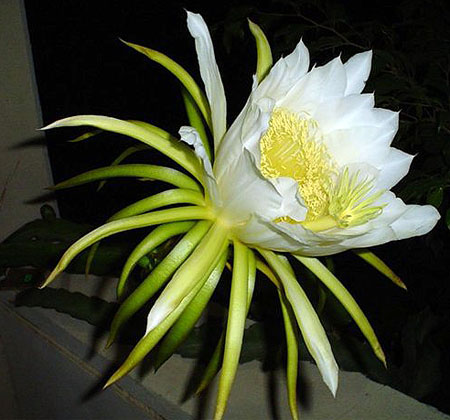
How is this for a beautiful flower?

It is worth growing just for the scent and beauty.
If you can get it to produce and are good at pollinating, it is not unreasonable for 3 to 4 year old plants to produce about 220 lbs of fruit per year. The average life expectancy is around 20 years.
To support your Dragon, I found this useful information from the University of Florida. Dragon Fruit plants may become quite large and spreading, and therefore individual plants should be planted 15 to 25 ft or more away from trees, structures, and electrical lines. A strong trellis should be established that may withstand several hundred pounds of stem weight. A weak trellis may buckle under the weight of a mature plant. Do not use wires on the trellis because they may cut or damage the stems. If wire is used, it should be covered by hoses. For the home landscape, consider a trellis for individual plants which should consists of a post and a structure at the top of the post to support the plant. An arbor type trellis may also be constructed. Individual plants growing on a short tree or on a pile of rocks or blocks could also be used as supports for a few plants.
I created the post with a structure on top to support mine. I am hoping for some rapid growth this year.
In case you were wondering what the fruit looked like, here it is:

There are actually a few different varieties.
Red, with white pulp like above.
Red, with red pulp:

And a Yellow, with white pulp:

To top all this off, eating Dragon fruit is good for you. It is high in Vitamin C and dietary fiber. There are also reports that it aids in type 2 diabetes glucose level control.
I hope this encourages you to go out and try to find a Dragon Fruit plant. Maybe then you can make your OWN movie of how you Trained your dragon.
Happy Growing!
Darren
UPDATE: This has actually been one of my most popular posts! I have received many, many questions and comments regarding this one.
I have also received pictures of success that folks have had, such as this one from Irene W.
She lives in California. This is a nice harvest! Great job Irene!!
Believe it or not, you may actually have a Dragon Fruit plant growing in your house right now! If not, you have probably seen one numerous times. Remember seeing something that looks like this?

Photo courtesy of W. Chow ( http://www.vivapitaya.com ) He has a GREAT website to learn more about this unusual fruit.
The green rootstock is Dragon Fruit or Hylocereus undatus. I have actually done this before, you can just cut the top part off.....the yellow, orange or red Cactus. Unfortunately, it will not live on its own. That cactus can not produce chlorophyll, that is why it is grafted onto something that can. Another option is to wait until the rootstock sends out a shoot and root it. This is very simple. Once the shoot is large enough to cut off, dip the cut end into a little root hormone and place in a pot with some potting mix. Keep soil barely damp. It should root in a couple of weeks.
These plants can very easily be grown in pots. Roger Washington down in Florida grows them in containers at his farm. He runs a company called Reddragonfruit.com

Dragon Fruit is native to South and Central America, it is commercially grown successfully in both Thailand and Vietnam. Southern California and parts of Florida are very good for growing Dragons. So, looking at these places, you can tell that they are not looking to live in the Sahara Desert. If you don't live in a tropical environment, they can be grown in a greenhouse.
They enjoy temperatures between 31 degrees and 100 degrees, either side of these extremes will hurt the plant. They can grow on a wide range of soil types, as long as it has good drainage. Although Dragons are members of the cactus family and may withstand dry periods, they have a fairly high water requirement. The plants should be planted in full or almost full sun (very light shade) for best growth and fruit production. An application of a 6-6-6 type fertilizer every two months is recommended.
As for many fruiting plants, the very young plants will not liberally flower or fruit at all until they have gotten much older and larger. These things need to put on quite a bit of weight, average of ten pounds worth of vines usually before they even think about flowering and fruiting. This can actually be attained in just a couple of years, depending on the size of the cutting used.
Lets say you have gotten yours to pretty good size, yet you see no flowers. It might be time to go on a midnight raid. Dragon Fruit plants bloom only at night, and unless you have a lot of bats or moths that pollinate Dragons, you are going to have to do it. I know, why not wait until morning? The flower will be gone by then, the first inkling of daybreak and the flower fades. The good news is that the plant tends to flower a couple of times a year. Even so called self pollinating Dragons will fail to produce fruit without the help of Bats, Moths or you. If you can, you need to plant a couple of them to help with cross pollination.
How is this for a beautiful flower?
It is worth growing just for the scent and beauty.
If you can get it to produce and are good at pollinating, it is not unreasonable for 3 to 4 year old plants to produce about 220 lbs of fruit per year. The average life expectancy is around 20 years.
To support your Dragon, I found this useful information from the University of Florida. Dragon Fruit plants may become quite large and spreading, and therefore individual plants should be planted 15 to 25 ft or more away from trees, structures, and electrical lines. A strong trellis should be established that may withstand several hundred pounds of stem weight. A weak trellis may buckle under the weight of a mature plant. Do not use wires on the trellis because they may cut or damage the stems. If wire is used, it should be covered by hoses. For the home landscape, consider a trellis for individual plants which should consists of a post and a structure at the top of the post to support the plant. An arbor type trellis may also be constructed. Individual plants growing on a short tree or on a pile of rocks or blocks could also be used as supports for a few plants.
I created the post with a structure on top to support mine. I am hoping for some rapid growth this year.
In case you were wondering what the fruit looked like, here it is:
There are actually a few different varieties.
Red, with white pulp like above.
Red, with red pulp:
And a Yellow, with white pulp:
To top all this off, eating Dragon fruit is good for you. It is high in Vitamin C and dietary fiber. There are also reports that it aids in type 2 diabetes glucose level control.
I hope this encourages you to go out and try to find a Dragon Fruit plant. Maybe then you can make your OWN movie of how you Trained your dragon.
Happy Growing!
Darren
UPDATE: This has actually been one of my most popular posts! I have received many, many questions and comments regarding this one.
I have also received pictures of success that folks have had, such as this one from Irene W.
She lives in California. This is a nice harvest! Great job Irene!!
Subscribe to:
Posts (Atom)