In most parts of the country, Fall is almost over and old man Winter has started taking his icy grip. Here in Charleston, we have had some frost on the vehicles, but have not had that real killer frost yet. So around here, there is still time to bring in your houseplants. You know, that Spider Plant that has been hanging on the back porch all Summer. The Snake Plant that is sitting in the corner over there by your BBQ grill. There are a few things you probably should do before you bring them back into the comfort of your home, unless you like creepy, crawly visitors.
To start off with, almost all houseplants are considered Tropical or at least Sub-Tropical, which means areas adjacent to Tropical areas.....Think of it as the tropical suburbs.
Ideally, the plants will want to be moved when the inside and outside temperatures are about the same. That means 70's during the day and mid 60's or so at night. I don't know about you, but that seems like a very short window of opportunity to me. I usually wait until the night time temperatures are forecast to be in the upper 30's. Now to be fair, I have a greenhouse and it is easier to move them in there on the spur of the moment than it would be to bring them into the house. So, you can decide for yourself when would be a good time to get started.
First off, it is important to get rid of pests on the plant or in the soil. This is especially important for those plants that have been sitting on the ground. You first want to look all around the leaves, on top, underneath, and in the leaf crevices. Pay special attention to where the leaf or stem is attached to the trunk. Then, if at all possible, take them out of their pots to see if anything has crawled in through the drainage holes. You would be amazed at what you might find down there. I am not trying to scare you, but, I did see a plant taken out of a three gallon pot to be planted and in the bottom was a baby snake. Probably would have been a bad thing if he/she made it indoors.
If there are any insects on the leaves, you can do one of a couple of things. Spray the plant with the hose and knock the little guys off, being careful not to remove too much of the soil or knocking the leaves off themselves. The other possibility is to use an insecticidal soap, it is safe for pets and humans. Some plants tend to hold the soap solution on their leaf surfaces. This may cause burning. Before using any insecticide, check the label to see if the plant is listed. If not, test a small area on your plant for sensitivity. It may take anywhere from seven to ten days for symptoms to appear.
Okay, you have the critters taken care of. You noticed when you took the pot out of its container, it was a tad rootbound. Again, there are a couple of options here. First, you could just leave it until Spring. The plant is not going to grow much during the Winter months indoors. The problem with this is, the plant, if it is too terribly rootbound, will not be able to take up any water. The roots will basically repel it and there is not enough soil to absorb any water for later use. There is also the possibility that it will grow some during the Winter and just make matters worse. So, as long as it is already out of the pot, why not repot now?
You will want to use a good potting mix. What is a good potting mix? Well, it will have these basic elements: Dense enough to support the plant, Good nutrient-holding capacity, Allows water and air to pass through readily, yet retains adequate moisture, Free of insects, diseases and weed seeds. I will start with the last item because I seem to get the question "Why can't I just use dirt from my yard?"
Garden soils contain too many bacteria and are generally not recommended for plants grown in containers. Unlike artificial mixes, which can be used right from the bag, native soil mixes must first be sterilized to kill disease organisms, insects and weed seeds. An artificial mix which includes commercially prepared mixes are "soilless" or "artificial," which means they contain no soil. Most contain a combination of organic matter, such as peat moss or ground pine bark, and an inorganic material, such as washed sand, perlite or vermiculite. Yes, you can make your own artificial potting mix, no you can not use sand from the beach....it will contain too much salt. Any decent combination of the above ingredients will make a good potting mix, the best one out there is in your imagination. Experiment and find one that works for you. Just remember the above basic elements that I mentioned which are required and you will be fine. I should also mention that many commercial potting mixes contain a slow release fertilizer. Most of the time during the Winter, the plants go into a resting or dormant phase and will not need the food. You do not have to go out of your way to find one with a certain amount of food in it. The rules change come Spring, so with it in there you will have somewhat of a head start to an early feeding should you forget.
Okay,I am going to assume you have the plant out of its pot. Gently disturb the root system so that roots are not in a tight rootball or as we like to say "Tickle the roots a little". If the roots are too tight to loosen, slice through the rootball slightly with a knife to loosen them. The next item I am going to mention has been discussed to great lengths by many gardeners. I have actually been in some of these "discussions". The general rule of thumb is: Select a pot that is 1 or 2 inches larger in diameter than the current pot. For a houseplant this is fine, because many times there is not room for anything much larger. I am under the belief that what ever size pot you can manage and will fit in the space is fine. Of course, this can also be taken with a grain of salt. I am not expecting to put a four inch plant into a 30 gallon container, there are some things that common sense should be applied to. I AM suggesting that if you take a plant out of a six inch pot and you have room for a ten inch pot, go for it! You will not, or should not, have to repot anytime soon.
You can put some wire mesh or broken shards of clay pot in the bottom to help retard soil from coming out of the drainage holes. You will want to plant the plant in the pot at the same level or even slightly higher than the original pot. This will help prevent foot rot.
The main cause of death of potted indoor plants is over-watering. Roots need both water and oxygen, and when surrounded by water, they cannot take up any oxygen. These roots will rot and eventually the whole plant may die. The symptoms of over watering and under watering are very similar. The plant will appear wilted.
When I am doing my Citrus lectures, I get asked a question that is relevant to this topic: "How often should I water my plant?" While there are a couple of minor differences, basically the answer will be the same...When it needs it! Okay, after the laughter dies down, I usually go into the variables that apply to this question.
What kind of plant is it? A cactus is not going to need as much as a philodendron.
What kind of soil are you using? One with lots of sand will need more than one that has lots of peat in it.
What kind of pot is it in? A clay pot will dry out much faster than a plastic pot.
How much sun is it getting/how close to a heat vent is it? This one is kind of self explanatory.
The best rule of thumb is, stick your finger in the soil. If it is dry to the first knuckle, water.....unless it is a Cactus. Then all bets are off and unless you only water it every six months or so, I doubt you will be able to under water any kind of Cactus. You will eventually get the feel for when your plants need a drink. Another good way to tell is by the weight of the pot, if it is very light, it probably needs a drink. I mentioned earlier that over and under watering have the same symptoms. If you have been watering every other day and it is wilted, stop! If you haven't watered in three weeks and it is wilted, water! See, simple as that. Remember to have some kind of dish under the plant to catch runoff and empty it when it is done draning to prevent root rot.
The amount of light inside can be a difficult hurdle to cross. If you have the time, over a period of about a week, gradually reduce light levels by moving plants from sun to light shade to heavy shade, and finally indoors. Once indoors, the plant may develop leaf yellowing or drop as it adjusts to lower light. Most of the time this is not a major problem, unless you just HATE leaf litter on your new carpet. Here again, I will give you a couple of options. You can put the plant in a different window. The ideal side is a southern exposure, followed by East then West. North just absolutely is the worst, unless of course you are reading this in Australia, then reverse the whole North/South thing. Another option is grow lights. They are relatively inexpensive and can be placed on a timer. Do some research on how much light the particular plant you are growing requires and set the timer for that amount. There are many plants that require less Winter light than they do in the Summer for their dormant stage, again, research will tell you if your plant falls under this category.
Most people prefer a tidy house and think their plants should be also. Indoor plants may collect dust or greasy films that dull their appearance, making them less attractive. Clean leaves are also favorable for healthy growth. There are products on the market to clean and shine leaves, they are generally not recommended because the waxy coating residue may interfere with air exchange. Basically, they prohibit your plant from breathing. Never, NEVER use these products on plants that have hairy leaves, such as African Violets, you are really asking for problems here. The best way to clean leaves that are not hairy is to dampen a soft cloth with water and wipe the lower and upper surfaces of each leaf. An alternative is to place the entire plant in the shower to rinse it off. Plants with hairy leaves should not be dusted with a wet cloth but with a soft cosmetic brush. I remember either my mother or grandmother using mayonnaise to clean the plants leaves, I don't recommend this either because it too can clog the plants breathing.
I didn't mention types of containers because they are a personal choice. Many types of containers can be used for growing plants. Most pots with bottom drainage holes are made of plastic, ceramic or clay. Decorative containers without drainage holes can be made of clay, ceramic, plastic, wood, copper, brass and various other materials and should only be used as the outside vessel of a pot in a pot system. This way you can drain the water out and not remove the soil.
Well, I hope that helps you in bringing your beloved plant friends indoors. I read an interesting saying about indoor plants once, it goes something like this: They (plants) help us stay in touch with nature and, in a sense, "bring the outside indoors." I like that, Spring is way too far away right now.
Happy Growing!
Darren
Saturday, November 27, 2010


Sunday, November 14, 2010
How Sweet, or is it?
If you have ever been to the Lowcountry of South Carolina around this time of year, you will recognize what I am about to describe.
You are driving down the interstate or pretty much anywhere around the area and up ahead you see a purple haze in the median. Kind of looks like a fog or sometimes even smoke. You wonder if there is a problem. Should I slow down? Will it spread across the road?
As you get closer you begin to realize it is nothing of the sort.
 It is just some Muhlenbergia capillaris, also known as Sweetgrass and Gulf Muhly Grass. Muhlenbergia, one of the largest genera in this family, is named in honor of Giotthilf H.E. Muhlengerg (1753-1815), a minister, as well a a pioneer American botanist of German extraction whose family brought the Lutheran religion to Pennsylvania in the early part of the 18th century.
Sweet Grass is a showy clump forming type of grass that can get to 3 feet tall and just as wide. It does not produce runners, as it originates from the base clump.
That purplish or sometimes pink haze that you see is the flower or inflorescence. That flower can be 18 inches long and as much as 10 inches wide. It stands well above the wiry leaves. Appearing in late Summer, it will persist for 6-8 weeks.
Muhlenbergia capillaris is a variety of Muhlenbergia filipes, which is used in the making of Sweet Grass Baskets. Both of these grasses are native to South Carolina and they grow on the barrier islands along the coast, such as, Kiawah, Seabrook, Fripp, and Hilton Head. All together there are some 60 species of Mulenbergia.
Their growing range extends from Zone 5 all the way down to Zone 10. Full sun to light shade is the light requirement. This is an excellent plant for just about any type of soil you might have, it tolerates conditions from moist to dry, acidic to alkaline, and sandy to clay. It even tolerates salt spray. Being that it is tolerant of such poor conditions, it makes a good groundcover for those hard to fill areas. If you have a friend that is growing it or if you have had it a long time and want to have more in another part of the yard, the clumps can be dug up and hacked apart easily. This is best done in the Fall or early Spring. There is little to no problem with pests or diseases.
I am not a big fan of grasses, but I can tolerate Sweet Grass. It does have a pretty showing in the Fall, especially if you can find the rare white form (Muhlenbergia capillaris 'White Cloud') and mix the two together.
 Happy Growing!
Darren
You are driving down the interstate or pretty much anywhere around the area and up ahead you see a purple haze in the median. Kind of looks like a fog or sometimes even smoke. You wonder if there is a problem. Should I slow down? Will it spread across the road?
As you get closer you begin to realize it is nothing of the sort.

Sweet Grass is a showy clump forming type of grass that can get to 3 feet tall and just as wide. It does not produce runners, as it originates from the base clump.
That purplish or sometimes pink haze that you see is the flower or inflorescence. That flower can be 18 inches long and as much as 10 inches wide. It stands well above the wiry leaves. Appearing in late Summer, it will persist for 6-8 weeks.
Muhlenbergia capillaris is a variety of Muhlenbergia filipes, which is used in the making of Sweet Grass Baskets. Both of these grasses are native to South Carolina and they grow on the barrier islands along the coast, such as, Kiawah, Seabrook, Fripp, and Hilton Head. All together there are some 60 species of Mulenbergia.
Their growing range extends from Zone 5 all the way down to Zone 10. Full sun to light shade is the light requirement. This is an excellent plant for just about any type of soil you might have, it tolerates conditions from moist to dry, acidic to alkaline, and sandy to clay. It even tolerates salt spray. Being that it is tolerant of such poor conditions, it makes a good groundcover for those hard to fill areas. If you have a friend that is growing it or if you have had it a long time and want to have more in another part of the yard, the clumps can be dug up and hacked apart easily. This is best done in the Fall or early Spring. There is little to no problem with pests or diseases.
I am not a big fan of grasses, but I can tolerate Sweet Grass. It does have a pretty showing in the Fall, especially if you can find the rare white form (Muhlenbergia capillaris 'White Cloud') and mix the two together.
Darren
Sunday, November 7, 2010
Christmas, Thanksgiving, or Easter?
The holidays are fast approaching, as if you needed me to remind you of that!!
With the holidays come the ever present "Holiday Cactus". This is one of those questions that have been plaguing mankind for years, Do I have a Thanksgiving Cactus or an Easter Cactus or is the darn thing a Christmas Cactus?
Let's see if we can answer this.
The main difference between the Christmas, the Thanksgiving, and the Easter Cactus is the time of bloom. As their common names suggest, a Thanksgiving cactus can bloom in late Fall, one month before the Christmas cactus. The Easter cactus starts producing flower buds in February.
Now, what if your Cacti can't read a calendar? I know, they should have learned that at an early age. But if they never did learn, they are probably relying on the Day/Night length and Temperatures. Let's say that you are keeping them as houseplants and they can't see outside through the drapes?
There is another way to tell the different Cacti apart.
CHRISTMAS CACTUS
 photo courtesy of Paul J. Brunelle
The true Christmas Cactus does not have the points on the sides, but are still bumpy. The "Christmas Cactus" is Schlumbergera x buckleyi, a hybrid produced in the late 1840s by William Buckley at the Rollisson Nurseries in England.
THANKSGIVING CACTUS
The actual Thanksgiving Cactus, the plants most often sold as "Christmas Cacti" (by which name they sell best) are Schlumbergera truncata cultivars. These are clones selected for their colors, growth habit and given cultivar names. They bloom about a full month or more before the true Christmas cactus, given the same treatment, and so are more easily made to bloom at the best time for Christmas sales. The flowers might not last until Christmas though. They are also known by many popular names such as "Link Cactus", and "Grandmother's Cactus". Like I mentioned, these clones have been selected and bred for their many colors. They can come in Lavender, White, Fuschia, Red, Orange, and all shades in between.
 photo courtesy of Paul J. Brunelle
As you can see, there are a little bit more defined "points" on the sides.
EASTER CACTUS
The Easter Cactus is Rhipsalidopsis gaertneri . In some respects it is very similar to the Schlumbergera. However, it blooms in April (about Easter) and its flower is very different. It is not nearly as popular as the Thanksgiving or Christmas Cactus because it is a little bit more difficult to grow well, and it has the nasty habit of shedding its phylloclades (stem segments) at the slightest drought, or whenever over watered. It may also refuse to bloom for no apparent reason.
 photo courtesy of Paul J. Brunelle
As you can see, the edges are almost smooth and the flowers are very different.
Flower bud initiation in Thanksgiving and Christmas cacti start in response to cool temperatures and shortened day length so they should be left outdoors, away from artificial light until night temperatures dip into the 40s. At this time, they do best at temperatures between 50 and 65 degrees.
The Easter Cactus requires a dry period. From October to November, very little water is required for flower bud initiation. Easter cactus can be placed in the same cool area as the Thanksgiving and Christmas Cactus. In December, raise the temperature to about 65 degrees and water sparingly.
All three Holiday cacti can be propagated quite easily by removing a single segment and planting it a quarter of its length deep in a pot filled with slightly sandy soil. It helps to put some kind of rooting hormone on the base of the cutting. Place the pot in a well lit area (but not in direct sunlight) and keep the soil moist. The cutting should begin showing signs of growth after two or three weeks.
When it comes to overall care, they all have the same basic needs.
The soil should be evenly moist for best growth, but they are intolerant to constantly wet soil. They will do best in bright indirect light. Long term direct sunlight can burn the leaves and stunt growth. A well balanced general fertilizer applied once or twice a year is usually all that is needed.
Unless the plants outgrow their containers, you can usually get away with repotting every 2-3 years. The flowering can actually be encouraged by the plant being somewhat pot bound. If soil quality deteriorates rapidly, you might consider repotting more often. One of the best soil mediums to use is African Violet soil.
There are not many pests that bother Holiday cacti, other than Mealy Bugs. One easy solution is to touch each insect with an artist's brush or Q-tip dipped in rubbing alcohol. Heavier infestations can be treated with a strong spray of water or Insecticidal Soap, repeated at about weekly intervals. If this doesn't work, a Malathion spray should do the trick. Be careful with the strong spray of water however, the joints of the plants are quite fragile and can break apart if the plant is handled too roughly.
My Mother and Grandmother always had the most beautiful "Christmas Cactus" when I was growing up. I remember marveling at the pretty flowers. Well, I think I learned a little bit about growing them.
Take a look:


I hope you all receive a Thanksgiving or Christmas Cactus as a hostess gift, if not, go out and buy yourself one. You deserve it!
Happy Growing!
Darren
With the holidays come the ever present "Holiday Cactus". This is one of those questions that have been plaguing mankind for years, Do I have a Thanksgiving Cactus or an Easter Cactus or is the darn thing a Christmas Cactus?
Let's see if we can answer this.
The main difference between the Christmas, the Thanksgiving, and the Easter Cactus is the time of bloom. As their common names suggest, a Thanksgiving cactus can bloom in late Fall, one month before the Christmas cactus. The Easter cactus starts producing flower buds in February.
Now, what if your Cacti can't read a calendar? I know, they should have learned that at an early age. But if they never did learn, they are probably relying on the Day/Night length and Temperatures. Let's say that you are keeping them as houseplants and they can't see outside through the drapes?
There is another way to tell the different Cacti apart.
CHRISTMAS CACTUS
The true Christmas Cactus does not have the points on the sides, but are still bumpy. The "Christmas Cactus" is Schlumbergera x buckleyi, a hybrid produced in the late 1840s by William Buckley at the Rollisson Nurseries in England.
THANKSGIVING CACTUS
The actual Thanksgiving Cactus, the plants most often sold as "Christmas Cacti" (by which name they sell best) are Schlumbergera truncata cultivars. These are clones selected for their colors, growth habit and given cultivar names. They bloom about a full month or more before the true Christmas cactus, given the same treatment, and so are more easily made to bloom at the best time for Christmas sales. The flowers might not last until Christmas though. They are also known by many popular names such as "Link Cactus", and "Grandmother's Cactus". Like I mentioned, these clones have been selected and bred for their many colors. They can come in Lavender, White, Fuschia, Red, Orange, and all shades in between.
As you can see, there are a little bit more defined "points" on the sides.
EASTER CACTUS
The Easter Cactus is Rhipsalidopsis gaertneri . In some respects it is very similar to the Schlumbergera. However, it blooms in April (about Easter) and its flower is very different. It is not nearly as popular as the Thanksgiving or Christmas Cactus because it is a little bit more difficult to grow well, and it has the nasty habit of shedding its phylloclades (stem segments) at the slightest drought, or whenever over watered. It may also refuse to bloom for no apparent reason.
As you can see, the edges are almost smooth and the flowers are very different.
Flower bud initiation in Thanksgiving and Christmas cacti start in response to cool temperatures and shortened day length so they should be left outdoors, away from artificial light until night temperatures dip into the 40s. At this time, they do best at temperatures between 50 and 65 degrees.
The Easter Cactus requires a dry period. From October to November, very little water is required for flower bud initiation. Easter cactus can be placed in the same cool area as the Thanksgiving and Christmas Cactus. In December, raise the temperature to about 65 degrees and water sparingly.
All three Holiday cacti can be propagated quite easily by removing a single segment and planting it a quarter of its length deep in a pot filled with slightly sandy soil. It helps to put some kind of rooting hormone on the base of the cutting. Place the pot in a well lit area (but not in direct sunlight) and keep the soil moist. The cutting should begin showing signs of growth after two or three weeks.
When it comes to overall care, they all have the same basic needs.
The soil should be evenly moist for best growth, but they are intolerant to constantly wet soil. They will do best in bright indirect light. Long term direct sunlight can burn the leaves and stunt growth. A well balanced general fertilizer applied once or twice a year is usually all that is needed.
Unless the plants outgrow their containers, you can usually get away with repotting every 2-3 years. The flowering can actually be encouraged by the plant being somewhat pot bound. If soil quality deteriorates rapidly, you might consider repotting more often. One of the best soil mediums to use is African Violet soil.
There are not many pests that bother Holiday cacti, other than Mealy Bugs. One easy solution is to touch each insect with an artist's brush or Q-tip dipped in rubbing alcohol. Heavier infestations can be treated with a strong spray of water or Insecticidal Soap, repeated at about weekly intervals. If this doesn't work, a Malathion spray should do the trick. Be careful with the strong spray of water however, the joints of the plants are quite fragile and can break apart if the plant is handled too roughly.
My Mother and Grandmother always had the most beautiful "Christmas Cactus" when I was growing up. I remember marveling at the pretty flowers. Well, I think I learned a little bit about growing them.
Take a look:

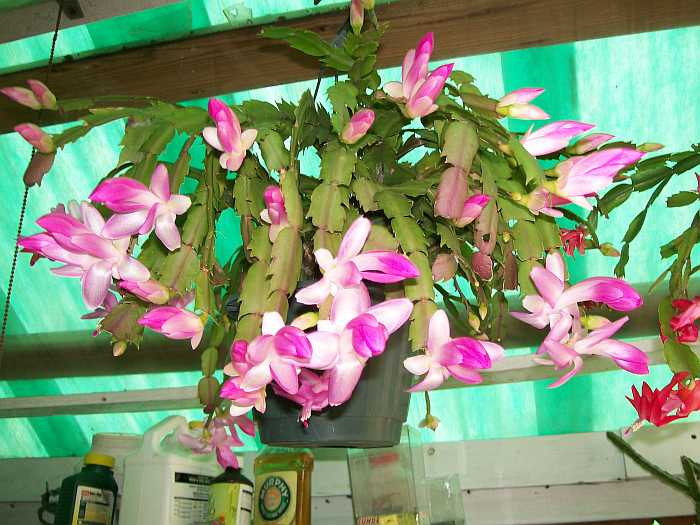

I hope you all receive a Thanksgiving or Christmas Cactus as a hostess gift, if not, go out and buy yourself one. You deserve it!
Happy Growing!
Darren
Sunday, October 31, 2010
The Tag Does NOT Always Speak the Truth
This past week I was out at the fairgrounds, helping to identify some plants that were being placed in the flower shows. It never fails, there are LOTS of people out there that have no clue what they are growing. Yet, they want to enter their prized plants. We get the, it has pretty pink flowers, or, it changes color in the Fall.
To enter a flower show, you need to know the botanical names, as well as the common names.
As any of you that know me, I am a stickler for tags. Just ask my Mother. I like to know what the plant is. That way I know if I need to grow it in the sun, or shade, without taking a chance of cooking it.
However, with that being said, Tags are NOT the be all, to end all. I refer back to the helping identify plants for the flower show. I am the Citrus Guy, just look at the name on the blog you are reading!! I know a little something about Citrus.
We had a woman bring in a monster of a Lemon. It was a very nice specimen. She put it in as a Meyer Lemon. I said, "No, it's not a Meyer, it is a Ponderosa Lemon". She said, "The label that came with the tree says it is a Meyer Lemon". I pulled out my books and showed everybody the difference between a Meyer and a Ponderosa. Meyers have more of a nipple. Ponderosa more flat on the bottom. This was not even discussing the size. Meyers DO NOT get that big. I tried to explain that tags can be wrong. Liners can and do get mixed up at nurseries. Tags can get switched on plants. She insisted that the tag is right and that I didn't know what I was talking about.
So, I just walked away from the situation. The fruit was beautiful, made me envious. Well, apparently one of the judges also knows a little bit about Citrus. She ended up getting only an honorable mention because points were taken off for being misnamed.
I tell you this story to get you to do a little homework when buying plants. I, nor anybody else, will ever be able to identify every plant put in front of them. Tags are a very useful tool, but they can be wrong. If you are buying a plant you are familiar with, but lets say it is a different cultivar, research it online. Flower colors, fruit, what have you. I have a friend that really wanted an Orange tree. He went to a place to get said Orange tree. The salesman said, "YES, we have Orange trees, let me run in back and get one". The tree was beautiful. No flowers, fruit or tag, but very healthy. Well, you know where this is going. The next year it flowered and fruited. The fruit never turned Orange. He contacted me to see what was wrong with it. We talked for a while and I went over to his house. It was a Lime. How did I find out? I tasted one of the green fruit, definitely a Lime. The place he bought it from was now out of business, can't imagine why?! He now has a very nice healthy Lime tree and still wants an Orange tree. People can and will say anything!!
So please, while I sing the praises of tags, they are not always right.
Nurseries and Garden Centers have gone to a more efficient tagging system. They are using tags that are more efficient in tracking inventory. There is more information on them. They know there are more people out there that want to know more about the growing conditions of plant they are buying. In the past you would pick up a Cactus and it would read succulent. While all Cacti are succulents, not all succulents are Cacti. Still, there is a long way to go in the world of plant tags.
I know this posting is a little different from the posts I usually make. I just kind of felt bad for the woman with her Lemon and my friend. I really don't want this kind of thing to happen to anybody else. In today's world, there is too much information available out there and sadly too much dishonesty. You should be able to know exactly what you are getting. Hopefully, this will help at least one person.
On a closing note. Tuesday is election day here in the United States. Those close to me know which way I lean politically and I am not going to bring it up now, it does not belong in a gardening blog. But, I will say this....I don't care if you like Donkeys or Elephants. I don't care if you drink Tea. It doesn't matter if you are Conservative or Liberal. PLEASE, get your fannies out there and VOTE!!
Happy Growing!
Darren
To enter a flower show, you need to know the botanical names, as well as the common names.
As any of you that know me, I am a stickler for tags. Just ask my Mother. I like to know what the plant is. That way I know if I need to grow it in the sun, or shade, without taking a chance of cooking it.
However, with that being said, Tags are NOT the be all, to end all. I refer back to the helping identify plants for the flower show. I am the Citrus Guy, just look at the name on the blog you are reading!! I know a little something about Citrus.
We had a woman bring in a monster of a Lemon. It was a very nice specimen. She put it in as a Meyer Lemon. I said, "No, it's not a Meyer, it is a Ponderosa Lemon". She said, "The label that came with the tree says it is a Meyer Lemon". I pulled out my books and showed everybody the difference between a Meyer and a Ponderosa. Meyers have more of a nipple. Ponderosa more flat on the bottom. This was not even discussing the size. Meyers DO NOT get that big. I tried to explain that tags can be wrong. Liners can and do get mixed up at nurseries. Tags can get switched on plants. She insisted that the tag is right and that I didn't know what I was talking about.
So, I just walked away from the situation. The fruit was beautiful, made me envious. Well, apparently one of the judges also knows a little bit about Citrus. She ended up getting only an honorable mention because points were taken off for being misnamed.
I tell you this story to get you to do a little homework when buying plants. I, nor anybody else, will ever be able to identify every plant put in front of them. Tags are a very useful tool, but they can be wrong. If you are buying a plant you are familiar with, but lets say it is a different cultivar, research it online. Flower colors, fruit, what have you. I have a friend that really wanted an Orange tree. He went to a place to get said Orange tree. The salesman said, "YES, we have Orange trees, let me run in back and get one". The tree was beautiful. No flowers, fruit or tag, but very healthy. Well, you know where this is going. The next year it flowered and fruited. The fruit never turned Orange. He contacted me to see what was wrong with it. We talked for a while and I went over to his house. It was a Lime. How did I find out? I tasted one of the green fruit, definitely a Lime. The place he bought it from was now out of business, can't imagine why?! He now has a very nice healthy Lime tree and still wants an Orange tree. People can and will say anything!!
So please, while I sing the praises of tags, they are not always right.
Nurseries and Garden Centers have gone to a more efficient tagging system. They are using tags that are more efficient in tracking inventory. There is more information on them. They know there are more people out there that want to know more about the growing conditions of plant they are buying. In the past you would pick up a Cactus and it would read succulent. While all Cacti are succulents, not all succulents are Cacti. Still, there is a long way to go in the world of plant tags.
I know this posting is a little different from the posts I usually make. I just kind of felt bad for the woman with her Lemon and my friend. I really don't want this kind of thing to happen to anybody else. In today's world, there is too much information available out there and sadly too much dishonesty. You should be able to know exactly what you are getting. Hopefully, this will help at least one person.
On a closing note. Tuesday is election day here in the United States. Those close to me know which way I lean politically and I am not going to bring it up now, it does not belong in a gardening blog. But, I will say this....I don't care if you like Donkeys or Elephants. I don't care if you drink Tea. It doesn't matter if you are Conservative or Liberal. PLEASE, get your fannies out there and VOTE!!
Happy Growing!
Darren
Sunday, October 24, 2010
Holy Holly!
While I was talking to my mother last weekend, she asked me a question about Hollies. She wanted to know if they should be flowering right now, I gave her one of my solid answers of No,..... well Maybe. How is THAT for decisiveness?
I needed to look it up.
From all the research I have seen, flowering in the Fall is unusual. Hers are. Well, like we always say, apparently the plant did not read the research!
Hollies are a very diverse species of plants. There are over 400 species of the genus Ilex. While some Hollies are native to the United States, many were introduced from South America and Asia.
There are of course the hollies that you see all the time and can tell it is a holly. For instance you have the Ilex aquifolium, also known as the English Holly.
 Makes you think of Christmas doesn't it? There IS a reason the song goes, "Deck the halls with boughs of Holly"!
Then there are the plants that if you didn't know them, you would not think of it as holly. For instance you have the Ilex vomitoria. This one is named because it was used by Southeastern Native Americans as a ceremonial stimulant known as "The Black Drink". As the name suggests, the tea's purgative properties were one of its main uses, most often ritually.
 Also known as the Dwarf Yaupon Holly. There is a taller version of the Yaupon and a Weeping version of the taller one.
Okay, how about this one? It is commonly known as the Inkberry Holly, (Ilex glabra)
 Doesn't really look like a Holly, now does it?
So as you can see there are MANY different characteristics of the Holly. They can be deciduous or evergreen, small (18") or large (over 50'), and may be rounded, pyramidal or columnar in form. There are many, many similarities however.
Hollies are dioecious plants which means male and female flowers are located on separate plants. Female plants produce berries while male plants do not.
Many selections or cultivars are female plants which produce attractive fruit. Most dwarf cultivars do not produce berries since they are commonly propagated vegetatively from male plants. A male plant must be in the vicinity to pollinate the female plant. Pollen is transported primarily by bees from distances of 1 1/2 to 2 miles. So there is a VERY good chance that there will be a male nearby to your female plant. Of course, like everything else in Nature, there are exceptions, and there are hollies that are self pollinating.
While most people find the berries very pretty, they are somewhat toxic to humans, though their poisonous properties are overstated and fatalities almost unknown. They are an extremely important food source for birds and other wild animals. The colors of the berries can range from the common red, to a yellow orange to black, depending on the cultivar.
Most hollies require well drained soil that is rich in organic matter and slightly acid. They can grow in sun or shade, but will produce more berries in a sunnier spot.
They prefer a moist soil, but certainly not wet. They should never be allowed to stand in water for extended periods of time as they will develop root rot. Irrigation will be needed if a dry spell occurs.
Fertilize established hollies in March with any good fertilizer that is listed for acid loving plants or hollies themselves.
Holly can be grown from seed, but is seldom done due to the length of time required and the variabilty of the seedlings. Cuttings are more commonly used. Done in the Spring time, cuttings should be 3 to 5 inches long and treated with a rooting hormone. A humid environment to minimize water loss is required for optimum rooting.
Hollies require minimal pruning except to train the plants for special purposes, (i.e. topiaries, animal shapes, etc.) or to remove diseased or dead branches. Since they produce berries in the Fall that remain throughout the Winter they should be pruned in late Winter, before new growth begins to emerge. Any heavy pruning after flowering in the Spring will most likely remove berries.
For the most part, if you take good care of your hollies, they are relatively pest free. The most common insect pests found include scale, leaf miners, mites and spittlebugs. Many different scale insects injure hollies by sucking plant juices from leaves and stems. A substance called honeydew is secreted by some scales and a sooty mold fungus grows on the honeydew. Besides the unattractive appearance of sooty mold, hollies infested with scale become weak and unproductive.
Diseases known to attack hollies include twig dieback, stem gall, and root rot. Again, if you take good care of your bushes, they should not have much problem.
Here are some interesting Holly facts I found:
The ancient Romans believed that holly warded off lightning strikes and witchcraft and sent boughs of holly to friends during the festival of Saturnalia, which is celebrated at the Winter solstice.
The use of Holly as a symbolic winter decoration, with its shiny, prickly leaves and blood-red berries, goes back in history to the Celtic peoples of Northern Europe, who decorated their homes with it during the time of the Winter solstice, or Yule.
The early Christian Church retained many of the Celtic and Roman traditions to help celebrate the birth of Christ. The early Celtic Christians associated the prickly holly leaves with the crown of thorns from the crucifixion and the red berries with the blood of Christ.
As many of you know, I love Christmas and I love using Green Holly bushes as decoration, but my absolute favorite Holly is the Variegated English Holly.

I will leave you with one more little Holly fact, well, it may not be fact, but I believe in it. Last year, I noticed that all the Holly bushes here where VERY heavy with berries and I predicted a cold Winter, which we got. I believe that Mother Nature produced a heavy crop of berries to feed all the critters over that cold Winter. I am noticing a light set of fruit this year and it has been predicted to be a warmer, drier Winter than usual.....coincidence? We will see!
Happy Growing!
Darren
I needed to look it up.
From all the research I have seen, flowering in the Fall is unusual. Hers are. Well, like we always say, apparently the plant did not read the research!
Hollies are a very diverse species of plants. There are over 400 species of the genus Ilex. While some Hollies are native to the United States, many were introduced from South America and Asia.
There are of course the hollies that you see all the time and can tell it is a holly. For instance you have the Ilex aquifolium, also known as the English Holly.

Then there are the plants that if you didn't know them, you would not think of it as holly. For instance you have the Ilex vomitoria. This one is named because it was used by Southeastern Native Americans as a ceremonial stimulant known as "The Black Drink". As the name suggests, the tea's purgative properties were one of its main uses, most often ritually.

Okay, how about this one? It is commonly known as the Inkberry Holly, (Ilex glabra)

So as you can see there are MANY different characteristics of the Holly. They can be deciduous or evergreen, small (18") or large (over 50'), and may be rounded, pyramidal or columnar in form. There are many, many similarities however.
Hollies are dioecious plants which means male and female flowers are located on separate plants. Female plants produce berries while male plants do not.
Many selections or cultivars are female plants which produce attractive fruit. Most dwarf cultivars do not produce berries since they are commonly propagated vegetatively from male plants. A male plant must be in the vicinity to pollinate the female plant. Pollen is transported primarily by bees from distances of 1 1/2 to 2 miles. So there is a VERY good chance that there will be a male nearby to your female plant. Of course, like everything else in Nature, there are exceptions, and there are hollies that are self pollinating.
While most people find the berries very pretty, they are somewhat toxic to humans, though their poisonous properties are overstated and fatalities almost unknown. They are an extremely important food source for birds and other wild animals. The colors of the berries can range from the common red, to a yellow orange to black, depending on the cultivar.
Most hollies require well drained soil that is rich in organic matter and slightly acid. They can grow in sun or shade, but will produce more berries in a sunnier spot.
They prefer a moist soil, but certainly not wet. They should never be allowed to stand in water for extended periods of time as they will develop root rot. Irrigation will be needed if a dry spell occurs.
Fertilize established hollies in March with any good fertilizer that is listed for acid loving plants or hollies themselves.
Holly can be grown from seed, but is seldom done due to the length of time required and the variabilty of the seedlings. Cuttings are more commonly used. Done in the Spring time, cuttings should be 3 to 5 inches long and treated with a rooting hormone. A humid environment to minimize water loss is required for optimum rooting.
Hollies require minimal pruning except to train the plants for special purposes, (i.e. topiaries, animal shapes, etc.) or to remove diseased or dead branches. Since they produce berries in the Fall that remain throughout the Winter they should be pruned in late Winter, before new growth begins to emerge. Any heavy pruning after flowering in the Spring will most likely remove berries.
For the most part, if you take good care of your hollies, they are relatively pest free. The most common insect pests found include scale, leaf miners, mites and spittlebugs. Many different scale insects injure hollies by sucking plant juices from leaves and stems. A substance called honeydew is secreted by some scales and a sooty mold fungus grows on the honeydew. Besides the unattractive appearance of sooty mold, hollies infested with scale become weak and unproductive.
Diseases known to attack hollies include twig dieback, stem gall, and root rot. Again, if you take good care of your bushes, they should not have much problem.
Here are some interesting Holly facts I found:
The ancient Romans believed that holly warded off lightning strikes and witchcraft and sent boughs of holly to friends during the festival of Saturnalia, which is celebrated at the Winter solstice.
The use of Holly as a symbolic winter decoration, with its shiny, prickly leaves and blood-red berries, goes back in history to the Celtic peoples of Northern Europe, who decorated their homes with it during the time of the Winter solstice, or Yule.
The early Christian Church retained many of the Celtic and Roman traditions to help celebrate the birth of Christ. The early Celtic Christians associated the prickly holly leaves with the crown of thorns from the crucifixion and the red berries with the blood of Christ.
As many of you know, I love Christmas and I love using Green Holly bushes as decoration, but my absolute favorite Holly is the Variegated English Holly.
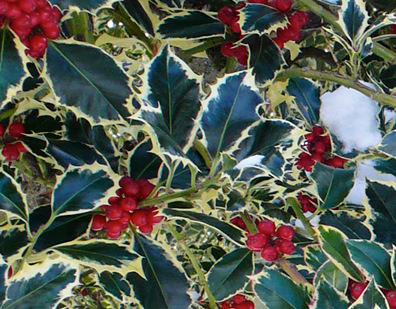
I will leave you with one more little Holly fact, well, it may not be fact, but I believe in it. Last year, I noticed that all the Holly bushes here where VERY heavy with berries and I predicted a cold Winter, which we got. I believe that Mother Nature produced a heavy crop of berries to feed all the critters over that cold Winter. I am noticing a light set of fruit this year and it has been predicted to be a warmer, drier Winter than usual.....coincidence? We will see!
Happy Growing!
Darren
Sunday, October 17, 2010
Oh Yea, They're Hot!
Well, Summer has gone. Fall is fast approaching. Winter will soon rear it's ugly head. I do have a little something that will make some of you smile, I know my mother will.....Only 64 more days until the days start getting longer again!
Like most of you, I use the Winter to start planning my next years garden. The catalogs come in and I start drooling over everything. I want at least one of each and sometimes two.
One thing that I love to grow is Hot Peppers, and boy, I had a great crop this year. So, to give you some ideas of what to start dreaming about, I thought I would give you some pictures of and information about, Hot Peppers.
Chili peppers or hot peppers have been a part of the human diet since at least 7500 BC. There is archaeological evidence at sites located in southwestern Ecuador that chili peppers were domesticated more than 6000 years ago,and is one of the first cultivated crops in the Americas that is self-pollinating.
Christopher Columbus called them "Peppers", because they had a bite similar to white and black pepper, incidentally there is no botanical relationship between the two. Hot Peppers are in the genus Capsicum spp. and the black and white pepper are Piper nigrum.
There are only a few common species of peppers, those being:
Capsicum annuum, which includes many common varieties such as bell peppers, wax, cayenne, jalapeños, and the chiltepin
Capsicum frutescens, which includes the chiles de árbol, malagueta, tabasco and Thai peppers
Capsicum chinense, which includes the hottest peppers such as the naga, habanero, Datil and Scotch bonnet
Capsicum pubescens, which includes the South American rocoto peppers
Capsicum baccatum, which includes the South American aji peppers.
Even though there are only a few species, there are many cultivars and hybrids. However, peppers are commonly broken down into only three groupings: bell peppers, sweet peppers, and hot peppers. I like the hot peppers and I usually end up with the C. chinese, C. annum and C. frutescens. The hotter the better.
I did a blog sometime ago on Scoville units, so I won't go into great detail here on them. Just a quick overview, Bell peppers rate a zero. Jalapenos rate between 2,500-8000. Tabasco peppers rate 30,000-50,000. Bhut Jolokia (Ghost peppers) rate 800,000-1,000,000. Yes, you read that right, One Million. That's a hotta peppa!!
I use some of those as dehydrated flakes on my scrambled eggs. These ranges will vary according to growing conditions, heat, soil, water and a host of other things, so take them with a grain of salt.
Want to see some pictures so you know what to look for in the catalogs?
 CHILE HABANERO
 JALAPENO
 ATOMIC STARFISH
 DOLMALIK (From Turkey)
 BHUT JOLOKIA
Peppers take roughly 70 – 90 days to mature and during this time they like to be kept as warm as possible. 80 degrees is where they like it, they can and will handle lower temperatures, they just won't do as well. I think I had such a great season because of how freekin hot it was this year!
They want full sun and in their early part of life, a good amount of water. A well drained soil helps to avoid root rot.
Peppers are ready to be picked as soon as they are big enough or you can leave them to change color and flavor gradually. I like to see what color they are going to change to. The Atomic Starfish turn a really pretty shade of Orange. Many will turn Red, Yellow, Orange, Black and all shades in between. Habanero Peppers can even come in Brown or White.
One thing that you should remember when handling these little packets of fire, the oils will get on your hand no matter how careful you are. I know a person that was working with peppers last weekend. She was telling me that if she happened to be biting her cuticles even 6 days later, it burned her lips and tongue. I found a little secret that worked for me if my hands are burning. My wife uses these wipes to remove makeup at night, I rub them all over my hands and it seems to help. Give it a try sometime.
Harvesting your peppers will cause you to have many more. The plant will continue to try and reproduce until frost kills it. Not a bad problem to have I think.
So when the Winter blahs really start to get to you and the catalogs are starting to pile up, look up some hot peppers. If you have saved any or canned any from the Summer, they will warm you up on a cold Winter's night. Just writing about them makes me want some of my Jalapeno poppers, time to eat!
Happy Growing!
Darren
Like most of you, I use the Winter to start planning my next years garden. The catalogs come in and I start drooling over everything. I want at least one of each and sometimes two.
One thing that I love to grow is Hot Peppers, and boy, I had a great crop this year. So, to give you some ideas of what to start dreaming about, I thought I would give you some pictures of and information about, Hot Peppers.
Chili peppers or hot peppers have been a part of the human diet since at least 7500 BC. There is archaeological evidence at sites located in southwestern Ecuador that chili peppers were domesticated more than 6000 years ago,and is one of the first cultivated crops in the Americas that is self-pollinating.
Christopher Columbus called them "Peppers", because they had a bite similar to white and black pepper, incidentally there is no botanical relationship between the two. Hot Peppers are in the genus Capsicum spp. and the black and white pepper are Piper nigrum.
There are only a few common species of peppers, those being:
Capsicum annuum, which includes many common varieties such as bell peppers, wax, cayenne, jalapeños, and the chiltepin
Capsicum frutescens, which includes the chiles de árbol, malagueta, tabasco and Thai peppers
Capsicum chinense, which includes the hottest peppers such as the naga, habanero, Datil and Scotch bonnet
Capsicum pubescens, which includes the South American rocoto peppers
Capsicum baccatum, which includes the South American aji peppers.
Even though there are only a few species, there are many cultivars and hybrids. However, peppers are commonly broken down into only three groupings: bell peppers, sweet peppers, and hot peppers. I like the hot peppers and I usually end up with the C. chinese, C. annum and C. frutescens. The hotter the better.
I did a blog sometime ago on Scoville units, so I won't go into great detail here on them. Just a quick overview, Bell peppers rate a zero. Jalapenos rate between 2,500-8000. Tabasco peppers rate 30,000-50,000. Bhut Jolokia (Ghost peppers) rate 800,000-1,000,000. Yes, you read that right, One Million. That's a hotta peppa!!
I use some of those as dehydrated flakes on my scrambled eggs. These ranges will vary according to growing conditions, heat, soil, water and a host of other things, so take them with a grain of salt.
Want to see some pictures so you know what to look for in the catalogs?


Peppers take roughly 70 – 90 days to mature and during this time they like to be kept as warm as possible. 80 degrees is where they like it, they can and will handle lower temperatures, they just won't do as well. I think I had such a great season because of how freekin hot it was this year!
They want full sun and in their early part of life, a good amount of water. A well drained soil helps to avoid root rot.
Peppers are ready to be picked as soon as they are big enough or you can leave them to change color and flavor gradually. I like to see what color they are going to change to. The Atomic Starfish turn a really pretty shade of Orange. Many will turn Red, Yellow, Orange, Black and all shades in between. Habanero Peppers can even come in Brown or White.
One thing that you should remember when handling these little packets of fire, the oils will get on your hand no matter how careful you are. I know a person that was working with peppers last weekend. She was telling me that if she happened to be biting her cuticles even 6 days later, it burned her lips and tongue. I found a little secret that worked for me if my hands are burning. My wife uses these wipes to remove makeup at night, I rub them all over my hands and it seems to help. Give it a try sometime.
Harvesting your peppers will cause you to have many more. The plant will continue to try and reproduce until frost kills it. Not a bad problem to have I think.
So when the Winter blahs really start to get to you and the catalogs are starting to pile up, look up some hot peppers. If you have saved any or canned any from the Summer, they will warm you up on a cold Winter's night. Just writing about them makes me want some of my Jalapeno poppers, time to eat!
Happy Growing!
Darren
Sunday, October 10, 2010
Not Exactly a Domestic Brand
Well, it is nice to be able to write a blog again. The past two weeks have been incredibly hectic. I guess everybody decided to read my last blog on Fall being the best time to plant. We got extremely busy at work, which is a good thing. Then each of the past two weekends, the Master Gardeners have had something going on. Which brings me to today's post.....but first....forgive me for this one folks....I believe today must be a good day to fertilize your plants....it is everybody's most popular fertilizer...10-10-10. Okay, sorry.....I had to get that one out.
I mentioned the Master Gardeners have had a busy couple of weekends. Last week we were out at beautiful Magnolia Gardens for their Autumn on the Ashley event. The MG's were selling plants from the nursery I work at. I had picked them out and passed the word around to all pertinent people. I got a reply back rather quickly that I should investigate and check on one of the plants I was planning on bringing. It is considered an invasive species and we DO NOT want to be known for spreading a bad plant around.
Well, they were half right. The plant that is invasive is Nandina domestica. I was bringing Nandina domestica 'Firepower'. A dwarf version. I will go through some of the differences here.
Also known as heavenly bamboo, and despite the common name, it is not a bamboo at all. Nandina is an evergreen or semi-evergreen woody shrub often used in landscaping. It is a native of China and Japan.
Reaching heights of 6-8 feet tall, it is a very elegant and lacy plant. The dwarf plant only reaches 2-5 feet tall.
Preferring reasonably rich soil, it does not thrive in sand. Nandina can be grown in USDA hardiness zones 4-10. It can take heat and cold, from 110 degrees to 10 degrees. It grows well in full sun to partial shade and requires moderate to low water. It knows practically no pests unless it is extremely stressed. Leaf spot diseases can cause the lower leaves to drop from the plant in the humid regions of the nation. The disease appears to be most severe on plants grown in partial shade where the foliage can remain wet. It is one of the toughest and most adaptable plants in a variety of conditions.
'Firepower' Nandina is a noninvasive selection of the invasive ornamental, Nandina domestica, as determined by the University of Florida/IFAS Infraspecific Taxon Protocol, which is a a tool to evaluate invasiveness of cultivars and varieties. The regular Nandina is listed as a Class I invasive species by the Florida Exotic Pest Plant Council which means that it is "actively disrupting plant communities" It produces seeds which are spread by birds ingesting them. It also spreads slowly by underground rhizomes. 'Firepower' is propagated asexually via division, cuttings or tissue culture. While not considered rhizomatous, the "crown" of 'Firepower' Nandina can increase in diameter with time. Regular Nandina domestica has naturalized and invaded habitats all over the Southeast.
I think the Firepower is much prettier anyway, especially in the Fall. The leaves turn a fire red, hence its name.

Regular Nandina is a little more plain:
 Plus, you see it has the berries.
We went ahead and sold the dwarf 'Firepower', it actually sold very well, once we explained to people it would not be taking over their yards. With all this being said, many cultivars have been developed for size, berry color, and Fall and Winter leaf color, and are available at nurseries.
I am still in the thinking that invasiveness is a state of mind, to some degree. I can make the argument for just about any plant. Crape Myrtles here in the South are practically a staple in any yard, I call them crap myrtles. I see seedlings popping up all over the place in my yard, yet they are revered as the most beautiful thing this side of the Mason Dixon line. My Nandina is just sitting in the corner, minding its own business, and it has the same moniker as a serial killer.....where is the justice?!
Happy Growing!
Darren
I mentioned the Master Gardeners have had a busy couple of weekends. Last week we were out at beautiful Magnolia Gardens for their Autumn on the Ashley event. The MG's were selling plants from the nursery I work at. I had picked them out and passed the word around to all pertinent people. I got a reply back rather quickly that I should investigate and check on one of the plants I was planning on bringing. It is considered an invasive species and we DO NOT want to be known for spreading a bad plant around.
Well, they were half right. The plant that is invasive is Nandina domestica. I was bringing Nandina domestica 'Firepower'. A dwarf version. I will go through some of the differences here.
Also known as heavenly bamboo, and despite the common name, it is not a bamboo at all. Nandina is an evergreen or semi-evergreen woody shrub often used in landscaping. It is a native of China and Japan.
Reaching heights of 6-8 feet tall, it is a very elegant and lacy plant. The dwarf plant only reaches 2-5 feet tall.
Preferring reasonably rich soil, it does not thrive in sand. Nandina can be grown in USDA hardiness zones 4-10. It can take heat and cold, from 110 degrees to 10 degrees. It grows well in full sun to partial shade and requires moderate to low water. It knows practically no pests unless it is extremely stressed. Leaf spot diseases can cause the lower leaves to drop from the plant in the humid regions of the nation. The disease appears to be most severe on plants grown in partial shade where the foliage can remain wet. It is one of the toughest and most adaptable plants in a variety of conditions.
'Firepower' Nandina is a noninvasive selection of the invasive ornamental, Nandina domestica, as determined by the University of Florida/IFAS Infraspecific Taxon Protocol, which is a a tool to evaluate invasiveness of cultivars and varieties. The regular Nandina is listed as a Class I invasive species by the Florida Exotic Pest Plant Council which means that it is "actively disrupting plant communities" It produces seeds which are spread by birds ingesting them. It also spreads slowly by underground rhizomes. 'Firepower' is propagated asexually via division, cuttings or tissue culture. While not considered rhizomatous, the "crown" of 'Firepower' Nandina can increase in diameter with time. Regular Nandina domestica has naturalized and invaded habitats all over the Southeast.
I think the Firepower is much prettier anyway, especially in the Fall. The leaves turn a fire red, hence its name.
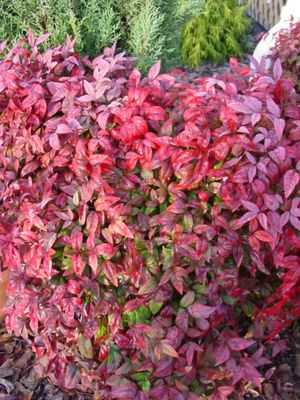
Regular Nandina is a little more plain:

We went ahead and sold the dwarf 'Firepower', it actually sold very well, once we explained to people it would not be taking over their yards. With all this being said, many cultivars have been developed for size, berry color, and Fall and Winter leaf color, and are available at nurseries.
I am still in the thinking that invasiveness is a state of mind, to some degree. I can make the argument for just about any plant. Crape Myrtles here in the South are practically a staple in any yard, I call them crap myrtles. I see seedlings popping up all over the place in my yard, yet they are revered as the most beautiful thing this side of the Mason Dixon line. My Nandina is just sitting in the corner, minding its own business, and it has the same moniker as a serial killer.....where is the justice?!
Happy Growing!
Darren
Subscribe to:
Posts (Atom)