Saturday, November 12, 2011

A Mini Attack

Many of my friends and family consider me "odd". I just heard many of them say "Amen". That is okay, I wear that badge with honor. However,I am like many of my fellow gardeners and plant freaks. We all go through phases of different favorite plants. For me I will always hold Citrus as my most favorite, however, there comes times when other plant families grab our attention. Don't deny it, you know it is true.
Along with my Citrus, I am heavy into Camellias. This helps soothe my competitive side. I enjoy showing and competing in different flower shows.
I also have a very extensive collection of different exotic fruits, many of which I am sure you have never heard of, Pacay, Jabotica and Mamey, just to name a few. These all live next to some of my more normal fruits, Strawberries, Blueberries, Figs, etc.
The past year or so, I have kind of gone back to my roots. Pun intended.
I really cut my horticultural teeth on Cactus' or Cacti if you prefer and Succulents. Though this time, I have aimed at the Mini Succulents.


To begin with succulents and cacti are very easy to grow. Mini succulents are even better! They hardly take up any room and if you are lucky, many will flower for you!
To start, you need to buy from a reputable nursery. there are many online. Just type in mini succulents and a slew of them will pop up. The hardest part is going to be choosing just one plant.
A succulent is any plant with thick, fleshy water storage parts. Succulents store water in their leaves, their stems or their roots. These plants have adapted to survive in very hot, dry conditions throughout the world, from Africa to the deserts of North America.
After you have chosen one or two of them or maybe fifty of them!! I am telling you, it will be tough just to pick a few! You will need to start them off right.
Find yourself a nice pot, make sure it has drainage holes. You can use clay or plastic, it is completely a personal choice, the plants don't care. Many cacti and succulents have shallow fibrous roots and do not require or use the full depth of a standard pot, half pots or pans can be a great choice. Putting a shallow rooted plant in a deep pot can be counter-productive as the soil below the reach of the roots will stay wet for prolonged periods of time after watering and may become stagnant.
Buy a commercially packaged soil mix that is made especially for cacti/succulents or, make your own using equal parts of both coarse sand and potting mix. The biggest thing to remember is, LOTS of drainage. Succulents will develop root rot very easy and they do not like constantly wet feet.


SENECIO SCAPOSUS

Most succulents need as much light as you can give them. The more they get, the happier they are. Let me give you a word of caution here. You may want to bring them in during the Winter, especially if you live somewhere that gets very cold. More on their cold tolerance in a minute. Even if you put them in the sunniest window you have in your house, they will not be getting as much sun as they do being outside. When you bring them back out the following Spring, be careful not to sunburn them.


SUNBURNED CACTUS

To avoid this, bring your plants out gradually. Place them under some taller plants or trees and move them out farther and farther into the full sun every couple of days.
I mentioned earlier that they are easy to grow, unless you have a heavy watering hand. I have literally gone weeks, almost months not watering some of my succulents. I don't suggest this, but it is nice to know that they will survive such harsh treatment. There is no hard and fast rule as to when they should be watered. There are many variables to consider, like, type of pot used. Clay will dry out faster than plastic. The type of soil medium used. If you use more sand, it will naturally dry out faster. Weather plays a big role. Lots of sun and heat will dry the soil out faster than if you have had a week of clouds and cooler temperatures. The bottom line is, the potting mixture should dry out between waterings.


LITHOPS SPP.

Succulents are much more cold tolerant than many people think. In the desert, where there is sometimes a large fluctuation between day and night time temperatures, succulents can live through cold nights. I am sure you have seen pictures of snow covered cacti. NO!!?? Okay, here was some of mine a couple of years ago.


I only lost one and it was not healthy before the storm anyway. In my greenhouse, it has dropped to 30 degrees with no ill effect on any of my other cactus or succulents.
They do like to be fed. If you feed your succulents every 4-6 weeks with your favorite liquid fertilizer, that will be plenty.
Other than the dreaded root rot from too much watering, succulents are pretty much problem free. The only real pests that they encounter will be the occasional Mealy Bug or Aphid. The best thing I have found to use on these is a strong spray of water. Oils and soaps can actually damage the plant more than the insect. You can also pick them off if the infestation is not too severe. If you must use a chemical, please follow the directions...It Is The Law! I would also suggest trying a small spot on an inconspicuous location on the plant and wait and see if it hurts it.


ECHEVERIA HYBRID

No matter what kind of succulent or cacti you're growing, the rules are pretty similar between the different species. They are all easy to grow and will give you years of happiness. I will admit, I had one other reason for writing about these cute little plants other than informing you how to grow them. It is called a little bit of bragging.
I mentioned my competitive side earlier. If you are as bad as I am, you might want to look into your local or state fair. There might just be a category for your little guys.....Like a small container grown plants category. At our local fair, this category was for small growing or classified as dwarf or miniature plants. I went one step farther and entered into the Collectors Showcase Award.
This was the one I won this year!


Happy Growing!
Darren

Sunday, October 30, 2011

Good Nutrition is for your Plants too!

Everyday we are bombarded by news reports and TV commercials stressing good nutrition. Eat right, stay away from fat and sugars, blah, blah, blah.
The past week or so I have been extremely busy as a Master Gardener. I have been working the Home and Garden Show, doing a lecture or two, and working our information booth out at the Coastal Carolina Fair. At every single event I got asked "What is wrong with my plant?"
I think we need to start having those nutrition commercials for plants also. It is absolutely amazing to me the amount of people that think they know how to grow plants, but have no idea that they need to be fed!
Okay, to be fair, I was asked by one nice lady....Why do I need to feed my plants? Nobody is feeding the plants in the forest.
I told her she was partially right. Mother Nature was feeding them. She had a very perplexed look on her face after that.
We have basically screwed with the natural order of things. In the forest, leaves drop off every Autumn. They fall to the ground and decompose. Nobody rakes them up into a nice neat pile and hauls them away. That is food for the plants for next year. Along with animal droppings, worm castings, other plants that die, and all kinds of other micro-organisms. That is how Mother Nature feeds her plants. In short, she has a HUGE compost bin. In our yards we clean, primp, rake, and remove all of that food. It is even worst in our container plants. THAT is why we must feed our plants. She walked away with a brand new look on feeding.
If you look at a bag of plant food, you will see three numbers. There are all kinds of combinations, I will use 5-1-3. The 5 is the amount of Nitrogen in this product.
Nitrogen is the primary component of proteins and is a part of every living cell. This nutrient is usually more responsible for increasing plant growth than any other nutrient, as long as it is used within reason and in conjunction with other nutrients. Shortages can cause slow growth, reduced leaf size, yellowing, short branches, premature Fall color and leaf drop, and increases the likelihood of some diseases. An over abundance can cause excessive shoot and foliage growth, reduced root growth, and increased susceptibility to environmental stresses and some other plant diseases.
This what a Nitrogen deficiency can look like:


Notice the yellow leaves compared to everything around it? This is a Citrus tree that some how or another kept getting missed when it came to feeding time. Everything else around it looks fine. Nitrogen is a nutrient that moves very freely through the soil and is literally washed out every time you water or it rains, especially in a container such as this one. Even in the ground, Nitrogen can be depleted and needs to be replaced.
The second number (1 in my example) is Phosphorus. This nutrient plays a role in photosynthesis, respiration, energy storage and transfer, cell division, and cell enlargement.
Though less common than Nitrogen deficiency, Phosphorus shortages can look like this:


Purple veins may appear on the leaves or the leaves may take on a purplish color. It will also produce stunted growth and small thin stems. Like I mentioned, it is much less common a problem. If you have ever applied any fertilizer, the chances are good that the Phosphorus is still there. It does not move through the soil hardly at all.
The third number, (3 in my example) is Potassium. I should pause here a second and give you a tiny memory trick. Do you have trouble trying to figure out what order the numbers are in on the bag? As long as you can remember the three nutrients, Nitrogen, Phosphorus and Potassium are the three numbers listed on a fertilizer bag, it is always listed in alphabetical order.
Now, back to Potassium deficiency. It too is involved in many of the plants growth processes. It is also vital to photosynthesis and helps regulate water in plants. Potassium fertilization helps plants overcome drought stress, increases disease resistance, and improves Winter hardiness.
It can look like this:


Typical symptoms of Potassium deficiency in plants include brown scorching and curling of leaf tips. The symptoms generally first appear on older leaves. Potassium can move through the soil fairly quickly, faster than Phosphorus, but not as fast as Nitrogen.
That is a very quick idea of what are called the Macro-Nutrients. These are what a plant needs the most of.
There is also a list of Micro-Nutrients. These are needed by the plant, but in much lesser amounts.
This list includes:
Boron. Believed to be involved in carbohydrate transport in plants; it also assists in metabolic regulation. Boron deficiency will often result in bud dieback.
Chlorine. Necessary for osmosis and ionic balance; it also plays a role in photosynthesis.
Copper. A component of some enzymes and of vitamin A. Symptoms of copper deficiency include browning of leaf tips and chlorosis (leaf yellowing).
Iron. Essential for chlorophyll synthesis, which is often why an iron deficiency also results in chlorosis.
Manganese. Activates some important enzymes involved in chlorophyll formation. Manganese deficient plants can develop chlorosis between the veins of its leaves. The availability of manganese is partially dependent on soil pH.
Molybdenum. Essential to plant health. Molybdenum is used by plants to reduce nitrates into usable forms. Some plants use it for nitrogen fixation, thus it may need to be added to some soils before seeding legumes (Beans and Peas).
Zinc. This also participates in chlorophyll formation, and activates many enzymes. Symptoms of zinc deficiency include chlorosis and stunted growth.
So, as you can see, many nutrients rely on each other, or deficiencies can mimic each other.
There is not much need to worry about the Micro-nutrients, most good fertilizers already have them.
Which brings me to my next point. Types of fertilizers.
You should ALWAYS get your soil tested by your local extension office before applying any fertilizer. It could actually save you some money, time, and headaches in the end.
With that being said, the shear number of fertilizers on the market can be overwhelming! There are granules, water soluable, slow release, quick release, natural, and on and on. In a way I can see why people don't feed their plants, they have no idea what to use!!
Let me break down a few of the more common ones.
Slow release fertilizer. It is exactly what it sounds like. They release nutrients at a rate that makes them available to plants over a long period. They are applied less often and many believe they are better for the environment because they have less chance of leaching into the water supply. While I am on this topic, please do not use fertilizer spikes. If you want the whole story as to why not, I can give it to you. Suffice to say, they are just bad news.
Water Soluable. Again, exactly what it sounds like. This fertilizer is mixed with water at a specified rate. This type of fertilizer needs to be applied more often, but it is available to the plant much more quickly.
Natural Fertilizers. When it comes to the naturals, there is often a lot of quess work involved. Most natural materials are far less predictable in nutrient content, nutrient release, and nutrient efficiency than commercial grade fertilizers. Before most natural fertilizers can be absorbed by plants, they have to be broken down to an inorganic form by soil microorganisms through a decaying process called mineralization. This process is affected by moisture, temperature, and the microbial species and populations in the soil. Some examples of Natural fertilizers include, Blood Meal, Sewer Sludge, Animal Manures, Fish Emulsion and Cottonseed Meal.
The advantages and disadvantages of natural and synthetic fertilizers relate to the consumer, not to the plant. Use what you feel comfortable with, or have had success with.
This whole article just barely scratches the surface of fertilizers. I did not even get into the effect soil pH has on fertilizers. Or "when" to fertilize the plant if it is in the ground or in a container, especially if you will be protecting the containerized plants over the Winter or anything else like that. If you have a specific question in that regard, please feel free to contact me.....TheCitrusGuy@netzero.com.
There is so much information out there and new studies are being done almost on a weekly schedule. I wanted to bring your attention to the fact that plants DO need to be fed, whether it be naturally or artificially.
I will leave you with this story, completely true!
A woman came to me with a Citrus problem. She had a Meyer Lemon that she bought two years ago. It was a nice little tree already bearing fruit. She was growing it in a pot. When she came to me, the tree had not produced any fruit the prior year and was turning yellow. After a few questions I found out she did not know it needed to be fed, and had not given it anything to eat in the two years she had owned it!! I asked her how she would feel if she had not eaten in two years!?
Please remember to feed your plants!!
Happy Growing!
Darren

Sunday, October 16, 2011

A Good, Bad Bug?

I was alerted to today's topic by one of my followers,
(Thank You Alicia..a.k.a. lpyrbby )
I figured this was a problem that is starting to reach many parts of the Southeast, so I might want to get a handle on it. This is one of those situations, are you a good bug or a bad bug? Think Wizard of Oz here.
It's scientific name is Megacopta cribraria. It is better known as Bean Plataspid, Lablab Bug, Globular Stink Bug, or Kudzu Bug. It is pea-sized and brownish with a wide back end, kind of like a boxy ladybug.


It was first discovered, I use discovered because it had not been found anywhere on this continent, until Halloween weekend 2009 in Northeast Georgia. Gives a whole new meaning to "Trick or Treat" doesn't it? Let me give you the evidence for good versus bad.
I will start here. The Kudzu Bug eats, what else? Kudzu.
Kudzu is itself an invasive plant. Some of its nicknames include, "Mile a Minute Plant" and "The Vine that Ate the South".


Photo courtesy of Insectsinthecity

The Kudzu plant was introduced to the United States in 1876 at the Centennial Exposition in Philadelphia, then was introduced into the Southeastern United States in 1883 at the New Orleans Exposition. The vine was widely marketed as an ornamental plant to be used to shade porches. In the first half of the 20th century, Kudzu was distributed as a high protein cattle fodder. It was also used as a cover plant to help prevent soil erosion. The Soil Erosion Service recommended its use to control the erosion of slopes, which led to the government aided distribution of 85 million seedlings and government funded plantings. Since then it has been spreading in the Southern U.S. at the rate of 150,000 acres annually. Its quick growth wreaks havoc on the ecosystem, it smothers and strangles other plants, uproots trees and breaks branches with its weight. It tops the nation's invasive species list.
Now, along comes the Kudzu Bug. Its favorite delicacy, Kudzu. The good news here is, it may slow down the spread of this rapidly growing vine, though not significantly. Any help is greatly appreciated.
Sounds like all good news huh?
Well, hold on a second. Did I mention this thing is a type of stinkbug? The smell has been described as "not an awful smell, more of a bittersweet, pungent, unpleasant odor". Some people have reported being able to smell the stench from their cars while crews are cutting Kudzu overgrowth along highways.
Okay fine, get a heavy duty air freshener for your car.
Well, there is more. As Fall approaches and the Kudzu begins to lose its leaves, the bug needs somewhere to go. Apparently they have been seen congregating on light colored surfaces, especially the white parts of houses.


They can invade your attic or crawl space, looking for a place to hunker down for the Winter. A basic insecticide for household pests will temporarily control them around your home, but the best defense is to have good screening up on all of your openings. You will want to gently remove these guys from your home, should they get inside. Squishing them will leave a stain and stink up the joint. Use a vacuum to suck them up, then remove the bag immediately to an outside trash can or place the bugs in a container of soapy water.
Have you decided yet? Good Bug or Bad Bug?
It may help alleviate our Kudzu problem here in the Southeast. The bug can now be found in 143 Georgia counties, all South Carolina counties, 42 North Carolina counties and 5 Alabama counties. As long as we have a good air freshener and some bug spray, we can kind of control him and his stench.
HOWEVER, you knew there was one more caveat didn't you?
The folks in the agriculture world are a little nervous. See, this thing has an appetite for more than just Kudzu. Apparently, it has discovered it likes Wisteria, which again may not be a bad thing here in the South, but also Soybeans, Green Beans and it possibly could be heading for a famous legume, Peanuts. There is also concern that its tastes could broaden even wider. There is no known natural enemy to the Kudzu Bug here in the United States.
How the bug got here remains a mystery. So you decide, Good Bug or Bad Bug? Either way, this is one wicked "Trick or Treat" bestowed upon the United States!
Happy Growing!
Darren

Sunday, October 9, 2011

A Rash of Radishes

Here in the South, we are lucky enough to have almost a 365 day growing season. The cool season crops are just going in. As I was talking to my mother the other day, we were comparing what we had planted so far and what we were planning on planting.
The topic of radishes came up. The California Rare Fruit Growers Association has made this the year of the Pomegranate, I disagree, I think it should be the year of the radish. Apparently my brother has decided to plant LOTS of them and as far as I know, the consumption of radishes in my family is not exactly brisk. Though, for some apparent reason, I even planted some this year. A radish conspiracy?
I had the seeds, so why not?
The radish, Raphanus sativus, is thought to have originated in East Asia or more than likely China, but the exact location is unknown. Egyptian writing reports that radishes were a common food in ancient Egypt before the pyramids were built. In Greece, radishes were so highly valued that imitations of them were made of gold. The radish did not make its way to England until approximately 1548. By 1629 they were being cultivated in Massachusetts.
The earliest radishes to be cultivated were the black varieties.


This variety is turnip-like in size and shape, approximately eight
inches long. Black radishes have a dull black or dark brown skin. When
peeled, their flesh is white, quite pungent, and drier than their other color counterparts.
Black radishes have a longer shelf-life than most other varieties, so they are
available year-round.
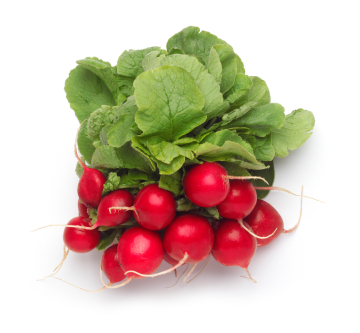
Red Globe is the radish most people know. It is the most popular variety in the United States. This is the familiar looking red and white "button".


One other radish I would like to mention is the Daikons. They are very large, carrot-shaped radishes that are up to 18 inches long and weigh one to two pounds. Daikons have a white flesh that is juicy and a bit hotter than a red radish, but milder than black.


I mentioned that here in the South we have an almost year round growing season. Radishes are considered a cool season crop, preferring temperatures between 40-70 degrees. Optimum temperature range is 60-65 degrees. The nice thing about radishes is, they are a very quick crop to turn around from seed to table. Most requiring only 20-35 days to mature. Even some of my friends up North may still have time to plant some. If nothing else, they work great in a container and can be brought into a garage if the temperature starts to go below freezing. There are some varieties that require 40-50 days.
Because radishes grow so rapidly, a rich, fertile soil is essential. Sandy or sandy-loam soils are preferred. The soil should be free of stones, clods, lumps, and undecayed organic matter. To be mild, tender, and attractive, the radishes must be grown rapidly. Slow growth or checked growth results in roots that are tough, woody, pithy, and pungent. The "hotness" of radishes results from the length of time they have grown rather than from their size.
To plant, sow seeds one quarter to a half inch deep in rows spaced 3 inches apart. After the seedlings appear, you will want to thin them out so they have room to grow. Usually you will want about 2-3 inches apart on all side. Seeds typically sprout in three to seven days when sown in 60 degree soil.
Keep an even moisture level. Sometimes radishes simply split open as they mature and get older, this is the result of uneven watering. Trying to make up for a period of drought with a lot of water all at once will cause the radish to grow too rapidly and split open.
Diseases are not usually a problem when growing radishes, probably due to their quick growth. There are a few pests that you may need to look out for. Flea beetles make numerous small holes in radish leaves.


Flea Beetle

Cabbage root maggots and cutworms sometimes rasp holes or channels into radish skins. Aphids and various caterpillars, such as cabbage loopers and diamondback moths will also eat the leaves. All of these pests are easily prevented by covering the plants with lightweight floating rowcovers.
There are many, many different named radishes on the market, it might take a little research to uncover many of them. Some to look for include: Cherry Belle, Easter Egg, Round Black Spanish,Icicle and the unusual sounding French Breakfast.
Radishes are most often eaten raw. Use a stiff vegetable brush and scrub them under cold running water. Do not peel radishes, unless there is some kind of problem with the skin. Pare away the top and root end then slice, dice, shred, or serve whole.
I have discovered some other interesting ways to eat and use these tasty little treats.
In China and Japan, most of the radish crop is pickled in brine, in much the same way that we pickle cucumbers.
How about an Open-Faced Radish Sandwich

4 bagels cut in half or 8 slices bread
8 ounces cream cheese
6 small globe radishes
salt and pepper

1. Spread bagels or bread slices with 1/4 inch cream cheese.
2. Using s sharp knife or mandolin, slice radishes very thin. Overlap the radish slices on top of the cream cheese. Sprinkle each sandwich with salt and pepper.
Maybe my brother has already seen these recipes and that is why he planted so many. If any of these recipes pan out to be good, maybe I will be planting a Rash Of Radishes myself!
Happy Growing!
Darren

Sunday, September 25, 2011

Popcorn Anybody?

Well, yesterday was the Fall version of the annual North Charleston Plant Swap. It was a smashing success with 90 participants and over 2000 plants swapped. During the setup phase, all was well....until.
The Clemson Extension Agent, who was there to participate, came up to me and said, "We have a problem".
She went on to say that somebody had brought a VERY invasive plant, and as Master Gardeners we really can not let them be propagated. I was not aware that somebody had brought it, at first I was not even aware of how invasive it was. I had heard of it, but was not totally familiar with it.
I am now.
The plant was Sapium sebiferum, also know as the Chinese Tallow Tree, and the Popcorn Tree. You will also find it still listed as Triadica sebifera, but the Sapium sebiferum is the proper name.
The Popcorn tree is native to China and Japan where it has been cultivated for its useful seeds and as an ornamental for more than a thousand years. It is said that Benjamin Franklin introduced it into the United States in 1776 for use of its waxy tallow in soaps and candles.
It is a deciduous tree (loses its leaves) that may reach 60 feet in height. The bark is a light gray. It has heart-shaped leaves with a pointed tip.


Slender, drooping spikes up to 8 inches long appear from April to June. In Fall the leaves turn brilliant shades of scarlet, orange, yellow and maroon.


Popcorn Trees can invade a variety of habitats ranging from swampy to saline waters, and from full sun to shade situations. It is often found growing along roadsides, coastal areas, and streams. Larger specimens can produce up to 100,000 seeds that may be eaten and dispersed by birds, facilitating the spread. Native species are crowded out once the Chinese Tallow becomes established. The leaves and fruit are toxic to cattle and cause nausea and vomiting in humans.
It tolerates almost any soil and can grow 5 feet tall in its first year. They are considered moderately drought tolerant. However, It was planted as a street tree in California where it apparently has not yet become invasive, perhaps because of insufficient rainfall.
They have become so invasive, first off, being that they are a native of Eastern Asia, which is the same latitudes as the Southeastern U.S. they love the growing conditions here, but primarily because of the seeds that are readily eaten and dispersed by birds. The seeds also float and can be carried easily by rivers, streams, and stormwater runoff to new destinations and virtually all of them germinate somewhere. The seeds are in a fruit that are 3 lobed, brown capsules, 1/2 inch in diameter, when mature the outer part splits revealing 3 white waxy seeds that resemble popcorn, hence its common name. They mature in late Summer to early Fall.


Photo Courtesy of University of Georgia

If all of this is not bad enough, The leaves produce allelopathic chemicals that change soil content and therefore makes the area uninhabitable to native species.
It has gotten so bad that, the State of Florida lists the Popcorn Tree or Chinese Tallow as a noxious weed and prohibits its introduction, movement or release.
To kill these things, cut the tree down and immediately paint the stump with a triclopyr herbicide such as Brush-B-Gon, Garlon, Pathfinder, Chopper or something like Round-up brush killer. Make sure you follow the label directions or get a certified professional to apply these. Results also can be obtained by spraying the bark in a 6 inch wide band all around the base of the trunk with one of the triclopyr herbicides. I don't usually suggest such harsh treatment because of the danger it can pose to the homeowner and the landscape, BUT, tests of simply cutting down the trees resulted in extensive root and stump sprouting. Before applying any herbicide, read the label!! I can not emphasize this enough.
This is nasty tree. Yes, it has pretty Fall foliage and can be used for some good shade. Tree species recommended that are similar in size to Chinese Tallow include Maples (Acer spp.) and Crape Myrtles (Lagerstroemia spp.). Might I also suggest to use an Eastern Redbud (Cercis canadensis), or a Red Mulberry (Morus rubra) instead. At least the Red Mulberry will give you something good to eat!
Happy Growing!
Darren

Sunday, September 18, 2011

Mosquito be gone

I was actually searching for a good blog article today when I got a couple of very nice e-mails from a woman who just found my blog. She lives very close by and was wondering about growing Lemon Eucalyptus to rid her yard of mosquitoes.
I am going to use this as an opportunity to help her and others with this biting problem.
I will start with the Corymbia citriodora, or Lemon Eucalyptus, also known as Lemon Scented Gum, and Blue Spotted Gum. There are some sites that still refer to it as Eucalyptus citriodora.


Corymbia citriodora

The U.S. Centers for Disease Prevention and Control has now approved oil of Lemon Eucalyptus, also known as p-menthane 3,8-diol or PMD, as an effective mosquito repellent.
This evergreen tree is native to Queensland, Australia. In nature the trees will reach anywhere from 75-100 ft. Even though it gets very big in nature, it's size is easily controlled with selective pruning. It will even flourish in a large container this way. The trees are hardy in USDA zones 9-11, so a greenhouse will be needed for colder climates.
Citriodora needs full sun with a well-drained soil. These trees grow in very nutrient poor soils and fertilizer is not needed. They are propagated by seed in the Spring.
The oil of the lemon eucalyptus is a natural, plant-based repellent oil that is prepared from the leaves. It is commercially compared to Citronella.
You would think that Citronella would be made from the Citronella Tree (Citronella mucronata) which is native to Chile.


Citronella mucronata

It is an evergreen tree, which can grow up to about 30 feet tall with a diameter of about 3 feet. The bark is dark gray and rough.
In its native habitat, It grows in areas of high humidity and constant rain. It is mostly found on steep slopes, and usually in shaded places where there is protection from direct sunlight. The Citronella Tree can tolerate low temperatures down to about 18 degrees and can even survive an occasional snow.
Well, this is not the source of "true" Citronella oil either.
There is another plant that has a deceptive name of Citronella Plant. It is a geranium plant marketed as "Pelargonium citrosum".


Pelargonium citrosum

The marketing suggests that if you plant this around your yard, it will chase away mosquitoes. Not only is the plant ineffective in repelling mosquitoes, the mosquitoes were seen landing and resting on the plant on a regular basis. It does have a very nice lemony scent.
Okay, I have held you in suspense long enough.....if you want to grow the "true" Citronella oil plant, look for Cymbopogon nardus.


Cymbopogon nardus

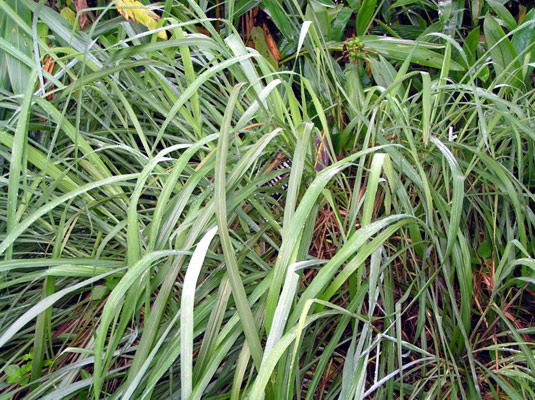
It is a coarse, clump-forming tropical grass that can grow 5-6 ft tall. Citronella grass is native to southeast Asia and grown commercially in Sri Lanka, India, Burma, Indonesia and Java. It is widely naturalized in tropical Asia and grown as an ornamental in South Florida and southern California.
It does best in full sun. It is a perennial (comes back every year) in USDA zones 10-12. It needs a long, warm growing season, and may not survive cool, damp Winters. Being that it does not spread by runners, as some grasses do, but is a clumping grass, growing it in a container is an option. Propagation is by dividing the clumps. It is not picky about its soil, it will grow pretty much in anything you give it.
As I mentioned, Citronella grass is the source of the commercial Citronella oil. The oil from this grass can be mixed with other vegetable oils and used in massages or rubbed on the skin for an insect repellent. If you are one of those that like to burn Citronella candles or incense, I have bad news for you. Studies have shown that to keep mosquitoes away, you would have to burn so many candles that the smoke would be almost intolerable.
It is also been reported that Citronella oil repels cats.
I hope this helps clear up some of the confusion about the different Citronella plants out there. Some will disagree with what I have said, they will swear up and down that the geranium works or that they burn a Citronella candle and they never see a mosquito. This may be true. It is also possible that there wasn't any mosquitoes around or that they found somebody better tasting!
Happy Growing!
Darren
Sunday, September 11, 2011

A Rose by any other name.....

...may not even be a Rose!
This is where the common names of plants can really get you in trouble. The past couple of weeks, I have been asked about some of the tall bushes that have all kinds of flowers on them. What are they? Is the most common question, followed by: Are they hard to grow? and Where do you get them?
The plant in question here is the Rose of Sharon, If you lived in Britain or Australia they would think you are talking about Hypericum calycinum, which is an evergreen flowering shrub native to Southeast Europe and Southwest Asia. We know it here as St. John's Wort.
It looks like this:


I know there are a bunch of people that just had a cow! That is NOT a Rose of Sharon!! It is if you live in Australia or Britain.
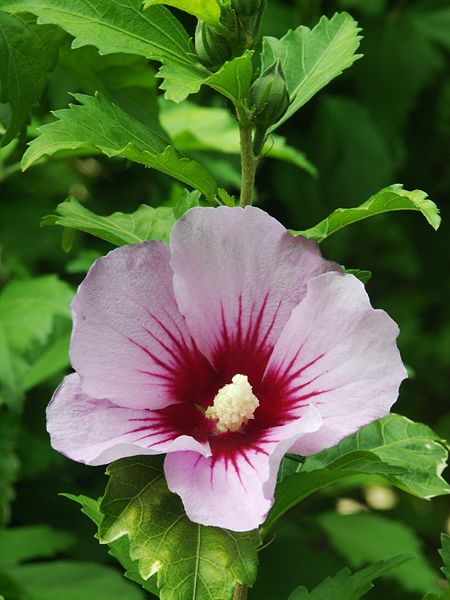
Here in the good old USA, the Rose of Sharon (Hibiscus syriacus) looks like this:


THIS is the plant everybody has been asking me about.
See how common names can get very confusing? Depending on who you ask, or where they are from may determine what kind of plant you get. That is why I try to talk in botanical names whenever possible. It also goes by other common names such as: Althea Rose, Syrian Rose, and Shrubby Althea. There are many other plants out there with an identity crisis, but I digress.
The Rose of Sharon (Hibiscus syriacus) is a deciduous (loses its leaves) flowering shrub native to East Asia. It is the national flower of South Korea and was mentioned in an article produced 1,400 years ago. So this flower has been around for quite sometime.
It is an upright plant that produces colorful, cup-shaped flowers in Summer and Fall. They can range from 2-4 inches across.
The colors are almost infinite in number, including blue, pink, red, lavender, purple, white, and many of these in combinations depending on the variety.


Some have flowers that strongly resemble the familiar hibiscus; as you can see above. There are others that have small double petals that appear rose-like or are almost like a peony.


The Rose of Sharon grows well in USDA hardiness zones 5B through 9A. It will attain a pretty decent size. Averaging from 8-10 feet tall and 6-8 feet wide. It is best to grow Rose of Sharon in full sun, it can tolerate up to part shade. It prefers moist, well drained soil that contains lots of organic matter, though, it is able to tolerate a wide variety of soil and drought conditions. The plant may survive extreme conditions, but the buds may drop off if the plant is watered too much or too little, or if too much fertilizer is applied. When it comes to feeding, fertilize your Rose of Sharon just before the flowering period. Apply a balanced granular fertilizer according to the package directions.
If you want bigger blooms, in the Winter or early Spring, prune off last seasons growth. It will flower on the new growth. This is also a good time to be propagating them. It is easily propagated by hardwood cuttings that are 4 - 6 inches long taken in the Winter and planted about 1-1.5 inches deep in a mixture of coarse sand and peat moss. Stick the cut ends in some rooting hormone and keep these warm, moist and humid. You can also use softwood cuttings in the Spring, using the same method as above.
Aphids and Spider Mites can be a real nuisance, However, one of the biggest problems that Rose of Sharon faces is the Japanese Beetle.


If you have leaves that look like this, then you have a Japanese Beetle problem.


My mother just cringed when she saw these pictures, she is very accustomed to this problem. Her favorite way to deal with it, walk around the yard with a bucket of soapy water and drown the little varmints.
You can also use a product called Milky Spore. It is an organic approach to ridding your yard of the grubs that turn into the beetles. One word of caution, you will need to get pretty much your entire neighborhood involved in this. Just because your yard is protected, they live next door, and the pupating beetles will fly over for a feast.
Diseases that you need to be aware of include leaf spot, blight, and cankers. These can be controlled with fungicides or proper placement of plants. Make sure that there is good air circulation between them and they are planted in the proper place.
As you can imagine, with a history as long as this beautiful flower, there are some interesting tidbits surrounding it, especially in the world of music.
"Rose of Sharon" is a song by Robert Hunter (From the Grateful Dead) which he released on his solo album Tiger Rose.
"Rose of Sharon" is a song sung by Joan Baez on the album Day After Tomorrow.
Judah Robertson has an album entitled "Rose of Sharon".
The Rose of Sharon is referenced in the Bob Dylan song "Caribbean Wind."
Rose of Sharon is also the official flower of Phi Beta Chi, a national Lutheran-based Greek social letter sorority.
There are many, many other references to the Rose of Sharon from Biblical mentions to Novels and Poetry. I just find the flower very pretty and I hope you do too.
Just remember, a Rose by any other name...might just be something completely different!
Happy Growing!
Darren