Sunday, September 25, 2011

Popcorn Anybody?

Well, yesterday was the Fall version of the annual North Charleston Plant Swap. It was a smashing success with 90 participants and over 2000 plants swapped. During the setup phase, all was well....until.
The Clemson Extension Agent, who was there to participate, came up to me and said, "We have a problem".
She went on to say that somebody had brought a VERY invasive plant, and as Master Gardeners we really can not let them be propagated. I was not aware that somebody had brought it, at first I was not even aware of how invasive it was. I had heard of it, but was not totally familiar with it.
I am now.
The plant was Sapium sebiferum, also know as the Chinese Tallow Tree, and the Popcorn Tree. You will also find it still listed as Triadica sebifera, but the Sapium sebiferum is the proper name.
The Popcorn tree is native to China and Japan where it has been cultivated for its useful seeds and as an ornamental for more than a thousand years. It is said that Benjamin Franklin introduced it into the United States in 1776 for use of its waxy tallow in soaps and candles.
It is a deciduous tree (loses its leaves) that may reach 60 feet in height. The bark is a light gray. It has heart-shaped leaves with a pointed tip.


Slender, drooping spikes up to 8 inches long appear from April to June. In Fall the leaves turn brilliant shades of scarlet, orange, yellow and maroon.


Popcorn Trees can invade a variety of habitats ranging from swampy to saline waters, and from full sun to shade situations. It is often found growing along roadsides, coastal areas, and streams. Larger specimens can produce up to 100,000 seeds that may be eaten and dispersed by birds, facilitating the spread. Native species are crowded out once the Chinese Tallow becomes established. The leaves and fruit are toxic to cattle and cause nausea and vomiting in humans.
It tolerates almost any soil and can grow 5 feet tall in its first year. They are considered moderately drought tolerant. However, It was planted as a street tree in California where it apparently has not yet become invasive, perhaps because of insufficient rainfall.
They have become so invasive, first off, being that they are a native of Eastern Asia, which is the same latitudes as the Southeastern U.S. they love the growing conditions here, but primarily because of the seeds that are readily eaten and dispersed by birds. The seeds also float and can be carried easily by rivers, streams, and stormwater runoff to new destinations and virtually all of them germinate somewhere. The seeds are in a fruit that are 3 lobed, brown capsules, 1/2 inch in diameter, when mature the outer part splits revealing 3 white waxy seeds that resemble popcorn, hence its common name. They mature in late Summer to early Fall.


Photo Courtesy of University of Georgia

If all of this is not bad enough, The leaves produce allelopathic chemicals that change soil content and therefore makes the area uninhabitable to native species.
It has gotten so bad that, the State of Florida lists the Popcorn Tree or Chinese Tallow as a noxious weed and prohibits its introduction, movement or release.
To kill these things, cut the tree down and immediately paint the stump with a triclopyr herbicide such as Brush-B-Gon, Garlon, Pathfinder, Chopper or something like Round-up brush killer. Make sure you follow the label directions or get a certified professional to apply these. Results also can be obtained by spraying the bark in a 6 inch wide band all around the base of the trunk with one of the triclopyr herbicides. I don't usually suggest such harsh treatment because of the danger it can pose to the homeowner and the landscape, BUT, tests of simply cutting down the trees resulted in extensive root and stump sprouting. Before applying any herbicide, read the label!! I can not emphasize this enough.
This is nasty tree. Yes, it has pretty Fall foliage and can be used for some good shade. Tree species recommended that are similar in size to Chinese Tallow include Maples (Acer spp.) and Crape Myrtles (Lagerstroemia spp.). Might I also suggest to use an Eastern Redbud (Cercis canadensis), or a Red Mulberry (Morus rubra) instead. At least the Red Mulberry will give you something good to eat!
Happy Growing!
Darren

Sunday, September 18, 2011

Mosquito be gone

I was actually searching for a good blog article today when I got a couple of very nice e-mails from a woman who just found my blog. She lives very close by and was wondering about growing Lemon Eucalyptus to rid her yard of mosquitoes.
I am going to use this as an opportunity to help her and others with this biting problem.
I will start with the Corymbia citriodora, or Lemon Eucalyptus, also known as Lemon Scented Gum, and Blue Spotted Gum. There are some sites that still refer to it as Eucalyptus citriodora.


Corymbia citriodora

The U.S. Centers for Disease Prevention and Control has now approved oil of Lemon Eucalyptus, also known as p-menthane 3,8-diol or PMD, as an effective mosquito repellent.
This evergreen tree is native to Queensland, Australia. In nature the trees will reach anywhere from 75-100 ft. Even though it gets very big in nature, it's size is easily controlled with selective pruning. It will even flourish in a large container this way. The trees are hardy in USDA zones 9-11, so a greenhouse will be needed for colder climates.
Citriodora needs full sun with a well-drained soil. These trees grow in very nutrient poor soils and fertilizer is not needed. They are propagated by seed in the Spring.
The oil of the lemon eucalyptus is a natural, plant-based repellent oil that is prepared from the leaves. It is commercially compared to Citronella.
You would think that Citronella would be made from the Citronella Tree (Citronella mucronata) which is native to Chile.


Citronella mucronata

It is an evergreen tree, which can grow up to about 30 feet tall with a diameter of about 3 feet. The bark is dark gray and rough.
In its native habitat, It grows in areas of high humidity and constant rain. It is mostly found on steep slopes, and usually in shaded places where there is protection from direct sunlight. The Citronella Tree can tolerate low temperatures down to about 18 degrees and can even survive an occasional snow.
Well, this is not the source of "true" Citronella oil either.
There is another plant that has a deceptive name of Citronella Plant. It is a geranium plant marketed as "Pelargonium citrosum".


Pelargonium citrosum

The marketing suggests that if you plant this around your yard, it will chase away mosquitoes. Not only is the plant ineffective in repelling mosquitoes, the mosquitoes were seen landing and resting on the plant on a regular basis. It does have a very nice lemony scent.
Okay, I have held you in suspense long enough.....if you want to grow the "true" Citronella oil plant, look for Cymbopogon nardus.


Cymbopogon nardus

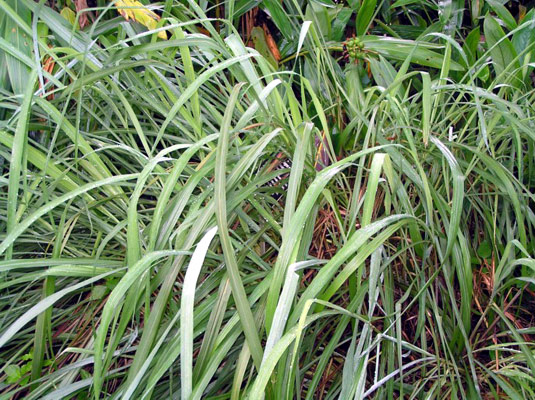
It is a coarse, clump-forming tropical grass that can grow 5-6 ft tall. Citronella grass is native to southeast Asia and grown commercially in Sri Lanka, India, Burma, Indonesia and Java. It is widely naturalized in tropical Asia and grown as an ornamental in South Florida and southern California.
It does best in full sun. It is a perennial (comes back every year) in USDA zones 10-12. It needs a long, warm growing season, and may not survive cool, damp Winters. Being that it does not spread by runners, as some grasses do, but is a clumping grass, growing it in a container is an option. Propagation is by dividing the clumps. It is not picky about its soil, it will grow pretty much in anything you give it.
As I mentioned, Citronella grass is the source of the commercial Citronella oil. The oil from this grass can be mixed with other vegetable oils and used in massages or rubbed on the skin for an insect repellent. If you are one of those that like to burn Citronella candles or incense, I have bad news for you. Studies have shown that to keep mosquitoes away, you would have to burn so many candles that the smoke would be almost intolerable.
It is also been reported that Citronella oil repels cats.
I hope this helps clear up some of the confusion about the different Citronella plants out there. Some will disagree with what I have said, they will swear up and down that the geranium works or that they burn a Citronella candle and they never see a mosquito. This may be true. It is also possible that there wasn't any mosquitoes around or that they found somebody better tasting!
Happy Growing!
Darren

Sunday, September 11, 2011

A Rose by any other name.....

...may not even be a Rose!
This is where the common names of plants can really get you in trouble. The past couple of weeks, I have been asked about some of the tall bushes that have all kinds of flowers on them. What are they? Is the most common question, followed by: Are they hard to grow? and Where do you get them?
The plant in question here is the Rose of Sharon, If you lived in Britain or Australia they would think you are talking about Hypericum calycinum, which is an evergreen flowering shrub native to Southeast Europe and Southwest Asia. We know it here as St. John's Wort.
It looks like this:


I know there are a bunch of people that just had a cow! That is NOT a Rose of Sharon!! It is if you live in Australia or Britain.
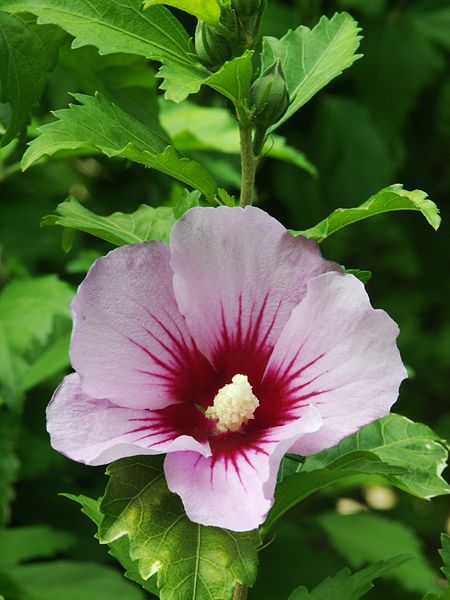
Here in the good old USA, the Rose of Sharon (Hibiscus syriacus) looks like this:


THIS is the plant everybody has been asking me about.
See how common names can get very confusing? Depending on who you ask, or where they are from may determine what kind of plant you get. That is why I try to talk in botanical names whenever possible. It also goes by other common names such as: Althea Rose, Syrian Rose, and Shrubby Althea. There are many other plants out there with an identity crisis, but I digress.
The Rose of Sharon (Hibiscus syriacus) is a deciduous (loses its leaves) flowering shrub native to East Asia. It is the national flower of South Korea and was mentioned in an article produced 1,400 years ago. So this flower has been around for quite sometime.
It is an upright plant that produces colorful, cup-shaped flowers in Summer and Fall. They can range from 2-4 inches across.
The colors are almost infinite in number, including blue, pink, red, lavender, purple, white, and many of these in combinations depending on the variety.


Some have flowers that strongly resemble the familiar hibiscus; as you can see above. There are others that have small double petals that appear rose-like or are almost like a peony.


The Rose of Sharon grows well in USDA hardiness zones 5B through 9A. It will attain a pretty decent size. Averaging from 8-10 feet tall and 6-8 feet wide. It is best to grow Rose of Sharon in full sun, it can tolerate up to part shade. It prefers moist, well drained soil that contains lots of organic matter, though, it is able to tolerate a wide variety of soil and drought conditions. The plant may survive extreme conditions, but the buds may drop off if the plant is watered too much or too little, or if too much fertilizer is applied. When it comes to feeding, fertilize your Rose of Sharon just before the flowering period. Apply a balanced granular fertilizer according to the package directions.
If you want bigger blooms, in the Winter or early Spring, prune off last seasons growth. It will flower on the new growth. This is also a good time to be propagating them. It is easily propagated by hardwood cuttings that are 4 - 6 inches long taken in the Winter and planted about 1-1.5 inches deep in a mixture of coarse sand and peat moss. Stick the cut ends in some rooting hormone and keep these warm, moist and humid. You can also use softwood cuttings in the Spring, using the same method as above.
Aphids and Spider Mites can be a real nuisance, However, one of the biggest problems that Rose of Sharon faces is the Japanese Beetle.


If you have leaves that look like this, then you have a Japanese Beetle problem.


My mother just cringed when she saw these pictures, she is very accustomed to this problem. Her favorite way to deal with it, walk around the yard with a bucket of soapy water and drown the little varmints.
You can also use a product called Milky Spore. It is an organic approach to ridding your yard of the grubs that turn into the beetles. One word of caution, you will need to get pretty much your entire neighborhood involved in this. Just because your yard is protected, they live next door, and the pupating beetles will fly over for a feast.
Diseases that you need to be aware of include leaf spot, blight, and cankers. These can be controlled with fungicides or proper placement of plants. Make sure that there is good air circulation between them and they are planted in the proper place.
As you can imagine, with a history as long as this beautiful flower, there are some interesting tidbits surrounding it, especially in the world of music.
"Rose of Sharon" is a song by Robert Hunter (From the Grateful Dead) which he released on his solo album Tiger Rose.
"Rose of Sharon" is a song sung by Joan Baez on the album Day After Tomorrow.
Judah Robertson has an album entitled "Rose of Sharon".
The Rose of Sharon is referenced in the Bob Dylan song "Caribbean Wind."
Rose of Sharon is also the official flower of Phi Beta Chi, a national Lutheran-based Greek social letter sorority.
There are many, many other references to the Rose of Sharon from Biblical mentions to Novels and Poetry. I just find the flower very pretty and I hope you do too.
Just remember, a Rose by any other name...might just be something completely different!
Happy Growing!
Darren

Monday, August 29, 2011

Let's go to Bahia!

I have a very interesting thing going to happen in the next two weeks that I will talk about in a future Blog. Suffice it to say, it involves my Citrus and my yard. So, I have to really get to work and clean up a few things, you know...weed, prune, hide the dead stuff....the normal type of things to do if there was major company coming over...hint, hint.
I am trying to shift my grass mowing schedule off, by a couple of days, so it will look nice for a specific date. As I was glancing over it, I realized I don't really have a "normal" grass. Most people have heard of Zoysia, Centipede or Bermuda. I mostly have Bahia.

Bahiagrass (
Paspalum notatum) was introduced from Brazil in 1914. It was originally used as a pasture grass on the sandy soils of the Southeastern United States. It is also known as Highway Grass. It is an aggressive, warm season perennial (comes back every year) grass. Bahiagrass is primarily planted in the deep South and coastal areas as shown in this map.

Bahiagrass spreads by seeds and rhizomes (a horizontal, modified stem found at or just below ground level) and forms an extensive, deep root system. It sustains better than other grasses in infertile, sandy soils and does not require high inputs of water or fertilizer. It is very drought tolerant. The aggressive nature and drought tolerance of Bahiagrass makes it ideal for erosion control along roadsides and highway rights of way. Hence it's other name of Highway Grass. This does come at a cost though, it also makes it difficult to control as a weed in the landscape. Or in my case, the entire lawn. Although Bahiagrass does not produce a carpet like, dense lawn like some other warm season lawn grasses, it does provide a good, low maintenance lawn where slightly reduced visual quality is acceptable. That is me all over!
Bahiagrass is easily identified by its distinctive “Y-shaped” seed head. You have probably seen it a million times if you have spent anytime in the South. It looks like this:


There are some disadvantages to having this grass take over the yard. Many people find the tall, unsightly seed heads that show up throughout the Summer, and Fall months objectionable. So to this end, it needs to be cut every 5-7 days. Those seed stems are also very tough and can wear out mower blades, requiring them to be sharpened frequently. It is recommended that it be cut to a height of 3-4 inches.
Bahiagrass will go dormant and turn brown during drought situations and in the Winter after the first good frost. It also responds quickly to rainfall after a severe drought, greening up fast.
It prefers an acidic soil,or low pH. A high pH tends to cause yellowing of the leaf tissue due to its inability to absorb iron, causing an iron deficiency. In the research I have seen, this grass does not have good tolerance for shade, traffic, or saltwater. I can agree with the shade and traffic, it definitely does not like to grow under trees or be stepped upon a lot. I do not have any salt issues, so I can only go by the research here, but it would not surprise me to see it flounder at the beach. Some pun intended.
Bahiagrass has very few to any insect problems, but it is susceptible to mole crickets. There are only a few disease problems, none of which are severe, and for the most part are rare.
Many people out there that want a golf course perfect looking lawn. Bahiagrass will screw that up in a heartbeat. It grows in an open growth habit, which can result in weed encroachment into sparse areas. It has a coarse leaf texture and it provides less cushioning for recreational activities than some of the other grass' might. I am not going to go into the ins and outs of ridding your grass of this weed. There are many products out there, all with different ways and times of application, for control. Before starting a weed control program homeowners should realize that complete eradication of Bahiagrass (or any weed for that matter) from the landscape is not practical. A better approach is to control (not eradicate) the weed by limiting the infestation to a tolerable level.
The way I look at it, if it is green and it is growing, I have a lawn!
Happy Growing!
Darren

Sunday, August 21, 2011

Oh Gee, an Ogeechee Lime

I have just recently gotten reconnected with an old friend of mine. Probably been two years or so since we last spoke. He runs a nursery in the upper part of South Carolina. He is one of my Citrus mentors and I have learned a great deal from him. I was asking how business has been and how all of his Citrus trees (he has a grove up there) have fared. I didn't know it, but he has branched out from just Citrus and vegetables. He was telling me all the cool new fruits he has started selling and one of them REALLY caught my eye.....The Ogeechee Lime. Of course being the Citrus Guy I had to find out more about this "Lime," I had never heard of. Well, it's not Citrus folks!
The Ogeechee Lime (Nyssa ogeche) is in the Tupelo Family. It is also known as Ogeechee tupelo, sour tupelo gum, white tupelo, and bee tupelo.
This tree is native to the Southeast and was first discovered by William Bartram along the Ogeechee River in Georgia. Ogeechee tupelo requires a very moist site and is distributed along the borders of rivers, swamps, and ponds. So if you have a really wet spot in your yard that nothing seems to grow in, this might just be the plant you are looking for.
At maturity it will average between 30 and 40 feet tall with a 25-30 foot spread. It is deciduous, so you will be raking leaves up in the Fall from it. Full sun to partial shade. The bark is even rather attractive.


There is some discrepancy as to how wide of a growing range these things have. The consensus seems to be Zones 7-9 with the Ogeechee river in Georgia being the center point.
There are two wonderful by products of this tree. I mentioned that it is in the Tupelo family, I am sure many of you have heard of Tupelo Honey. Pure Tupelo honey has a light amber golden color with a slight greenish cast. This honey is a choice table grade honey with a delicious flavor and a delicate distinctive taste. Honey produced from the White Tupelo is the only honey that will not granulate.
The other thing this tree produces is fruit.


In the Spring, white flowers appear. The tree is then a striking figure when it is laden with its red fruits, kind of looking like dates, but they are about the size and shape of pecan nuts. They hang in profuse clusters from August till late Fall, long after they are ripe and the leaves have fallen. Some people consider the fruit to be of only marginal quality, it is used as a substitute for limes and other sour citrus. It is also used as an ingredient in drinks, marmalades, and sauces.
Each fruit contains one, rarely two seeds that have a papery seedcoat. You will want to plant the seeds as soon as possible, they have a relatively short life span. There is not much research on when a seedling tree will produce fruit, however, seedlings planted on a lake shore in Florida grew to a height of almost 8 feet in 3 years and matured a good crop of fruit at that time.
There are a number of Wildlife issues that are associated with the Ogeechee Lime, The dense foliage provides excellent nesting and escape cover for birds. Fruits are eaten by opossums, otters, raccoons, deer, bear, and squirrels. It is a favorite food among ducks and you can watch them congregate around the tree to pick up the fruit as it falls.
There apparently are not many problems associated with this tree, no pests or diseases are of major concern but it is occasionally bothered by Tupelo leaf miner, scale, rust, and leaf spot.
If I have gotten you excited about growing one of these, you might encounter a couple of problems. Unfortunately, it is usually not grown by many nurseries.
But there is hope!
Remember I started this blog out by saying that friend of mine is growing them?
He has a nice website of all the Citrus trees he sells, you can see that here: Website
Or if you just want to send Stan an E-Mail and ask about the Ogeechee Lime, his e-mail is: citrusman99@hotmail.com
Either way, I hope I have opened your eyes to a new native tree, my friends at the Native Plant Society will be so proud!
Happy Growing!
Darren
Sunday, August 14, 2011

What Fun, Gus.

I have been bouncing e-mails back and forth with a friend of mine about his Kaffir Lime. It is strictly an indoor tree due to the weather conditions he has, apparently it is always windy and rips the leaves off of the Citrus trees. He has experienced an array of different problems, Spider Mites, Mealies, pruning issues, but the latest e-mail had to do with a new problem. He wrote: "I am also noticing what appears to be some tiny flies...almost like fruit flies that are hanging around the soil level.
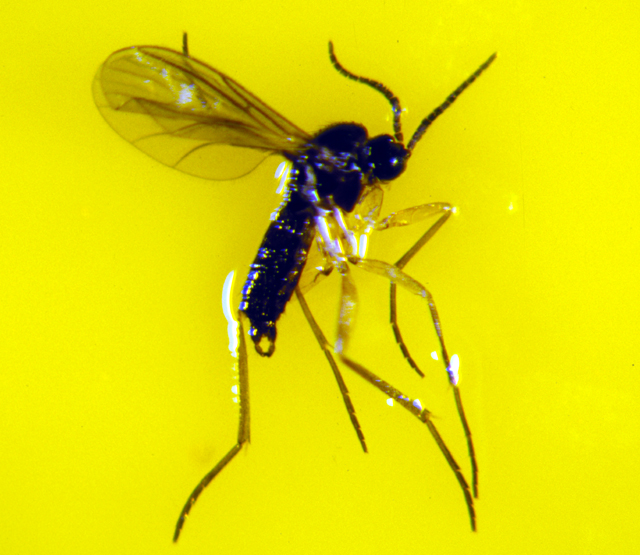
I love answering all kinds of questions, but it is nice to get an easy one occasionally. I sent a message back letting him know he has Fungus gnats (Bradysia species).
If you could see one under a microscope, they look like this:


These things are small, mosquito-like insects, often found in homes and offices, usually in the vicinity of houseplants. Adults are 1/8 inch long, delicate, black flies with long legs and antennae. There is a distinct “Y-shaped” pattern on the forewings. A great way to monitor and see them for yourself is to use yellow sticky cards. The adults are attracted to yellow and will be captured on them. This may be helpful in mass trapping adult females, which will also help in reducing the number of larvae in the next generation.
Fungus gnats are prevalent during most of the year, but they develop significant populations in Winter and Spring or when the weather has been cloudy and overcast for a number of days. In a home setting they can appear at pretty much anytime.
Fungus gnats are typically harmless to healthy plants and people. The adults are insects that do not bite, but can inflict extensive damage to seedlings,cuttings and young plants. The larvae also feed on the developing callus of directly stuck cuttings, delaying rooting. Fungus gnat larvae usually are located in the top 2 to 3 inches of the growing medium, depending on moisture level. The larvae are wormlike and translucent, with a black head.


They can often be found under decaying plant material on the soil surface. Their presence can be readily detected by placing a small piece of potato or carrot on the surface for a couple days and then observe it with the aid of a hand lens. Larvae also produce thin "webs" on the soil surface which can become obvious when droplets of moisture collect on them. Spraying a fine mist of water on the soil surface can aid in this.
The fungus gnat's life cycle from egg to adult may be completed in as little as three to four weeks depending on temperature. Eggs are laid in cracks and crevices in the media surface and mature in four to six days. During their seven to ten day life span, adult females may lay up to 200 eggs.
Control of fungus gnats can be difficult but not impossible. Proper water management is crucial. The most important strategy is to allow the growing medium to dry between waterings, especially the top 1 to 2 inches. The theory is, the dryness of the growing medium will decrease survival of any eggs laid and/or larvae that hatch from the eggs.
Insecticides may be necessary if fungus gnat problems persist several weeks after watering practices have been adjusted. The most effective treatments are those that are persistent; killing the adults for up to three days. A number of pyrethroid based insecticides, with extended persistence, are available for use on houseplants. Please make sure you read the label and it has listed the pest and the plant that you are using it on, this is the law!
The use of short persisting contact insecticides such as those containing soaps, oils, and neem oil, do not provide sufficient long term control of fungus gnat adults and require repeat applications at short intervals (usually every couple of days) to work.
I mentioned earlier about the use of the yellow sticky cards helping to reduce female populations. And for something else to remember, the larvae in the growing medium will not be directly affected by any insecticides applied to kill adults.
Unless you have a really bad infestation, these creatures will not cause enough noticeable harm. Just watch your watering, allow the medium to dry out. Some things to watch out for are; plants with succulent stems, such as geraniums, sedum, coleus and poinsettias, these are especially prone to injury and can suffer serious losses. As the young feeder roots and stems are damaged, the affected plants wilt. Leaves may turn yellow and drop.
Hopefully you will not ever have a major infestation, Though, I am pretty sure at some time or another you will have some of these guys come for a visit. If the soil is moving like an earthquake or the plant starts to fly around, you may want to consider losing that particular plant.
Happy Growing!
Darren

Saturday, August 6, 2011

Damsels and Dragons

You read all the time about attracting beneficial insects to your garden. This list may include such things at Ladybugs, Assassin Bugs, Bees and so on. There are a couple of beneficials that come around every year that I just love to watch. I often wonder just how many insects I would have if it weren't for these friends,they are the Damsels and Dragons of the yard....better known as Damselflies and Dragonflies.
Both of these creatures belong to the order Odonata, which translated means "Toothed Ones"


Damselfly


Dragonfly

Currently about 5000 species of Dragonflies and Damselflies are known; experts guess that there are probably between 5500 and 6500 species in total.
While both Dragonflies and Damselflies belong to the same group, there are many noticeable differences.
We will start with their eyes. They both have very large compound eyes relative to the rest of their body. Each compound eye is composed of nearly 28,000 individual units. More than 80% of their brain is devoted to analyzing visual information. The Dragonflies have eyes that touch, or nearly touch, at the top of the head. The Damselflies eyes are clearly separated, usually appearing on each side of the head.
While it might be a little difficult to tell the difference in their eyes, their bodies are pretty much a dead giveaway. The Dragonfly body is usually very stocky. We have one here that kind of looks like a flying marijuana cigarette, unfortunately I have not been able to snap a picture of it. The Damselfly on the other hand, is very slender and fragile looking. You can see this in the pictures above.
When they are resting, they hold their wings differently. Again, as you can see in the pictures above, the Dragonfly hold its wings out open, while the Damselfly holds them closed above the body.
Dragonflies are some of the fastest insects in the world. They can fly forward at about 100 body lengths per second,to put that in terms we can relate to, about 38 MPH. They can also fly backwards at about 3 body lengths per second, plus are capable of hovering in the air for sixty seconds or so. Damselflies are much weaker fliers in comparison.
The odonata order are known to be among the oldest of insects. The oldest recognizable fossils of the group are 325 million years old. They must be doing something right to be hanging around for that long.
I enjoy having them around because, one, they are fun to watch fly around and two, because they are valuable predators that eat mosquitoes, and other small insects like flies, bees, ants, and on the rare occasion, butterflies. A grown dragonfly can eat more than 50 mosquitoes a day or it can eat food equal to its own weight in about 30 minutes. Think about how much food you would have to eat at that rate?!
Here are some more scary facts, today's Damsels and Dragons have an average wingspan of just under 2 to just over 3 inches. There are fossils belonging to some species of these carnivorous insects with wings spreading to spans in the range of two and a half feet and made their food out of other insects and even small amphibians. If some of these were alive today, I have visions of my Chihuahua being carried away by some big old Dragonfly as lunch!
Most of a Dragonflies life is spent in the larval stage where it molts from six to fifteen times. Depending on altitude and latitude, larval development varies from the common one or two years to as many as six years. At that time, the nymph crawls up out of the water and molts one last time, emerging from its old skin as an adult with functional wings. After this final molt, the life span is anywhere from one month to six months, depending on the species.
Both Damsels and Dragons start their life in water, therefore they are often found near water: ponds, lakes, canals, streams, rivers and swamps. They are found on every continent except for Antarctica.
As beneficial as these things are, they have gotten a bum wrap in some cultures.
In Europe, Dragonflies have often been seen as sinister. Some English vernacular names, such as "devil's darning needle" and "ear cutter", link them with evil or injury.
The Norwegian name for Dragonflies is "Øyenstikker", which literally means Eye Poker and in Portugal they are sometimes called "Tira-olhos" meaning, Eye snatcher.
I must admit, I had not heard this one: In the Southern United States the term "snake doctor" refers to a folk belief that Dragonflies follow snakes around and stitch them back together if they are injured.
There are other interesting things associated with them. For some Native American tribes they represent swiftness and activity, and for the Navajo they symbolize pure water. The part about the water makes sense, Dragonflies are fairly sensitive to pollution.
In some parts of the world they are a food source, eaten either as adults or larvae; in Indonesia, for example, they are caught on poles made sticky with birdlime,(a sticky substance made from the bark of a holly bush, usually Ilex aquifolium) then fried in oil as a delicacy.
I was asked this question one day, do Dragonflies or Damselflies bite? No, though large dragonflies will sometimes try to bite, they fail to break the skin.
I don't recommend this one, but, Japanese children catch large Dragonflies as a game, using a hair with a small pebble tied to each end, which they throw into the air. The Dragonfly mistakes the pebbles for prey, gets tangled in the hair, and is dragged to the ground by the weight. I guess its better than running the streets or playing X-Box all day!
I will leave you today with a look at some of the beautiful colors that these creatures come in. I urge you to go out into the field or even your backyard and look for your own Damsels and Dragons. You might also want to thank them for the hard work they do eating all of those nasty bugs!


Happy Growing!
Darren