Showing posts sorted by relevance for query dragon fruit. Sort by date Show all posts

Saturday, April 3, 2010

How to Train Your Dragon......Fruit

I am always looking for neat and unusual plants to try and grow. If they produce food of any kind even better. I tend to lean towards fruit however, just the sweet tooth talking I guess. I learned about Dragon Fruit from my Cactus studies. They are in the genus Hylocereus.
Believe it or not, you may actually have a Dragon Fruit plant growing in your house right now! If not, you have probably seen one numerous times. Remember seeing something that looks like this?

Photo courtesy of W. Chow ( http://www.vivapitaya.com ) He has a GREAT website to learn more about this unusual fruit.
The green rootstock is Dragon Fruit or Hylocereus undatus. I have actually done this before, you can just cut the top part off.....the yellow, orange or red Cactus. Unfortunately, it will not live on its own. That cactus can not produce chlorophyll, that is why it is grafted onto something that can. Another option is to wait until the rootstock sends out a shoot and root it. This is very simple. Once the shoot is large enough to cut off, dip the cut end into a little root hormone and place in a pot with some potting mix. Keep soil barely damp. It should root in a couple of weeks.
These plants can very easily be grown in pots. Roger Washington down in Florida grows them in containers at his farm. He runs a company called Reddragonfruit.com


Dragon Fruit is native to South and Central America, it is commercially grown successfully in both Thailand and Vietnam. Southern California and parts of Florida are very good for growing Dragons. So, looking at these places, you can tell that they are not looking to live in the Sahara Desert. If you don't live in a tropical environment, they can be grown in a greenhouse.
They enjoy temperatures between 31 degrees and 100 degrees, either side of these extremes will hurt the plant. They can grow on a wide range of soil types, as long as it has good drainage. Although Dragons are members of the cactus family and may withstand dry periods, they have a fairly high water requirement. The plants should be planted in full or almost full sun (very light shade) for best growth and fruit production. An application of a 6-6-6 type fertilizer every two months is recommended.
As for many fruiting plants, the very young plants will not liberally flower or fruit at all until they have gotten much older and larger. These things need to put on quite a bit of weight, average of ten pounds worth of vines usually before they even think about flowering and fruiting. This can actually be attained in just a couple of years, depending on the size of the cutting used.
Lets say you have gotten yours to pretty good size, yet you see no flowers. It might be time to go on a midnight raid. Dragon Fruit plants bloom only at night, and unless you have a lot of bats or moths that pollinate Dragons, you are going to have to do it. I know, why not wait until morning? The flower will be gone by then, the first inkling of daybreak and the flower fades. The good news is that the plant tends to flower a couple of times a year. Even so called self pollinating Dragons will fail to produce fruit without the help of Bats, Moths or you. If you can, you need to plant a couple of them to help with cross pollination.
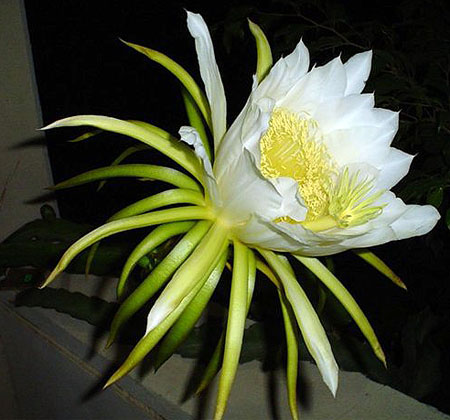
How is this for a beautiful flower?


It is worth growing just for the scent and beauty.
If you can get it to produce and are good at pollinating, it is not unreasonable for 3 to 4 year old plants to produce about 220 lbs of fruit per year. The average life expectancy is around 20 years.
To support your Dragon, I found this useful information from the University of Florida. Dragon Fruit plants may become quite large and spreading, and therefore individual plants should be planted 15 to 25 ft or more away from trees, structures, and electrical lines. A strong trellis should be established that may withstand several hundred pounds of stem weight. A weak trellis may buckle under the weight of a mature plant. Do not use wires on the trellis because they may cut or damage the stems. If wire is used, it should be covered by hoses. For the home landscape, consider a trellis for individual plants which should consists of a post and a structure at the top of the post to support the plant. An arbor type trellis may also be constructed. Individual plants growing on a short tree or on a pile of rocks or blocks could also be used as supports for a few plants.
I created the post with a structure on top to support mine. I am hoping for some rapid growth this year.
In case you were wondering what the fruit looked like, here it is:

There are actually a few different varieties.
Red, with white pulp like above.
Red, with red pulp:


And a Yellow, with white pulp:


To top all this off, eating Dragon fruit is good for you. It is high in Vitamin C and dietary fiber. There are also reports that it aids in type 2 diabetes glucose level control.
I hope this encourages you to go out and try to find a Dragon Fruit plant. Maybe then you can make your OWN movie of how you Trained your dragon.
Happy Growing!
Darren

UPDATE: This has actually been one of my most popular posts! I have received many, many questions and comments regarding this one.
I have also received pictures of success that folks have had, such as this one from Irene W.


She lives in California. This is a nice harvest! Great job Irene!!

Sunday, July 11, 2010

Real Flying Dragons

Growing up I was very fond of "Godzilla" and "Gamara" movies. For the non-geeks in the audience, Gamara was a giant monster turtle.....he was a good guy type monster.
Anyway, the fairy tale, monster type stories, I never really got into was the flying dragon type ones. Godzilla to me was just more believable.
Then I got heavy into horticulture, now I believe in flying dragons!! Of course, I am talking about Poncirus trifoliata 'Flying Dragon'.
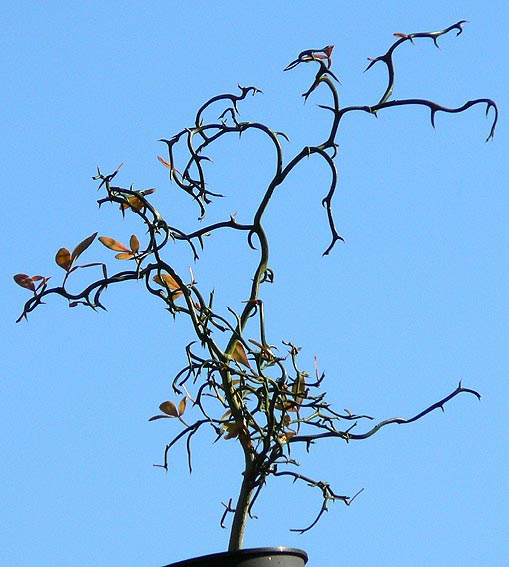
The dragon is one of only a few deciduous (loses its leaves in Winter) Citrus relatives. Without its leaves it looks like this:


Can you kind of see how it got its name? The branches look like dragons in flight.


There is also a straight form of the Poncirus trifoliata, all information regarding the two are interchangeable, other than the twisted stems.
Introduced to the U.S. from Japan in 1915. Highly prized in the Orient, where it has been cultivated for centuries. The dragon is used primarily as rootstock for other Citrus trees. A rootstock is a plant onto which another plant is grafted onto. Why would you want to graft one kind of Citrus onto another?
Flying Dragon is used for a number of reasons:
1) It gives some cold hardiness to the Citrus on top. FD is considered cold hardy to about -15 degrees. So folks as far north as Cape Cod, Massachusetts can grow the Flying Dragon. Sorry my northern friends, the scion (Citrus on top) will not survive that cold. It only offers it a couple of extra degrees of protection.
2) It dwarfs the Citrus tree. A dwarf tree is simply one defined by convention as being about 5 to 6 feet tall at maturity. In other words, a common grapefruit or sweet orange tree on "standard" or non-dwarfing rootstock will reach a 15 to 20-foot height at maturity, while a tree on Flying Dragon may grow to only "dwarf" size.
3) It also offers some resistance to certain soil borne illnesses. One example is it has resistance to Phytophthora foot rot. Foot rot, is also known as brown rot gummosis. This disease can affect the root system, the trunk below and above ground, branches, leaves, blossoms and fruit. Infection of the lower areas of the trunk results in dark, water-soaked areas in the active areas of infection. Often gum exudes profusely from active lesions. The dead bark frequently breaks away from the wood in vertical strips. In other words, a really nasty disease for Citrus.
The Flying Dragon is considered a slow growing tree. Requires full sun and a well draining soil. It does very well in containers and can be used as a Bonsai. It is also used for hybridization or breeding of other types of Citrus trees. I mentioned the cold hardiness of FD's. Breeders have been crossing the Poncirus with many other kinds of Citrus, trying to introduce that cold hardiness into some of the better tasting fruits. There has been very little success. There are a few good crosses out there however, Dragon Lime being one. This is a cross between the Flying Dragon and probably a Sweet Orange, though the exact parentage is not known. It has a Limeade like taste and is the size of a Sweet Orange. If nothing else,they have come up with some really weird names due to the crossings: Citradia (Poncirus and Seville Orange)....Citraldin (Poncirus and Calamondin) and my favorite... Tai-Tri (Poncirus trifoliata and Citrus taiwanica).
What about the fruit that it produces on its own? Have you ever tasted kerosene? That pretty much describes the flavor. They are edible in the sense that you won't die from eating them, but you may wish you would. Michael Dirr, in his "Manual of Woody Landscape Plants", comments that "Ripe fruits set aside for several weeks become juicy and develop a sprightly, slightly acid flavor. Serves as a substitute for lemon, pulp can be made into marmalade, and peel can be candied". I have never waited several weeks to try this, I can't get past the initial smell and gag reflex. They are ugly, seedy little fruits too, about the size of golfballs:


When growing FD beware of the thorns. I read somewhere that it maybe illegal to put barbed wire around your home, but the dragon is a very good, legal, substitute.(See very first picture again) Imagine having a solid hedge of this around your yard?
The name Poncirus trifoliata reveals a little about its description. The word trifoliata is a form of the word trifoliate or having three leaves or leaflike parts. As you can see in this picture:

Courtesy, University of Georgia


The dragon also produces pretty white flower that are fragrant and attract bees. With all this being said, Lets recap what that the Poncirus trifoliata is good for, Grafting, Hybridization, Ornamental, Stalag 13 encampment and one last thing that I haven't mentioned......They are good for Target Practice!!
Happy Growing!
Darren

Sunday, November 5, 2017

2017 Southeastern Citrus Expo

   
     I would be totally remiss as The Citrus Guy if I did not write about one of the greatest annual events to happen in the world of citrus for us amateur folks. It has been going on since 2003 when Southeastern Palm Society member Stan McKenzie organized the first-ever South Carolina Citrus Expo at Riverbanks Zoo and Botanical Gardens in Columbia, South Carolina. The expo has changed over the years and has become what is now known as the Southeastern Citrus Expo. It gets moved around from year to year and has been in places such as Virginia Beach, Virginia,  Fort Valley, Ga., Tifton, Ga, Florence, SC and Charleston, SC just to name a few.

     This year it will be in Savannah, Georgia!!

     This event is attended by Citruholics from around the country, and sometimes the world. The amount of expertise that will be on hand to answer any and all questions is second to none. A panel of experts will be brought up at the end to answer your questions, should you have any left after the itinerary of speakers is done.


Citrus trees will be for sale, though, due to quarantines, this will only apply to Georgia residents. The trees MUST stay in the state of Georgia. There will also be fruit to sample!


Books will be for sale.


Goodies galore! Raffles, giveaways, and so much more!


Of course, the obligatory fruit contest will be going on too!
 This contest is a friendly competition, though there will always be the ribbing and the poking for the bragging rights!


There is always a lot of fun when we all get together, it is just like a huge family!


     I truly hope that you can attend, you can make a weekend of it! There is always plenty to do in Savannah, I hear there is a Camellia Show the same Friday, not very far away. You can send me an e-mail if you are curious about that.
     All of the information that you should need is below. If you want or need even MORE information, you can contact me at TheCitrusGuy@netzero.com or go to our Facebook Page, there are pictures from many of the previous expos as well as more ways to contact us.
Happy Growing!
Darren

Print this page out below to take with you!

SOUTHEASTERN CITRUS EXPO 2017

The Southeastern Citrus Expo is coming to Savannah, Georgia on November 17 and 18, 2017.
Optional tours on Friday the 17th will include Franklin Farms of Statesboro and a Savannah backyard citrus orchard in the afternoon, as well as self-guided visits to the plantings at Armstrong State University and the Coastal Georgia Botanical Gardens. Additional tour possibilities will be forthcoming.
Saturday's conference sessions will be held at the beautiful Skidaway Island State Park, which borders Georgia's Intracoastal waterway.
http://www.gastateparks.org/SkidawayIsland
Confirmed speakers include Jamie Burrow of the University of Florida on citrus greening and other citrus growing challenges;
Lindy Savelle of the Georgia Citrus Association on the progress with commercial citrus growing in Georgia;
Billy Renz on the commercial citrus groves of Franklin Farms in Statesboro;
A panel of experts will share experiences and provide advice.
More presenters will be added.
If you grow citrus or want to learn how, mark your calendars and watch for further announcements about the conference schedule, as well as more information about tours and the citruholics banquet on Friday the 17th. If you have program ideas or questions, contact Marj Schneider at marjschneider@bellsouth.net


Friday, November 17: Places to Visit

Franklin Farms: 2:00 PM Tour,
200 Bohler Rimes Rd., Statesboro, GA
On I-16 exit onto Hwy. 301 and head north towards Statesboro. Bohler Rimes Rd is a little over 6 miles from the interstate. Turn Right on Bohler Rimes (It's a dirt road with a gate but we will have the gate open). Come about 1 mile down the dirt road and you will see some greenhouses and a packing house on the right. Pull in there and park.

John Trask Citrus Grove: 2:00 PM Tour
275 Orange Grove Rd., St. Helena Island, SC 
Look on map and head to Port Royal, Lady’s Island, St. Helena Island.  Once on St Helena turn onto MLK Drive. Go exactly 2.3 miles to Perry Rd. Turn right at Perry Rd. and continue for about one mile which intersects with Orange Grove Rd. Turn left onto OG Rd and proceed about 1/4 mile. See mailbox #275.  Across from mailbox is a red barn. Turn into the driveway to the red barn and someone will give direction to the citrus orchard.
Or even simpler, use GPS to #275 Orange Grove Rd, St. Helena Island.

In Savannah
Home of Marj & Don, Between 1:00-5:00 PM Tour
212 Oxford Dr., Savannah, GA
Turn east on Eisenhower Dr., turn left (north) on Waters Ave., continue north to Althea Pkwy (at blinking yellow light), turn left into Kensington Park, turn right onto Oxford Dr., continue to 212 Oxford, fifth house on left past Reynolds Ave. House number on the front door. Enter backyard by the gate on the left side when facing the house.

Coastal Georgia Botanical Gardens at the Historic Bamboo Farm, Self-Guided Tour
2 Canebrake Road, Savannah, GA
Take exit 94 from I-95 onto *Hwy. 204 towards Savannah. Turn right at first light onto Gateway Blvd., then left onto Canebrake Rd to your destination on left, just before Hwy. 17. *(Note: Hwy. 204 is Abercorn St., the same street as Armstrong State University and the Quality Inn.)

Armstrong State University (To tour campus plantings)
11935 Abercorn St, Savannah, GA
See Map Below
Take exit 94 from I-95 onto Hwy. 204 towards Savannah. Turn right off Abercorn onto campus road Arts Dr. Past the parking lot on the left is the campus police station. Park and obtain a free parking pass from the police station.


To Quality Inn Midtown
7100 Abercorn St. Savannah, Ga [Motel has an entrance on Abercorn and Eisenhower)

From the West: On I-16, follow to Exit 164A, GA-21/Lynes Pkwy, onto I-516 east. Follow to Abercorn St. Turn right onto Abercorn; turn left onto Eisenhower Dr., enter Quality Inn property on your left.
From the south:
On I-95, take exit 94 and make a right turn onto GA-204 (which is Abercorn St.). Drive 11.6 miles, turn right onto Eisenhower Drive, Quality Inn will be on the left side.

Coming from the North: on I-95, take exit 99 to I-16 East. Follow I-16 East to Exit 164A GA-21/Lynes Pkwy/I-516/US 17/US 80. Follow GA-21 S to Abercorn St. Turn right onto Abercorn, continue to Eisenhower Dr. and turn left. Quality Inn will be on the left.

Citruholics Banquet, 6:00 PM, Sweet Potatoes Kitchen
6825 Waters Ave., Savannah
Please arrive close to 6:00 PM. We will be ordering from the regular menu.
https://foursquare.com/v/sweet-potatoes-kitchen/4b92c65df964a520941a34e3/menu

From Quality Inn parking lot, turn left onto Eisenhower Dr. and in a little over ½ mile turn left onto Waters Ave. The restaurant is immediately on your left, just past the gas station.


Saturday Morning, November 18: Skidaway Island State Park group Shelter for Citrus Expo: Registration, 8:00-9:30 AM; Sessions begin 9:30 AM


To Expo from quality Inn: Turn left onto Eisenhower Dr.; Drive a little over a ½ mile to Waters Ave. and turn right. Waters Ave. will soon become Whitefield Ave, and then Diamond Causeway. Continue approximately 7 miles. Turn left onto State Park Rd. 1/2 mile to the Park.

To Expo from the west: On I-16, follow to Exit 164A, GA-21/Lynes Pkwy, onto I-516 East, which becomes DeRenne Ave. Continue to Truman Pkwy. Turn right and enter the Pkwy. Exit onto Whitefield Ave. Turn left onto Whitefield Ave. Turn left onto State Park Road. Park is straight ahead ½ mile.

To Expo from the north: on I-95, take exit 99 to I-16 East. Follow I-16 East to Exit 164A GA-21/Lynes Pkwy/I-516/US 17/US 80. Follow and I-516 becomes DeRenne Ave. Continue to Truman Pkwy. Turn right and enter the Pkwy. Exit onto Whitefield Ave. Turn left onto Whitefield Ave. Turn left onto State Park Road. Park is straight ahead ½ mile.


To Expo from the south: Take exit 94 from I-95 onto Hwy. 204 (which is Abercorn St.) towards Savannah. Turn right onto Truman Pkwy. Exit onto Whitefield Ave. Turn right onto Whitefield Ave. Turn left onto State Park Road. Park is straight ahead ½ mile. 


Fruit Competition Rules and Procedures


Fruit Preparation
1. All fruit entered must be grown by the entrant, either in a container or in the ground.
2. Before submission, fruit should be washed and prepared for eating. Judges may have to taste fruit in case of a tie.
3. A minimum of three fruit of a specific cultivar will constitute a single entry. For example, three Satsuma fruit are required to qualify as one entry. One of the fruit must be cut in half “against the grain” (as you would a grapefruit) to show the inside of the fruit.
4. Fruit must contain at least ½ inch of stem attached; one fruit should have a leaf attached to the stem. Submissions from growers in quarantined areas are exempt from this requirement.
5. Check the category sheet to determine best category for each entry.
At the Expo
1. Entering of fruit must be done during the assigned time, 8:00 to 9:15 AM. After this time, entries will not be accepted.
2. At the fruit contest area you will be given an entry number to ensure anonymity. Make sure you keep this number with you until the award ceremony.
3. An entry form must be filled out for each entry. Be sure to put your entry number on each form. Display plates will be provided.
4. Blue, red, and white ribbons will be awarded for each category.
In addition, there will be a “Best in Show,” “Honorable Mention,” and “Most Unique” award.


Citrus Categories for the Contest
Class 1. Satsuma
Class 2. Mandarin
Class 3. Sweet Orange
Class 4. Sour Orange
Class 5. Lemon
Class 6. Lime
Class 7. Grapefruit & Pomelo
Class 8. Kumquat, Calamondin & their Hybrids
Class 9. Trifoliate & its Hybrids
Class 10. Complex Hybrids
Class 11. Ichangensis Hybrids
Any cultivars not listed here will be assigned to a category by the judging coordinator.

Citrus Fruit cultivars
Satsumas: Armstrong, Brown Select, Early St. Ann, Kimbrough, Mijo, Miyagawa, Owari, Silverhill, others.
Mandarin: Changsha, Clementine, Clem-Yuz 2-2, Clem-Yuz 3-3, Dancy, Fallglo, Juanita, Keraji, Minneola Tangelo, Nasnaran, Orlando Tangelo, Page, Ponkan, Robinson, Shekwasha
Sweet Orange: Ambersweet, Cara Cara navel, Hamlin, Navel, Parson Brown
Lemon: Eureka, Harvey, Lisbon, Meyer, Ponderosa, Pink Variegated, Sanbokan, Ujukitsu
Lime: Australian finger, Bearss, Key, Persian
Sour Orange: Abers Narrowleaf, Bergamot, Bigaradier Apepu, Boquet des Fleurs, Chinotto, Citrus neoaurantium, Gou Tou, Nansho Daidai (Citrus taiwanica), Sauvage, Seville, Smooth Flat Seville, Willowleaf, Zhu Luan
Grapefruit & Pummelo: Bloomsweet, Chandler, Croxton, Duncan, Flame, Golden, Hirado Buntan, Marsh, Oroblanco, Pink Marsh, Ray Ruby, Rio Red, Ruby Red, Thompson Pink
Calamondin, Kumquat & Hybrids: Chang Shou, Fukushu, Hong Kong, Lemonquat, Limequat (Eustis, Lakeland, Tavares), Marmaladequat, Meiwa, Nagami, Nippon Orangequat, Procimequat, Sunquat
Trifoliate Orange and Hybrids: Citrange (Morton, Troyer, Carrizo, Benton, Rusk, others), Citrumelo (Dunstan, Swingle, USDA 80-5, others), Citradia, Citrandarin (CiClem #10, Citsuma, Changsha x English Large, others), Dragon Lime, Flying Dragon, Rubidoux, Standard
Complex Hybrids: Citrangequat (Thomasville, Sinton, others), Glen Citrangedin, Razzlequat, SanCitChang, US 119
Ichangensis Hybrids: Ichang Lemon, Ichang Papeda, Sudachi, Taichang lemon, Yuzu, Yuzuquat, Yuzvange


Cut Here To Use This Form
_______________________________________________________________________________


2017 Southeastern citrus Expo Fruit Competition form

Entrant’s Number _______________
(Will be provided by contest volunteer)
Class 1. Satsuma Cultivar_______________________________________________
Class 2. Mandarin Cultivar______________________________________________
Class 3. Sweet Orange Cultivar___________________________________________
Class 4. Sour Orange Cultivar____________________________________________
Class 5. Lemon Cultivar________________________________________________
Class 6. Lime Cultivar: ________________________________________________
Class 7. Grapefruit & Pomelo Cultivar_____________________________________
Class 8. Kumquat, Calamondin & their Hybrids Cultivar_______________________
Class 9. Trifoliate & its Hybrids Cultivar___________________________________
Class 10. Complex Hybrids Cultivar______________________________________
Class 11. Ichangensis Hybrids Cultivar____________________________________
NOTE: PLACE THIS SIDE UP DURING JUDGING
>>>>>>>>>>>>>Fold form here so information below does not show>>>>>>>>>>>>>>>>>

TO ENSURE THE CONCEALMENT OF THE PARTICIPANT’S IDENTITY DURING JUDGING, THIS SIDE MUST REMAIN DOWN. (Unfold and display the entire form after all judging
is complete) Please complete the following.
Where grown: ________________________ ______________________ State & County/Parrish USDA Hardiness Zone________
Thank you for your participation. Good luck!

Cut Here


Citrus Trees For Sale At Expo


Here is some good news if you are a Georgia resident.
Citrus trees will be available for attendees to order in advance of this year's Southeastern Citrus Expo, but only on a limited basis. Due to regulations to prevent the spread of citrus greening, trees can only be purchased from inspected nurseries and must stay in Georgia once they leave the expo. If you are a Georgia resident or the tree itself will stay in the state, you can buy any of the trees on offer from Mark Crawford or Lindy Savelle. Read on for the varieties they have for sale and place your orders before the expo on Saturday, November 18. Mark and Lindy will be bringing preordered trees to the expo, and don't count on them having extras, though you could get lucky! Again, these are trees that have to remain in Georgia.
Mark Crawford of Loch Laurel Nursery in Valdosta has the following varieties available. Trees are grafted, two-year-old trees in 4 or 5-gallon pots at $35 each. Contact Mark at 229-460-5922 or <craw142@bellsouth.net> to order trees in advance of the expo and arrange for payment. If you are in search of more unusual varieties, ask Mark if he has them. Visit Loch Laurel's website for further descriptions. http://www.lochlaurelnursery.com/citrus.asp
Satsuma varieties available:
Early Maturing: Oct-Nov.
Miho
Xie-Shan
Okitsu-Wase
Late Season: Nov.-Dec.
Owari
Frost Owari
Aoshima
Port Neches*
Agricola*
* Unregistered varieties that have good quality fruit.
Other cold-hardy citrus (Zone 8)
Juanita
Sugar Belle (On Rubidoux rootstock)
Kishu
Ambersweet
Lindy Savelle of 1 Dog Ventures LLC of Mitchell County has the following grafted varieties available. Unless otherwise designated, the trees are offered at a wholesale price of $25. They are one-year-old trees, 12 to 18 inches in height. Contact Lindy at <lindylamarsavelle@gmail.com> or at
850-830-1746 to order in advance of the expo and arrange for payment.
Citrus Tree List
Rootstocks available: Flying Dragon, Rubidoux, Rich 16-6 & Sour Orange.
UGA trees are priced higher, with a royalty for research going back to the university.
Satsumas:
Frost Owari
Early St Anne
LA Early
Silverhill
Brown Select
Other Varieties:
Keifer Lime
Persian Lime
Improved Meyer Lemon $40 (3 feet tall)
Thornless Key Lime $40 (3-4 feet tall)
Murcott Mandarin
UGA Sweet Frost Tangerine $50
UGA Pink Frost Grapefruit $50
UGA Grand Frost Lemon $50
Atwood Navel
Lisbon Lemon
Blood Orange
Valencia Orange
Nagami Kumquat

Monday, January 25, 2010

Feeling a little ill Mr. Citrus tree?

I would like to start my blog out today on a little different note.
Today is my 18th Wedding Anniversary, I married one of my best friends and have not been disappointed. Happy Anniversary Punky, I Love You!
I would also like to give a shout out to a couple of folks I consider friends, both of whom have blogs you should really check out.
Jenion who runs "Our Park Circle Homestead" http://jenion.blogspot.com/
and Kari who runs "Offshoots" http://scouthort.blogspot.com/
They are very well done and are doing great things with them. Good job you two!

Now, is your Citrus tree feeling a little under the weather? It maybe coming down with a disease.
There are a number of diseases that can infect Citrus. Greasy Spot, Citrus Scab,
Melanose, just to name a few. This article is not long enough to cover all of them. SO, I will cover the two biggest ones right now. Citrus Greening and Citrus Canker.
I have mentioned this before, but it is important enough to mention again.
IT IS ILLEGAL to ship, transport or smuggle Citrus out of the state of Florida!!
The USDA forbids the sale of citrus trees going out of state. I know what some of you are saying, the airports and roadside stands sell the little citrus trees for us to take home. They are using a loophole, on the box that the cute little Key Lime or Lemon comes in states "Grow your own Citrus tree indoors". The law somehow or another does not apply to "Houseplants". One of the biggest problems with this is, what do most people do with their houseplants during the Summer? Yup, they bring them outside and expose them to all the little nasties.
Let me tell you a little about each disease.
Citrus Greening, also called Huanglongbing or yellow dragon disease, is the most serious diseases of citrus in the world. Citrus greening disease is a major threat to the U.S. citrus industry. Other than tree removal, there is no effective control once a tree is infected and there is no known cure for the disease. Greening is spread by an insect, the Asian Citrus Psyllid and possibly by aphids. Infected trees may produce misshapen, unmarketable, bitter fruit. The trees in the orchards usually die 3-5 years after becoming infected and require removal and replanting.
The most characteristic symptoms of citrus greening are a blotchy leaf mottle and vein yellowing that develop on leaves attached to shoots showing the overall yellow appearance. Leaves with citrus greening have a mottled appearance that differs from nutrition related mottling in that greening induced mottling usually crosses leaf veins. Another characteristic is the blotches are not mirror images. If the left side of the leaf vein does not mirror the right side, it could very well be Greening disease. Nutrition related mottles usually are found between or along leaf veins and ARE mirror images.

Notice the uneven blotches on either side of the center vein.


Citrus Canker, caused by the bacterium Xanthomonas axonopodis is a leaf, fruit, and stem spotting disease that affects numerous species, cultivars, and hybrids of citrus and citrus relatives. Symptoms, Young lesions are raised on both surfaces of the leaf, but particularly on the lower leaf surface. The pustules later become corky and crater-like with a raised margin, sunken center and are surrounded by a yellow halo. Fruit lesions vary in size because the rind is susceptible for a longer time and more than one infection cycle can occur on the fruit. Major outbreaks of citrus canker occur when new shoots are emerging or when fruit are in the early stages of development. Frequent rainfall in warm weather, especially during storms, contributes to disease development.
Citrus canker is mostly a leaf-spotting and fruit rind blemishing disease,but when conditions are highly favorable for infection, it causes defoliation, shoot die-back, and fruit drop. In January 2006 eradication of citrus canker affected trees ended, they gave up, saying it CAN NOT be controlled. The disease does not hurt humans, but looking at the picture....I wouldn't want to eat it.

Hopefully, you will never have to deal with these two diseases yourself. Unfortunately, Citrus Greening has been discovered in Charleston County.....I don't have it on my trees, but I am keeping a very watchful eye.
Happy Growing!
Darren

Saturday, November 3, 2018

Citrus Not Quite Reincarnated

   
 Here we are, November already!

     November is when your fruit will really start to take off and turn ripe.
That is why the Southeastern Cold Hardy Citrus Expo is usually held this month. (More on that in a minute)


     I stressed this somewhat in the earlier part of this year, but, it might not have reached all of the proper folks and it is coming to light now. I have had an increasingly alarming rate of phone calls and e-mails talking about how their citrus tree died back this past January, but it has come back stronger than ever, it just didn't flower, what is wrong? In almost every case, except a couple, it is because the tree that was once there is no more, the rootstock has taken over.

Rootstock Suckers

     Rootstock, in case you didn't know, is what a "good fruit" is grafted onto. The rootstock of choice is used depending on what the grafter is trying to overcome. Some of them are used to dwarf the tree, others are used for nematode resistance, some are to deter different diseases and many other things. Not all citrus is grafted, but many are.

     I also heard from a couple of folks that their tree came back, it was a grapefruit, but this year the fruit is so much smaller, what happened? Again, the rootstock has prevailed.

Poncirus trifoliata

     Typical rootstocks that are used are mainly trifoliate hybrids and have the "tri" number of leaves. There are other rootstocks out there, Cleopatra, Bitter Orange (a.k.a. Seville) and many others that do not have the "tri" leaf. Those can be a little harder to discern from the original tree.

Swingle Citrumelo- Hybrid cross- Citrus paradisi x Poncirus trifoliata

     If you are uncertain as to what your tree might be now, feel free to e-mail me some pictures of the leaves, I can usually tell from those.
     Of course, if you have never seen how many different leaves there are on different citrus trees, take a look at this.


     You can click on the picture to make it bigger.
     Here is the key to what each of the 37 different leaves is:
a 'Nasnaran' mandarin (C. amblycarpa), b 'Galego Inerme Key' lime (C. aurantiifolia), c 'Narrow Leaf' sour orange (C. aurantium), d 'Bergamot' orange (C. bergamia), e 'Taiwan' mandarin (C. depressa), f 'Mauritius papeda' (C. hystrix), g C. hystrix hybrid, h 'Variegated' true lemon (C. limon), i 'Talamisan' orange (C. longispina), j 'Etrog' citron (C. medica), k 'Variegated' calamondin (C. madurensis), l 'Chinotto' orange (C. myrtifolia), m 'Star Ruby' grapefruit (C. paradisi), n 'Cleopatra' mandarin (C. reshni), o 'Fairchild' tangerine-tangelo [C. clementina 9 (C. paradisi 9 C. tangerina)], p 'Szincom' mandarin (C. reticulata), q 'Valencia Trepadeira' sweet orange (C. sinensis)\, r 'Variegated' sweet orange (C. sinensis), s 'Jaboti' tangor (C. sinensis 9 C. unshiu), t common ‘Sunki’ mandarin
(C. sunki), u ‘Tachibana’ orange (C. tachibana), v ‘Mency’ tangor (C. tangerina 9 C. sinensis),
w ‘Papeda Kalpi’ (C.webberi var. montana), x ‘Jindou’ kumquat (Fortunella hindsii),
y Fortunella sp., z ‘Changshou’ kumquat (F. x obovata), aa ‘Jindan’ kumquat (F. x crassifolia),
ab ‘Wart Java’ lime (Citrus sp.), ac Microcitrus papuana, ad ‘Benecke’ trifoliate orange
(Poncirus trifoliata), ae ‘Coleman’ citrange (C. sinensis 9 P. trifoliata), af ‘Flying Dragon’ trifoliate orange (P. trifoliata), ag ‘Chinese box-orange’ (Severinia buxifolia), ah ‘Limeberry’ (Triphasia trifolia), ai ‘Cravo’ mandarin (C. reticulata), aj ‘Citros Processo’ (Citrus sp.), ak ‘Jeroˆnimo’ lime (Citrus sp.).
COURTESY of https://www.researchgate.net

     I mentioned the Citrus Expo, it is in different places each year, The 2018 Southeastern Citrus Expo is being held in Valdosta, Georgia, on November 16 & 17, 2018

     If you are interested in growing citrus and want to learn more from other growers in the southeast, join them for this informative, once a year meeting of citrus growers north of Florida.

The Agenda is:

Friday, November 16th.Citraholics Banquet and optional tours

Banquet 6:30 PM
Mama June’s 3286 Inner Perimeter Rd., Valdosta. 229-245-6062

Saturday, Nov. 17. Conference Sessions will be held at Raisin Cane, 3350 Newsome Rd. Valdosta. 229-559-2000

Registration 8 - 9:30 AM Registration $15.00 Includes lunch

Fruit competition entry 8 - 9:30,


Plant Sales


9:30 – 12 Noon Speakers
With raffles in between each speaker

Confirmed speakers
Cally Walker, University of Florida Citrus Budwood and nursery production in Florida.

Anna Jameson, Brite Leaf Citrus Nursery, Lake Panasoffkee, FL Citrus tree production at a commercial certified nursery.

Pete Anderson, University of Florida, Quincy Experiment Station. Citrus in North Florida

Dr. Jose Chaparro, University of Florida, Citrus breeding and new varieties.

11:15 Questions about growing citrus

11:30 Results of Fruit Contest.

12:00 – 1:00 Lunch Available at Raisin Cane included with registration

1:00 – 4:00 Tours
Lowndes County Extension Citrus Rootstock trial. Jake Price , Lowndes County Extension
Commercial Satsuma Orchard and Variety Trial. Brent Biles
Non-commercial orchard and Nursery. Mark Crawford, Loch Laurel Nursery

Tour sites are all within a few miles of Raisin Cane.
Mark your calendars and watch for updates on the Southeastern Citrus Expo Facebook page.
If you want to be a vendor please contact Mark Crawford craw142@bellsouth.net or call 229-460-5922


Preconference Private Gardens open to visitors on Friday, November 16th

Adel, Georgia 25 miles north of Valdosta directly off I-75

Garden of Kent Thomas. Acres of palms, Japanese maples, and citrus around a beautiful lake.
305 Kent Dr.  Adel GA 229-560-1544
Traveling south on I-75 exit at the Sparks exit 41. Go east into Sparks and turn right onto US 41 south. When you cross over the railroad bridge just before Adel turn left at the BASE of the bridge onto South Ave. Kent Dr. is the first right off this road. Garden is on the left. Driveway has an entrance sign.
Traveling from Valdosta, take I-75 north to the second Adel exit. Go east and turn left onto US 41 north. Just outside town US 41 has a bend in the road just before going over a railroad bridge, bare to the right onto South Ave. and turn right at the first road - Kent Dr. Turn left into the second driveway where it says Enter.

Valdosta, Georgia

Garden of JD Thomerson. An outstanding garden of camellias, citrus, gingers and a variety of other interesting plants.
111 East Alden Ave. Valdosta 229-244-1050

Nashville, Georgia approximately 30 miles northeast of Valdosta

Triple Bee Nursery. A new citrus nursery operated by Hershell and Ricky Boyd.
1128 Seaborn Boyd Rd., Nashville, GA 229-356-0074, 229-686-7287
Use GPS to locate this location

Should be a GREAT Expo!

     If you have any questions about this or any of my other articles, please feel free to send me an e-mail to TheCitrusGuy@netzero.com
Follow me on FACEBOOK
Or check out my bookstore on my WEBSITE

Happy Growing!
Darren

Sunday, July 4, 2010

Greening Update: Good News, Bad News

I have written about Citrus Greening a number of times on this blog. With it being the most serious of Citrus diseases out there, the Citrus Guy would be totally remiss in not bringing it to your attention. Well, there have been some updates, both good and bad.
Let me bring you up to date very quickly on this disease in case you haven't heard about it.
Citrus Greening, also called Huanglongbing or yellow dragon disease, is a very serious disease of citrus. This bacterial disease is thought to have originated in China in the early 1900s. There are three strains of the bacteria, an Asian, an African version, and a Brazilian.
The Asian strain, Candidatus Liberibacter asiaticus was found in Florida in early September, 2005.
The most characteristic foliage symptoms of Citrus Greening are the blotchy mottling of leaves and leaf yellowing that may appear on a single shoot or branch. The disease may also cause small, narrow leaves and short stems that give plant growth a bunched appearance. Other symptoms include twig dieback, poor flowering, and stunted growth. Fruit from diseased trees is small and often misshapen. Typically, some green color remains even on ripe fruit. Affected fruit tastes bitter, medicinal, and sour. Seeds usually abort, and fruit set is poor. The tree may survive for several years, but death is inevitable.
The disease has been found in two parishes in Louisiana, and in two counties in South Carolina. The entire states of Georgia and Florida are under quarantine. There are also a number of Mexican states listed. The list of quarantines for the Asian Citrus Psyllid, the transmitter of the disease, seems to be getting longer every day. It includes: Alabama, Arizona, California, American Samoa, the Northern Mariana Islands, Florida, Georgia, Guam, Hawaii, Louisiana, Mississippi, Puerto Rico, South Carolina, Texas....Got the point? This thing is spreading.
THEN:
On April 21, 2010, the Animal and Plant Health Inspection Service (APHIS) confirmed the first detection of citrus greening, in plant tissue samples collected from Key Lime trees located at a local agricultural experiment station near St. Croix, U.S. Virgin Islands. In addition, plant tissue samples of Key Lime from nearby residential properties also tested positive for the disease. Based on recent surveys, the insect vector responsible for transmitting this disease, Asian Citrus Psyllid, is also present.
Okay, had enough bad news? Here is some good news.
A team of scientists from the Agricultural Research Service and the University of Florida’s Indian River Research and Education Center have turned an ornamental plant into a tool for combating this bacterial disease.
Periwinkle, (Catharanthus roseus), has proved to be an effective screening tool or treatments to control Huanglongbing, according to Yong-Ping Duan of the ARS, U.S. Horticultural Research Laboratory in Fort Pierce, Fla.
Duan and his colleagues have found that periwinkle performs well as a stand-in for citrus, becoming quickly infected with HLB bacterium, and responding well to antibiotic compounds tested to reduce infection. The researchers used HLB-infected lemon trees to infect periwinkle plants and then ran greenhouse experiments to find the optimal nutrient and soil treatments for regenerating periwinkle with high infection rates.
Duan emphasized that the results are limited to greenhouse settings and that the chemical compounds, must still be evaluated in field trials and approved for use by regulatory agencies before commercial use is possible.
Untold millions of dollars are being spent on finding ways to combat this disease. There are more than 130 projects and studies going on, according to Peter McClure of Evans Properties and the 2009 Citrus Achievement Award winner.
One of these studies that is going on, basically, will develop a vaccine that we can give to a sick Citrus tree so that it will produce antibacterial compounds to protect itself.
As a hobby Citrus grower and lecturer, I find this very exciting. We can put people on the moon, make huge pieces of metal fly and float, but we can't make a sick Lemon tree well?! Hopefully soon this disease will be just a footnote in the history of citriculture!
Happy Growing!
Darren

Thursday, December 30, 2010

Citrus Greening Hope

One of the nice things about the holidays is, you get to take time off from work, catch up on a few things and relax. Okay, strike the last part, who really gets to relax during the holidays?
I have been able to catch up on a few things though, namely a little bit of my reading. The stack of magazines and books I currently have would be a speed readers nightmare.
A couple of articles really grabbed my attention and they both pertained to Citrus Greening disease.
I was talking to somebody today from here in Charleston County (we are under quarantine for Greening) and she did not have any idea about it. I am doing a Citrus lecture for her garden club on the 11th, I think I am going to scare some of these folks.
Just to give some of you that may not know what Citrus Greening is, here is a Readers Digest version.
Huanglongbing (pronounced Hung-Long-Bing) or Yellow Dragon Disease is one of the most serious Citrus diseases. It is a bacterial disease that attacks the vascular system. Once infected, the tree will produce inedible bitter fruit, the fruit will not be able to ripen and the tree will ultimately die in a few years. There is currently no cure for the disease.
It is spread by a tiny insect known as the Asian Citrus Psyllid.
This is their feeding posture. 45 degrees to the stem. The adults are 3 to 4 mm (or 0.15748031496 inches) long with a mottled brown body. They are really very small. It only takes an infected Psyllid about 15 minutes to infect a tree.
It can also be transmitted by grafting.
The diseased leaves look like this.
This disease can be tricky to detect because it mimics many nutritional deficiencies. On the above picture, notice the non-mirrored yellowing. If this was nutritional the two sides of the leaves would be identical.
Like I said, this is an EXTREMELY short version of what Greening disease is. To find out if you are under quarantine here in the United States go to this link HERE It will tell you all you need to know.
Okay, that was your Citrus Greening mini lecture. I mentioned the two articles that grabbed my attention. The first one dealt with feeding the crap out of Greening infected trees to rejuvenate them. I guess the old cliche "Starve a cold and feed a fever" would be a good analogy here. Maury Boyd, a Citrus producer near Immokalee, Florida has successfully been applying a cocktail of nutrients to his ravaged trees. I won't go into the long list of what he is applying, but it is done three times a year just after each new flush of growth.
There is still many tests being performed on this treatment. The article goes on to say that Mr. Boyd is pleased with the overall health of his grove, he would have plowed them under before trying this method, and the fruit yields have met or exceeded industry average. Fruit quality has also improved.
I am not telling you to go out and start pouring all kinds of fertilizers on your trees, like I said, there is still MUCH research to do here.
The other article I mentioned will undoubtedly cause controversy. The title is "Genetic Engineering Tackles Citrus Greening". There was a lot of scientific mumbo jumbo, but I got the gist of it. Basically, to save the 9.3 billion dollar annual economic benefit to Florida, there may have to be some playing around with the genes of Citrus. The article also states that groups that are opposed to genetically modified foods of any kind may try to dissuade the public from turning to genetically engineered Orange Juice. It's not like they are trying to create a Frankenstein Orange, they have discovered that there are some genes in Spinach that may provide some resistance. They don't have a complete handle on all this yet, but it is in research. I, for one, have no problem with Genetically Modified Food or GMO's, though I am not sure if my Orange Juice had the aftertaste of Spinach, it would be all that great! Ha-Ha
This has been a VERY brief overview of what these articles said, both were 3+ pages long. I just wanted to show you that there is research going on to fix this horrible disease to Citrus. I remember just a couple of years ago there was a notion going around Florida that if something wasn't done soon the whole Citrus industry could be wiped out in 5-10 years! A very sobering thought.
One last thing I would like to mention. I know they have a huge stake in the Orange Juice industry, but if their OJ sales stopped they would not go bankrupt. I would like to THANK Coca-Cola for their 1.5 million dollar donation to research for finding a cure for HLB (Huanglongbing). Hopefully someday they will find one!
Happy Growing!
Darren

Wednesday, May 20, 2015

Citrus Pruning in mid Spring

To say the past two winters have been rough is probably an understatement! Many citrus trees took a pretty good hit and some have not survived, though many more have. Is this reason to want to quit trying to grow citrus? Absolutely not!!
While there has been some major losses of entire trees, I have been getting reports of trees that were thought to be dead, coming back. Hence the topic for today's discussion, pruning.
I get asked very often, when is the best time to prune my citrus tree? My usual response is, why do you want/need to prune it? There is always a myriad of reasons, many of which are not good reasons, "aren't I suppose to", "I saw online that it has to be done", "my neighbor did it". Then there is the little more reasonable "it is in my way" or "I don't like the way it looks".
This is a case of where you should research the plant before putting it in the ground. In the last two cases, moving the tree or pruning might be your only course of action. We can go into a huge, long discussion about this.
However, like I said at the beginning, there have been some rough winters and some folks trees were getting ready to be kindling, but lo and behold, they have sprouted new growth. What should I do now?
Do you have a tree that looks like this:


 This is also the reason that I usually tell people to hold off pruning any cold damage until you are sure what is truly dead.
Here is another picture of the same tree:


If you would have seen this tree just a few weeks ago, you would have written it off for dead. I had a hunch it would be fine, the cambium layer, just under the bark, was still green in places. Do you see now why I say hold off?


If I had just started cutting away, I might have cut off some new growth. Cold damage on citrus trees can be very deceiving. If the damage is low on the branch, there might be enough energy in it to initiate growth, but, if the damage is not allowing nutrients from the roots, it will be a short lived flush. Waiting until mid Spring gives you a better idea of where you stand. When you are pretty sure you can start cutting, prune small sections at a time, just getting to some green, living material, then stop. You don't want to cut too much off, but you also want to make sure you get all the dead wood off.
I wanted to also share something else that, because I did not prune when it was damaged, is showing some good signs.


This is my variegated Calamondin. The winter of 2013/14 almost killed it. It had dropped every leaf and was nothing but a couple of sticks. I watered it and just let it be, this year it is going to produce fruit again.
There is no real manual for pruning citrus, you need to remember that, if you start cutting citrus trees, you will be cutting flowers and fruit off.
I wanted to end this discussion today with some encouragement for those of you struggling with your trees. As you may or may not know, I grow all mine in pots. I do protect some of them over the winter, but not all. This is just a few of my trees that are bearing fruit this year:


Seedless Kishu Mandarin

Harvey Lemon


Buddhas Hand, Fruit and Flower


Variegated Valencia Orange


Poncirus trifoliata 'Flying Dragon' (Rootstock Citrus)

As always, if you have any questions about this or any of my other articles, feel free to ask. My address is TheCitrusGuy@netzero.com
Happy Growing!
Darren

Monday, February 8, 2010

Man, That's Cold

I received an e-mail from a new friend of mine named Claudia. She also writes a good Blog, Gardening Naturally with Claudia. You can check her blog out at:
http://gardeningnaturallywithclaudia.blogspot.com
She asked me a question that I never really gave much thought to, So I figured it would be a good subject for today's posting. She lives in Zone 5b (-10 to -15 Fahrenheit) Man, That's Cold!! She wanted to know what Citrus would be hardy in her climate. There is not much, BUT, there are some!
With that being said, let me give a few insights. Factors affecting hardiness are of course, minimum temperatures, how long it is, weather before the freeze, soil moisture and wind protection.
I have touched on some of this in other postings, but will revisit them here. Minimum temperature goes without saying, -10 to -15 is pretty cold.


As you can see from the above map, that kind of temperature and colder covers about one fourth of the country. So most of the ones I will list can be grown even further South.
How long the freeze is: One night of freeze may not hurt a plant too much, a week (or longer) could be another story.
The weather before the event: If you have had very cool temperatures and it has been rather consistent, that is a lot better than warm for a few days then a wicked cold spell.
Soil Moisture: Make sure plants are well watered before the event, the wind also falls under here. Cold and wind dry plants out. A dry plant is much more apt to be hurt by a freeze than a well watered one.

Now, as for Citrus that can handle that kind of cold. There is really only one for a Zone 5b. Poncirus trifoliata. It is hardy to about -15F There are two cultivars, a straight one with straight thorns and branches and ones with curved branches and thorns called 'Flying Dragon'.
This is one of the few actual deciduous (loses it leaves) Citrus. The best way to describe the fruit from this tree? I got this from the book 'Hardy Citrus for the Southeast' By Tom McClendon. He writes, "The fruit are edible, meaning that you won't die from eating them". That pretty much is the best description I can come up with other than, if you don't mind the taste of kerosene, this fruit is great! Tom also has uses listed for the Trifoliates: Hybridization, Ornamental and TARGET PRACTICE.
If you are willing to provide a little protection, maybe plant on the South side of your house and very close to a building or wall, you could grow some of these: Hardy to about 5F.
Citrandin (Poncirus X Citrus reticulata)
Citrange (Poncirus X Citrus sinensis)
Citrumelo ( Poncirus X Citrus paradisi)
Nansho Daidai Sour Orange (Citrus taiwanica)
Some of these may be palatable to you. I have actually had a decent Nansho Daidai. I also enjoy Sour Gummy Worms, so take that into consideration.

If you can protect down to about 10 degrees the list gets much better:
Bloomsweet Grapefruit
Yuzu (as seen on Martha Stewart)
Yuzu Hybrids
Nippon Orangequat
Changsha Mandarin
Juanita Tangerine
And actually there are many others.

Down to about 15 degrees and you are getting into the:
Kumquats and their Hybrids (Sunquat, Procimequat, etc.)
Calamandarin
Sour Oranges

Your Satsumas are in the upper teens, I don't recommend pushing these there though. I try to keep them no lower than mid to upper 20's along with:
Sweet Oranges
Meyer Lemon
Grapefruits

Like I said in the beginning, there are a LOT of factors that will effect cold hardiness. There are other steps that you can take to protect them.
Build a mini greenhouse over them. Grow them in Containers. I actually could go on for hours talking about this subject alone. Hopefully this gives you some ideas to try. Finding many of these varieties may prove to be difficult. There are some websites that you might be able to find some of them. Pick a couple and do a Google search. Later, I will do a post on finding some Citrus online, I have some great friends and will give you their websites. That my friends will be for later, for now you have to wait and come back often! LOL
Happy Growing!
Darren

Monday, January 18, 2010

Growing Citrus in Containers

As many of you know, I grow most (okay, ALL) my Citrus in containers. I have a number of reasons for doing so.
I rent, so if I should move anytime soon they can all come with me.
If I don't like where something is, OR, it doesn't like where it is, I can move it.
I can control the soil PH, water, and fertilizers better.
If we happen to have some REALLY cold weather, like the 18 degrees we have had this Winter, I can move them safely into the Greenhouse.
It's easier to toss something away that happens to die. I don't have to dig and dig to get the stump out.
These reasons go for all my plants that I grow in containers, which are many.
In the above picture, you can see all my Citrus to the right, A yellow Brugmansia top left and some of my Tomato plants bottom left. Yup, all of these are in containers.

One of the first questions I get is, Do you actually get any fruit?
YES! This is a picture of some immature Meyer Lemons. They were in a 30 gallon pot when this picture was taken.
Would you like to try your hand at Containerized Citrus growing? Here is all the How's to do it.

Container Citrus
Many types of Citrus can be grown successfully in containers, if you have a large enough pot. Don’t expect as big a tree as one grown in the ground however. Also, it is very important to find citrus trees grafted onto Poncirus trifoliata or Flying Dragon. This type of root stock dwarfs the tree (still giving you full size fruit) and gives it a few extra degrees of cold hardiness.
The biggest advantage of containerized trees is that they can be protected during freezing temperatures by temporarily storing them in an enclosed area. A nursery standard 15 gallon pot would be a good one to start out with. Once the tree out grows this one, you can move it up to a 30 gallon. A piece of advice though, either build a relationship with some really big, strong men or put casters of some kind on a 30 gallon, it gets pretty heavy. If you happen to see a landscape company working in your neighborhood, stop and ask if they happen to have any and if you can have one or two of either of these sizes. Many times they are more than happy to get rid of them. They won’t have to haul it back to their shop.
Be aware that plastic containers retain moisture longer than other types of pots. As with most plants, allow the upper surface of the soil to become dry to the touch and maybe an inch down, then water thoroughly. Citrus need lots of moisture, but don’t like wet feet all the time.
The potting mix you use is really a personal choice. Any good, well draining mix will work. I have found that a Cactus soil works well. A good blend of Peat, Sand, Perlite and Vermiculite will suffice. I have heard of people using Coconut Husk Chips, this author has no hands on experience with this however.
Good nutrition is essential but over fertilization can result in excessive vegetative or leafy growth, poor fruiting and possible death due to fertilizer salt accumulation. Salt accumulation is a common problem, often indicated by a white crust on the soil surface and around the drain holes. Slow release fertilizers with a ratio of 8-8-8 are excellent, particularly if it contains trace elements such as Iron, Magnesium and Manganese. An occasional foliar spray (spraying the leaves) with Fish Emulsion will also benefit the tree. If you are planning on moving the tree indoors during very cold nights (below 32) You can fertilize every three months and foliar feed every two weeks with a liquid fertilizer or the fish emulsion.
Citrus love sunlight, 8-10 hours if possible. Even in Winter, if the temps drop at night and you bring it in, bring it back out during the day after it warms up. If you forget or there is a long cold spell forecasted, don’t worry, your citrus tree will be fine for a few days in a garage or other sheltered spot.
Summer time can bring other problems with container citrus. The temperature in a black pot, outside in 8 hours of sunlight can easily reach 120 degrees. Two ways to alleviate this. First, shade the pot with low growing plants in other pots. This will give you a chance to have some flowers around your tree and make a very nice display. Second, paint your pots white. There are many paints designed for plastic, get some of them and paint them white. The white surface will reflect the rays of the sun and keep your roots many degrees cooler.
Container citrus have the same pest problems as their in ground counter parts.
I hope this has inspired you to try your hand at some Citrus in containers. In upcoming entries I will discuss pest problems, highlight some of my favorite varieties, some unusual varieties and some stuff you probably have never thought of trying to grow yourself.
Happy Growing!
Darren