Okay, I know I should not be angry. It is more or less just an issue of people being ignorant to the facts. Citrus trees, leaves, stems, roots, cuttings or any other part of the tree CAN NOT be brought out of Florida. Period, end of discussion.
I got on this rant today because I was talking to a gentleman that had just brought a Meyer lemon up from Florida. He had no idea it was illegal!! I quickly told him and explained everything to him. I also told him about watching for signs of disease. I have been harping on this for what seems like eons. Please pass this on to anybody you know, help me shout it from the rooftops.
This is what the USDA has to say about all this:
The entire state of Florida is under quarantine for Citrus Greening Disease and Asian Citrus Psyllids.
It is illegal to move live citrus plants, plant parts, budwood, or cuttings from Florida. (Note: Dooryard citrus fruit cannot be moved from Florida unless the fruit is packed at a certified packinghouse and has been issued a Limited Permit by USDA. Florida gift fruit must also come from a certified packinghouse and be shipped under a Limited Permit issued by USDA. In either case, dooryard citrus or gift fruit cannot be shipped to California, Texas, Arizona, Hawaii, Louisiana, American Samoa, Puerto Rico and the U.S. Virgin Islands.)
If you are buying Citrus trees online, check to see where they are from. If they are in Florida, they should have some kind of warning like this on their website.
Due to the widespread occurrence of Citrus Canker and Citrus Greening (Huanglongbing), the USDA placed the entire state of Florida under quarantine. It is against the law to ship or move trees outside the state. This is an action to protect the citrus industries in California, Texas, Arizona and Louisiana. Although we have never been allowed to ship to these states, the USDA feels this action is necessary to prevent a tree from Florida being moved into a citrus state by a homeowner or dealer.
Along with the entire state of Florida, the parishes Orleans and Washington in Louisiana, and Charleston and Beaufort Counties in South Carolina, are under quarantine for Citrus Greening Disease and Asian Citrus Psyllids. You can not move Citrus trees from any of these places.
I even learned this in researching for this article, In Florida, it is unlawful for homeowners to propagate citrus plants. This according to the Florida Department of Agriculture and Consumer Services, Division of Plant Industry.
IF you are caught leaving Florida with any part of the Citrus tree, they can fine you and will confiscate and destroy the tree.
Please don't risk your neighbors Citrus trees. Buy them from a non quarantine state. Leave Florida's trees in Florida. Please, help me pass this around, it is the only way we can stop the spread of this disease until they find a cure.
Happy Growing!
Darren
Wednesday, April 7, 2010


Tuesday, April 6, 2010
Wanting to Mull Over A Berry
One of my favorite plants that I grow is my White Mulberry tree. As a child in New Jersey, we had a Black Mulberry and a White one. There is also a Red cultivar, but I haven't tried that one yet. I would sit in the tree for hours just gorging myself on the fruit. What was funny back then, I knew the black one was really good. I was actually afraid of the white one for quite sometime. I thought there might have been something wrong with it, because it was white, not black. I was a child, what did I know? There was nothing even close to the internet back then. This was probably mid to late 70's. Once I tried the white one, and didn't die, I figured it was just a different kind and began eating it all the time too.
Sometime ago, maybe 3 or 4 years back, I actually found somebody online that wanted to trade a Mulberry tree for some Citrus I had, this was back when I could swap Citrus before any of the quarantines were in place. I couldn't wait to get it, childhood memories growing in my own backyard. I was shocked when it produced fruit the first time, and discovered it was a white variety.
The White Mulberry (Morus alba)is native to eastern and central China. The tree was introduced into America for silkworm culture in early colonial times and naturalized and hybridized with the native red mulberry. I lived on a very old farmland/plantation, I figure that is how it got to New Jersey.
The White Mulberry, and to a lesser extent the Red Mulberry, (Morus rubra) is quite tolerant of drought, pollution and poor soil. The White mulberry is considered a weed tree in many parts of the country including urban areas.
Mulberries need full sun and lots of room. You want or need about 15 feet between trees. Depending on the variety, they can reach anywhere from 30 to 80 feet tall. They need a well drained soil. They are considered drought resistant, but if they dry out too much during fruiting, they may abort most of the fruit.
They do not need much fertilization. With that being said, and I know there will be gasps of YUCK from some of you, the tree I use to sit in and eat that wonderful fruit from, was directly over a septic tank. Looking back at it now, I bet that thing had more fertilizer than it knew what to do with.
Pruning is not really needed, except to cut out deadwood and crossing branches. If you do need to prune it for size or shape, it is better to do it while dormant, they tend to "bleed" a lot.
Mulberries can be grown from seed, although the plants can take 10 years or more to bear. Softwood cuttings of White Mulberries root easily when taken in midsummer and treated with rooting hormone. Red Mulberries are less easily rooted. Black Mulberries (Morus nigra) are also somewhat difficult to propagate since they tend to bleed a lot. The Mulberry tree can live anywhere from 75 to hundreds of years, again depending on the variety.
They suffer from very few pests and diseases.
The fruit of the White and Red Mulberries are ripe in late Spring. The fruit of Black Mulberries ripen in Summer to late Summer.
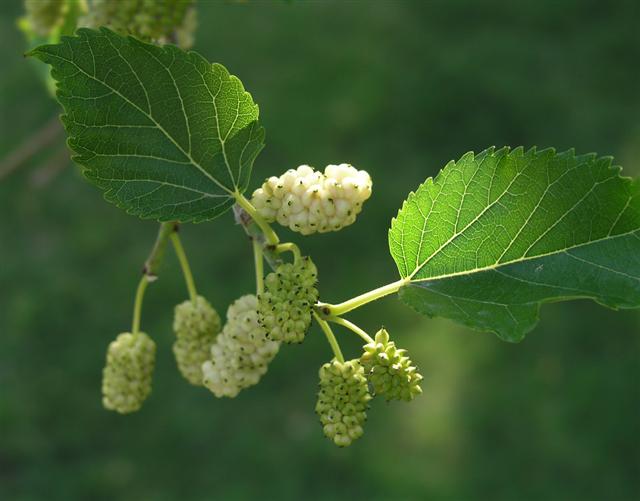
The fruit of the White Mulberry:

The fruit of the Black Mulberry:

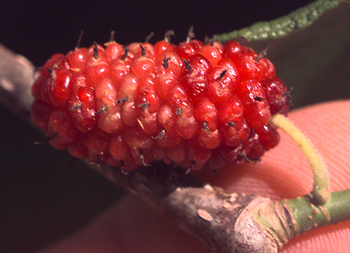
The fruit of the Red Mulberry:

The trees that I grew up with are long gone, plowed under for apartment complexes or some such thing. I wish I could go back in time and get some cuttings from those trees, or even bring the trees back. Being that can not happen, I will just enjoy my White Mulberry tree for the time being. It looks like it will be a very heavy crop this year. The fruit is just starting to form. Maybe someday I will get a Black one and a Red one, I would love to compare them side by side.
Happy Growing!
Darren
Sometime ago, maybe 3 or 4 years back, I actually found somebody online that wanted to trade a Mulberry tree for some Citrus I had, this was back when I could swap Citrus before any of the quarantines were in place. I couldn't wait to get it, childhood memories growing in my own backyard. I was shocked when it produced fruit the first time, and discovered it was a white variety.
The White Mulberry (Morus alba)is native to eastern and central China. The tree was introduced into America for silkworm culture in early colonial times and naturalized and hybridized with the native red mulberry. I lived on a very old farmland/plantation, I figure that is how it got to New Jersey.
The White Mulberry, and to a lesser extent the Red Mulberry, (Morus rubra) is quite tolerant of drought, pollution and poor soil. The White mulberry is considered a weed tree in many parts of the country including urban areas.
Mulberries need full sun and lots of room. You want or need about 15 feet between trees. Depending on the variety, they can reach anywhere from 30 to 80 feet tall. They need a well drained soil. They are considered drought resistant, but if they dry out too much during fruiting, they may abort most of the fruit.
They do not need much fertilization. With that being said, and I know there will be gasps of YUCK from some of you, the tree I use to sit in and eat that wonderful fruit from, was directly over a septic tank. Looking back at it now, I bet that thing had more fertilizer than it knew what to do with.
Pruning is not really needed, except to cut out deadwood and crossing branches. If you do need to prune it for size or shape, it is better to do it while dormant, they tend to "bleed" a lot.
Mulberries can be grown from seed, although the plants can take 10 years or more to bear. Softwood cuttings of White Mulberries root easily when taken in midsummer and treated with rooting hormone. Red Mulberries are less easily rooted. Black Mulberries (Morus nigra) are also somewhat difficult to propagate since they tend to bleed a lot. The Mulberry tree can live anywhere from 75 to hundreds of years, again depending on the variety.
They suffer from very few pests and diseases.
The fruit of the White and Red Mulberries are ripe in late Spring. The fruit of Black Mulberries ripen in Summer to late Summer.
The fruit of the White Mulberry:
The fruit of the Black Mulberry:

The fruit of the Red Mulberry:
The trees that I grew up with are long gone, plowed under for apartment complexes or some such thing. I wish I could go back in time and get some cuttings from those trees, or even bring the trees back. Being that can not happen, I will just enjoy my White Mulberry tree for the time being. It looks like it will be a very heavy crop this year. The fruit is just starting to form. Maybe someday I will get a Black one and a Red one, I would love to compare them side by side.
Happy Growing!
Darren
Monday, April 5, 2010
Over Eaters Anonymous
Should your plants be going to Over Eaters Anonymous? I know, there are people that tell me MINE should be going. There are reasons why the package directions are what they are. Just like overeating is not good for us, it's bad for plants.
One reason is of course, economics. You don't want to be spending more on feeding them than you need to. Waste not is to want not, isn't that the old saying our grandparents always said?
The next reason is salt accumulation. Many, if not most, of the chemical fertilizers today have salt content. Over time, they can rise to dangerous levels and can kill your plant. Organic fertilizers tend not to have this problem.
Another reason might be, over leafy plants. Fertilizers, especially when used in excess, may cause the plant to produce more leaves and foliage. This is important to know if you are growing say, Tomatoes. You want fruit, not leaves. Yes, the plant will look beautiful, but a beautiful plant doesn't help that BLT very much does it?
Probably the biggest reason not to over feed your plants is, over fertilization can cause plants to grow too quickly, leaving them more susceptible to disease and insects. I was reading an article in the American Vegetable Grower about just this subject. Research indicates that plants can’t grow quickly and defend themselves against insects at the same time.
The scientists wanted to determine the relationship among plant growth, how plants defend themselves against plant eaters (herbivores), and the protection plants receive from predators such as ladybugs that eat plant hungry insects.
Can plants have it all? Can they grow quickly and defend themselves against herbivores while at the same time solicit protection from ladybugs and other bodyguards? The answer is no. Remember, that new flush of growth is much more tender and tasty to a sap sucking insect.
In other words, you can be either a hard to eat, slow growing plant that doesn’t need bodyguards, or a tasty, fast growing plant that relies on outside protection.
“We can breed plants for fast growth, but if we do that, it appears we’re weakening the plants’ immunity against herbivores, making them more dependent upon protection from potentially unreliable predators,” says Kailen Mooney, assistant professor of ecology and evolutionary biology at University of California, Irvine.
She also said, "Natural selection favors faster-growing plants and those that easily fight off insects”. “If nature hasn’t found a way to combine both, perhaps it’s something that cannot be done.”
So by overfeeding your plants, you are producing more tender foliage. That foliage is just a huge neon sign that says "Hot Donuts Now" to any of those sap sucking insects.
Make sure you follow the package directions. If in doubt, it is always better to slightly underfeed your plant than to overfeed. I always heard, It is better to leave the table still a little hungry, than to gorge yourself into oblivion, or something like that!
Happy Growing!
Darren
One reason is of course, economics. You don't want to be spending more on feeding them than you need to. Waste not is to want not, isn't that the old saying our grandparents always said?
The next reason is salt accumulation. Many, if not most, of the chemical fertilizers today have salt content. Over time, they can rise to dangerous levels and can kill your plant. Organic fertilizers tend not to have this problem.
Another reason might be, over leafy plants. Fertilizers, especially when used in excess, may cause the plant to produce more leaves and foliage. This is important to know if you are growing say, Tomatoes. You want fruit, not leaves. Yes, the plant will look beautiful, but a beautiful plant doesn't help that BLT very much does it?
Probably the biggest reason not to over feed your plants is, over fertilization can cause plants to grow too quickly, leaving them more susceptible to disease and insects. I was reading an article in the American Vegetable Grower about just this subject. Research indicates that plants can’t grow quickly and defend themselves against insects at the same time.
The scientists wanted to determine the relationship among plant growth, how plants defend themselves against plant eaters (herbivores), and the protection plants receive from predators such as ladybugs that eat plant hungry insects.
Can plants have it all? Can they grow quickly and defend themselves against herbivores while at the same time solicit protection from ladybugs and other bodyguards? The answer is no. Remember, that new flush of growth is much more tender and tasty to a sap sucking insect.
In other words, you can be either a hard to eat, slow growing plant that doesn’t need bodyguards, or a tasty, fast growing plant that relies on outside protection.
“We can breed plants for fast growth, but if we do that, it appears we’re weakening the plants’ immunity against herbivores, making them more dependent upon protection from potentially unreliable predators,” says Kailen Mooney, assistant professor of ecology and evolutionary biology at University of California, Irvine.
She also said, "Natural selection favors faster-growing plants and those that easily fight off insects”. “If nature hasn’t found a way to combine both, perhaps it’s something that cannot be done.”
So by overfeeding your plants, you are producing more tender foliage. That foliage is just a huge neon sign that says "Hot Donuts Now" to any of those sap sucking insects.
Make sure you follow the package directions. If in doubt, it is always better to slightly underfeed your plant than to overfeed. I always heard, It is better to leave the table still a little hungry, than to gorge yourself into oblivion, or something like that!
Happy Growing!
Darren
Sunday, April 4, 2010
The Key Lime
It was some eleven years ago that I got my first Citrus tree. That fateful day will forever be etched in my wife's memory. We were at a grocery store right around the Christmas holidays. There in the floral section was a poor, sad looking little Calamondin tree. It was 50% off and still had some fruit on it. My wife said "You ought to get it", she regrets those words! Kinda.
That was back in 1999, the Calamondin was the first, second to come along was my Key Lime. I lost track after that. The Key Lime has been a sturdy little producer ever since I got it. There have been many a pie and cookies made from the fruit of this tree.

The Key Lime, also known as a Mexican lime or West Indian lime, originated in southern Asia and was carried by the Arabs across North Africa into Spain and Portugal. It was brought to the Americas by the Spanish and Portuguese explorers in the early part of the sixteenth century where it escaped cultivation and became naturalized in parts of the West Indies, some Caribbean countries, and southern Florida, specifically the Keys.
It is a small, bushy tree, rarely taller than 12 feet tall and wide, with slender branches armed with short spines. Its dense foliage consists of small, pale green, blunt-pointed leaves with narrowly winged petioles. There is a thornless Key Lime, but the yields of fruit are usually much lower.
Key lime trees require full sun, and are very sensitive to cold. They are among the most frost sensitive of the Citrus family. Considering they are so sensitive to the cold and stay relatively small, they make a good container grown tree. Albeit a decent size container, but one nevertheless.
They are well adapted to a variety of soils, but require good drainage and does not tolerate wet feet. Like all other Citrus, Key Limes are heavy Nitrogen (first number on the fertilizer bag) feeders. Don't forget, this is the nutrient that leaches out of the soil the most. A very important piece of information if you are growing it in a container.
Key lime is frequently propagated from seed, they will come true to type. From seed, you can expect fruit in 4-5 years. They are one of, if not THE, earliest Citrus to fruit from seed.
What would an article about Key Limes be without a mention of the pie?

As to who made the first key lime pie, no one really knows for sure as it has never been documented. The most likely story is that William Curry (1821-1896), a ship salvager and Florida's first self-made millionaire, had a cook that was simply know as Aunt Sally. It was Aunt Sally who created the pie in the mid to late 1800s. Some historians think that Aunt Sally didn't really create the Key Lime Pie, but probably perfected a delicacy that was the creation of area fishermen.
On July 1st, 2006, Key Lime Pie became the official pie of Florida. Of course, this followed on the heels of the time in 1965, Florida State Representative Bernie Papy, Jr. introduced legislation calling for a $100 fine to be levied against anyone advertising key lime pie that is not made with key limes. The bill did not pass.
So, go out, get yourself a bag of Key Limes at your local grocery store. Use them to make an authentic Key Lime Pie, they might try to resurrect the 1965 bill and you don't want to be fined! Then plant the seeds and in a few years you will have more Key Limes than you know what to do with.
Happy Growing!
Darren
That was back in 1999, the Calamondin was the first, second to come along was my Key Lime. I lost track after that. The Key Lime has been a sturdy little producer ever since I got it. There have been many a pie and cookies made from the fruit of this tree.

The Key Lime, also known as a Mexican lime or West Indian lime, originated in southern Asia and was carried by the Arabs across North Africa into Spain and Portugal. It was brought to the Americas by the Spanish and Portuguese explorers in the early part of the sixteenth century where it escaped cultivation and became naturalized in parts of the West Indies, some Caribbean countries, and southern Florida, specifically the Keys.
It is a small, bushy tree, rarely taller than 12 feet tall and wide, with slender branches armed with short spines. Its dense foliage consists of small, pale green, blunt-pointed leaves with narrowly winged petioles. There is a thornless Key Lime, but the yields of fruit are usually much lower.
Key lime trees require full sun, and are very sensitive to cold. They are among the most frost sensitive of the Citrus family. Considering they are so sensitive to the cold and stay relatively small, they make a good container grown tree. Albeit a decent size container, but one nevertheless.
They are well adapted to a variety of soils, but require good drainage and does not tolerate wet feet. Like all other Citrus, Key Limes are heavy Nitrogen (first number on the fertilizer bag) feeders. Don't forget, this is the nutrient that leaches out of the soil the most. A very important piece of information if you are growing it in a container.
Key lime is frequently propagated from seed, they will come true to type. From seed, you can expect fruit in 4-5 years. They are one of, if not THE, earliest Citrus to fruit from seed.
What would an article about Key Limes be without a mention of the pie?

As to who made the first key lime pie, no one really knows for sure as it has never been documented. The most likely story is that William Curry (1821-1896), a ship salvager and Florida's first self-made millionaire, had a cook that was simply know as Aunt Sally. It was Aunt Sally who created the pie in the mid to late 1800s. Some historians think that Aunt Sally didn't really create the Key Lime Pie, but probably perfected a delicacy that was the creation of area fishermen.
On July 1st, 2006, Key Lime Pie became the official pie of Florida. Of course, this followed on the heels of the time in 1965, Florida State Representative Bernie Papy, Jr. introduced legislation calling for a $100 fine to be levied against anyone advertising key lime pie that is not made with key limes. The bill did not pass.
So, go out, get yourself a bag of Key Limes at your local grocery store. Use them to make an authentic Key Lime Pie, they might try to resurrect the 1965 bill and you don't want to be fined! Then plant the seeds and in a few years you will have more Key Limes than you know what to do with.
Happy Growing!
Darren
Saturday, April 3, 2010
How to Train Your Dragon......Fruit
I am always looking for neat and unusual plants to try and grow. If they produce food of any kind even better. I tend to lean towards fruit however, just the sweet tooth talking I guess. I learned about Dragon Fruit from my Cactus studies. They are in the genus Hylocereus.
Believe it or not, you may actually have a Dragon Fruit plant growing in your house right now! If not, you have probably seen one numerous times. Remember seeing something that looks like this?

Photo courtesy of W. Chow ( http://www.vivapitaya.com ) He has a GREAT website to learn more about this unusual fruit.
The green rootstock is Dragon Fruit or Hylocereus undatus. I have actually done this before, you can just cut the top part off.....the yellow, orange or red Cactus. Unfortunately, it will not live on its own. That cactus can not produce chlorophyll, that is why it is grafted onto something that can. Another option is to wait until the rootstock sends out a shoot and root it. This is very simple. Once the shoot is large enough to cut off, dip the cut end into a little root hormone and place in a pot with some potting mix. Keep soil barely damp. It should root in a couple of weeks.
These plants can very easily be grown in pots. Roger Washington down in Florida grows them in containers at his farm. He runs a company called Reddragonfruit.com

Dragon Fruit is native to South and Central America, it is commercially grown successfully in both Thailand and Vietnam. Southern California and parts of Florida are very good for growing Dragons. So, looking at these places, you can tell that they are not looking to live in the Sahara Desert. If you don't live in a tropical environment, they can be grown in a greenhouse.
They enjoy temperatures between 31 degrees and 100 degrees, either side of these extremes will hurt the plant. They can grow on a wide range of soil types, as long as it has good drainage. Although Dragons are members of the cactus family and may withstand dry periods, they have a fairly high water requirement. The plants should be planted in full or almost full sun (very light shade) for best growth and fruit production. An application of a 6-6-6 type fertilizer every two months is recommended.
As for many fruiting plants, the very young plants will not liberally flower or fruit at all until they have gotten much older and larger. These things need to put on quite a bit of weight, average of ten pounds worth of vines usually before they even think about flowering and fruiting. This can actually be attained in just a couple of years, depending on the size of the cutting used.
Lets say you have gotten yours to pretty good size, yet you see no flowers. It might be time to go on a midnight raid. Dragon Fruit plants bloom only at night, and unless you have a lot of bats or moths that pollinate Dragons, you are going to have to do it. I know, why not wait until morning? The flower will be gone by then, the first inkling of daybreak and the flower fades. The good news is that the plant tends to flower a couple of times a year. Even so called self pollinating Dragons will fail to produce fruit without the help of Bats, Moths or you. If you can, you need to plant a couple of them to help with cross pollination.
How is this for a beautiful flower?

It is worth growing just for the scent and beauty.
If you can get it to produce and are good at pollinating, it is not unreasonable for 3 to 4 year old plants to produce about 220 lbs of fruit per year. The average life expectancy is around 20 years.
To support your Dragon, I found this useful information from the University of Florida. Dragon Fruit plants may become quite large and spreading, and therefore individual plants should be planted 15 to 25 ft or more away from trees, structures, and electrical lines. A strong trellis should be established that may withstand several hundred pounds of stem weight. A weak trellis may buckle under the weight of a mature plant. Do not use wires on the trellis because they may cut or damage the stems. If wire is used, it should be covered by hoses. For the home landscape, consider a trellis for individual plants which should consists of a post and a structure at the top of the post to support the plant. An arbor type trellis may also be constructed. Individual plants growing on a short tree or on a pile of rocks or blocks could also be used as supports for a few plants.
I created the post with a structure on top to support mine. I am hoping for some rapid growth this year.
In case you were wondering what the fruit looked like, here it is:

There are actually a few different varieties.
Red, with white pulp like above.
Red, with red pulp:

And a Yellow, with white pulp:

To top all this off, eating Dragon fruit is good for you. It is high in Vitamin C and dietary fiber. There are also reports that it aids in type 2 diabetes glucose level control.
I hope this encourages you to go out and try to find a Dragon Fruit plant. Maybe then you can make your OWN movie of how you Trained your dragon.
Happy Growing!
Darren
UPDATE: This has actually been one of my most popular posts! I have received many, many questions and comments regarding this one.
I have also received pictures of success that folks have had, such as this one from Irene W.

She lives in California. This is a nice harvest! Great job Irene!!
Believe it or not, you may actually have a Dragon Fruit plant growing in your house right now! If not, you have probably seen one numerous times. Remember seeing something that looks like this?

Photo courtesy of W. Chow ( http://www.vivapitaya.com ) He has a GREAT website to learn more about this unusual fruit.
The green rootstock is Dragon Fruit or Hylocereus undatus. I have actually done this before, you can just cut the top part off.....the yellow, orange or red Cactus. Unfortunately, it will not live on its own. That cactus can not produce chlorophyll, that is why it is grafted onto something that can. Another option is to wait until the rootstock sends out a shoot and root it. This is very simple. Once the shoot is large enough to cut off, dip the cut end into a little root hormone and place in a pot with some potting mix. Keep soil barely damp. It should root in a couple of weeks.
These plants can very easily be grown in pots. Roger Washington down in Florida grows them in containers at his farm. He runs a company called Reddragonfruit.com

Dragon Fruit is native to South and Central America, it is commercially grown successfully in both Thailand and Vietnam. Southern California and parts of Florida are very good for growing Dragons. So, looking at these places, you can tell that they are not looking to live in the Sahara Desert. If you don't live in a tropical environment, they can be grown in a greenhouse.
They enjoy temperatures between 31 degrees and 100 degrees, either side of these extremes will hurt the plant. They can grow on a wide range of soil types, as long as it has good drainage. Although Dragons are members of the cactus family and may withstand dry periods, they have a fairly high water requirement. The plants should be planted in full or almost full sun (very light shade) for best growth and fruit production. An application of a 6-6-6 type fertilizer every two months is recommended.
As for many fruiting plants, the very young plants will not liberally flower or fruit at all until they have gotten much older and larger. These things need to put on quite a bit of weight, average of ten pounds worth of vines usually before they even think about flowering and fruiting. This can actually be attained in just a couple of years, depending on the size of the cutting used.
Lets say you have gotten yours to pretty good size, yet you see no flowers. It might be time to go on a midnight raid. Dragon Fruit plants bloom only at night, and unless you have a lot of bats or moths that pollinate Dragons, you are going to have to do it. I know, why not wait until morning? The flower will be gone by then, the first inkling of daybreak and the flower fades. The good news is that the plant tends to flower a couple of times a year. Even so called self pollinating Dragons will fail to produce fruit without the help of Bats, Moths or you. If you can, you need to plant a couple of them to help with cross pollination.
How is this for a beautiful flower?
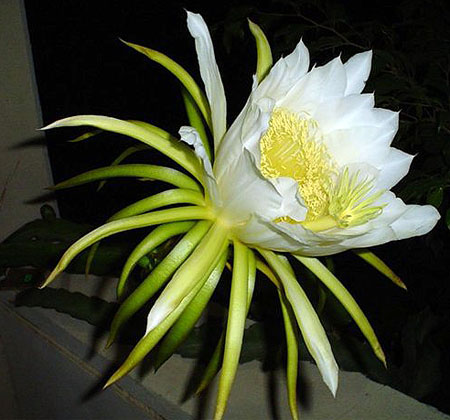
It is worth growing just for the scent and beauty.
If you can get it to produce and are good at pollinating, it is not unreasonable for 3 to 4 year old plants to produce about 220 lbs of fruit per year. The average life expectancy is around 20 years.
To support your Dragon, I found this useful information from the University of Florida. Dragon Fruit plants may become quite large and spreading, and therefore individual plants should be planted 15 to 25 ft or more away from trees, structures, and electrical lines. A strong trellis should be established that may withstand several hundred pounds of stem weight. A weak trellis may buckle under the weight of a mature plant. Do not use wires on the trellis because they may cut or damage the stems. If wire is used, it should be covered by hoses. For the home landscape, consider a trellis for individual plants which should consists of a post and a structure at the top of the post to support the plant. An arbor type trellis may also be constructed. Individual plants growing on a short tree or on a pile of rocks or blocks could also be used as supports for a few plants.
I created the post with a structure on top to support mine. I am hoping for some rapid growth this year.
In case you were wondering what the fruit looked like, here it is:

There are actually a few different varieties.
Red, with white pulp like above.
Red, with red pulp:

And a Yellow, with white pulp:

To top all this off, eating Dragon fruit is good for you. It is high in Vitamin C and dietary fiber. There are also reports that it aids in type 2 diabetes glucose level control.
I hope this encourages you to go out and try to find a Dragon Fruit plant. Maybe then you can make your OWN movie of how you Trained your dragon.
Happy Growing!
Darren
UPDATE: This has actually been one of my most popular posts! I have received many, many questions and comments regarding this one.
I have also received pictures of success that folks have had, such as this one from Irene W.

She lives in California. This is a nice harvest! Great job Irene!!
Friday, April 2, 2010
Greetings Myrtle
As a gardener there are many plants that I really like. There are also many plants, though not as many as the like column, that I dislike. Then there are the plants that I can either live with or without. The Waxmyrtle (Myrica cerifera) is one of those plants. I truly have nothing against this plant, but yet, they aren't all that glamorous either.

Just looks like a common shrub, huh?
Also known as Southern Bayberry, Waxmyrtles are a native plant to the United States, that will make my brethren in the Native Plant Society cheer. It is a large shrub to small tree, able to reach a height of 25 feet and the same in width, but it is usually seen in the 10 to 20 foot range. It has olive to gray green leaves, that have a bayberry scent when crushed. Colonists made bayberry candles by boiling the berries and collecting the floating wax, then pouring it into candle molds or hand-dipping wicks. It took about five pounds of berries to make one or two candles.
Waxmyrtles are fast growing shrubs, as much as 5 feet in height and width in a single year, with evergreen foliage. They are tolerant of salt spray and wind. Their hardiness zones are 7-11, which covers the eastern coast of the United States from New Jersey to southern Florida, and through the southern part of the nation on up into Washington state.
They can grow on a wide range of soils, though they prefer good drainage and slightly acidic soils. They are moderately drought tolerant, and can grow in everything from part shade to full sun.
Waxmyrtles are usually very easy to find in their hardiness range. Propagation is by seeds, which germinate easily and rapidly, tip cuttings,or transplanting wild plants.
There are not too many problems associated with Waxmyrtles, though cankers may form on old branches and trunks and kill them. Also, a lethal wilt disease caused by the fungus Fusarium oxysporum has recently been noted attacking Waxmyrtle plants in central and south Florida.
The biggest problem I have seen with Waxmyrtles is their inability to handle heavy snowfalls. But then again, how often does Charleston, SC get anywhere from 3-7 inches of snow?!
This is a picture of my neighbors Waxmyrtles. They are the ones bending way down. They are/were as tall as the house before the snow came.

They were damaged so badly, they had to have most of them cut way back.
The ones I have in my yard were relatively unaffected, why, I don't know. I am using them as a screen for the West side of my house. It does keep it about 10 degrees cooler, than without.
So, overall, they are an okay plant. Again, nothing to write home about, but can be good to fill in space in your yard or act as a heat shield.
Happy Growing!
Darren

Just looks like a common shrub, huh?
Also known as Southern Bayberry, Waxmyrtles are a native plant to the United States, that will make my brethren in the Native Plant Society cheer. It is a large shrub to small tree, able to reach a height of 25 feet and the same in width, but it is usually seen in the 10 to 20 foot range. It has olive to gray green leaves, that have a bayberry scent when crushed. Colonists made bayberry candles by boiling the berries and collecting the floating wax, then pouring it into candle molds or hand-dipping wicks. It took about five pounds of berries to make one or two candles.
Waxmyrtles are fast growing shrubs, as much as 5 feet in height and width in a single year, with evergreen foliage. They are tolerant of salt spray and wind. Their hardiness zones are 7-11, which covers the eastern coast of the United States from New Jersey to southern Florida, and through the southern part of the nation on up into Washington state.
They can grow on a wide range of soils, though they prefer good drainage and slightly acidic soils. They are moderately drought tolerant, and can grow in everything from part shade to full sun.
Waxmyrtles are usually very easy to find in their hardiness range. Propagation is by seeds, which germinate easily and rapidly, tip cuttings,or transplanting wild plants.
There are not too many problems associated with Waxmyrtles, though cankers may form on old branches and trunks and kill them. Also, a lethal wilt disease caused by the fungus Fusarium oxysporum has recently been noted attacking Waxmyrtle plants in central and south Florida.
The biggest problem I have seen with Waxmyrtles is their inability to handle heavy snowfalls. But then again, how often does Charleston, SC get anywhere from 3-7 inches of snow?!
This is a picture of my neighbors Waxmyrtles. They are the ones bending way down. They are/were as tall as the house before the snow came.

They were damaged so badly, they had to have most of them cut way back.
The ones I have in my yard were relatively unaffected, why, I don't know. I am using them as a screen for the West side of my house. It does keep it about 10 degrees cooler, than without.
So, overall, they are an okay plant. Again, nothing to write home about, but can be good to fill in space in your yard or act as a heat shield.
Happy Growing!
Darren
Thursday, April 1, 2010
April Fools Day
April Fools Day has always been one of my favorite holidays. I can act like myself and nobody seems to notice! One of my favorite jokes is when I place a small piece, about 1/4 of a dollar bill, taped to somebodies desk under their calendar. They see it and pull and pull, but it just won't come out. When they lift the calendar, I usually have a note taped to the dollar bill proclaiming April Fools. I also have a slight modification to this. Everything as above but put a bunch of those tiny plastic bugs under there too....especially ants. I usually get some pretty good screams from that.
One problem with April Fools Day history, nobody knows its origins. Some theorize that it was Europe's switch from the Julian calendar to the Gregorian in the 1500s, which changed New Years Day from late March to January 1st, creating an easy opportunity to play a prank on the forgetful. The major problem with this is, April Fools was mentioned back in the 14th Century in Canterbury Tales.
Even though nobody knows the origin of the jokes, they are widely played all over the world.
Here are some examples:
In Scotland, for instance, April Fool's Day is devoted to spoofs involving the buttocks and as such is called Taily Day. The origins of the "Kick Me" sign can be traced back to the Scottish observance.
In England, jokes are played only in the morning. Fools are called gobs or gobby and the victim of a joke is called a noodle. It was considered bad luck to play a practical joke on someone after noon.
In Portugal, April Fool's Day falls on the Sunday and Monday before lent. In this celebration, many people throw flour at their friends. I bet this one gets messy.
There are some jokes that are as old as time itself.....Your shoe is untied or setting your roommates clock back an hour are good ones. One of the funniest I have ever read about pertained to a British short film once shown on April Fool's Day that was a fairly detailed documentary about "spaghetti farmers" and how they harvest their crop from the spaghetti trees. I would be scared to meet the people that believed that one.
Then there is always this one I found online. Find a scrap of cloth. Place a dollar on the floor and stay nearby. When the victim comes by and bends down to pick up the dollar, rip the cloth loudly. Most people will reach back to see if they ripped their pants.
April Fools Day is an "Only for fun" observance. Nobody has to buy gifts or take anybody out to eat in a fancy restaurant. Nobody gets off from work or school. It's simply a fun little holiday, but a holiday which you better watch your back so you don't become an April Fool! I hope none of you fell for one today.
Being that this had NOTHING to do with gardening, I guess I could say April Fools??
Happy Growing!
Darren
One problem with April Fools Day history, nobody knows its origins. Some theorize that it was Europe's switch from the Julian calendar to the Gregorian in the 1500s, which changed New Years Day from late March to January 1st, creating an easy opportunity to play a prank on the forgetful. The major problem with this is, April Fools was mentioned back in the 14th Century in Canterbury Tales.
Even though nobody knows the origin of the jokes, they are widely played all over the world.
Here are some examples:
In Scotland, for instance, April Fool's Day is devoted to spoofs involving the buttocks and as such is called Taily Day. The origins of the "Kick Me" sign can be traced back to the Scottish observance.
In England, jokes are played only in the morning. Fools are called gobs or gobby and the victim of a joke is called a noodle. It was considered bad luck to play a practical joke on someone after noon.
In Portugal, April Fool's Day falls on the Sunday and Monday before lent. In this celebration, many people throw flour at their friends. I bet this one gets messy.
There are some jokes that are as old as time itself.....Your shoe is untied or setting your roommates clock back an hour are good ones. One of the funniest I have ever read about pertained to a British short film once shown on April Fool's Day that was a fairly detailed documentary about "spaghetti farmers" and how they harvest their crop from the spaghetti trees. I would be scared to meet the people that believed that one.
Then there is always this one I found online. Find a scrap of cloth. Place a dollar on the floor and stay nearby. When the victim comes by and bends down to pick up the dollar, rip the cloth loudly. Most people will reach back to see if they ripped their pants.
April Fools Day is an "Only for fun" observance. Nobody has to buy gifts or take anybody out to eat in a fancy restaurant. Nobody gets off from work or school. It's simply a fun little holiday, but a holiday which you better watch your back so you don't become an April Fool! I hope none of you fell for one today.
Being that this had NOTHING to do with gardening, I guess I could say April Fools??
Happy Growing!
Darren
Subscribe to:
Posts (Atom)